
HEALTH JOURNAL
Beginner Fitness: Build a Week That Fits Your Life
A practical guide to choosing aerobic activity, learning strength movements, and building a flexible first week without an all-or-nothing workout plan.

Starting exercise can feel like an equipment decision: which shoes, which app, which class? A more useful first question is what kind of movement you can comfortably repeat in the week you actually have. That answer might involve dancing in the living room, a pool session, a stationary bike, or a beginner strength class.
This guide is about assembling a routine, rather than mastering one exercise or chasing a step count. The examples are planning options for adults, not a personalized training prescription. Your starting point, access, preferences, and health history all belong in the plan.
Know the destination without making it day one
The CDC’s adult activity overview describes a weekly goal of at least 150 minutes of moderate aerobic activity, or 75 minutes of vigorous activity, plus muscle strengthening on at least two days. Strength work should cover the major muscle groups. These are population recommendations, not an entrance requirement for being active.
The Physical Activity Guidelines for Americans provide the evidence framework behind those recommendations. Short periods of movement can contribute to your week. Someone restarting after a long break can begin with a small amount and build gradually rather than trying to complete the full weekly target immediately.
Choose one aerobic option you can actually access
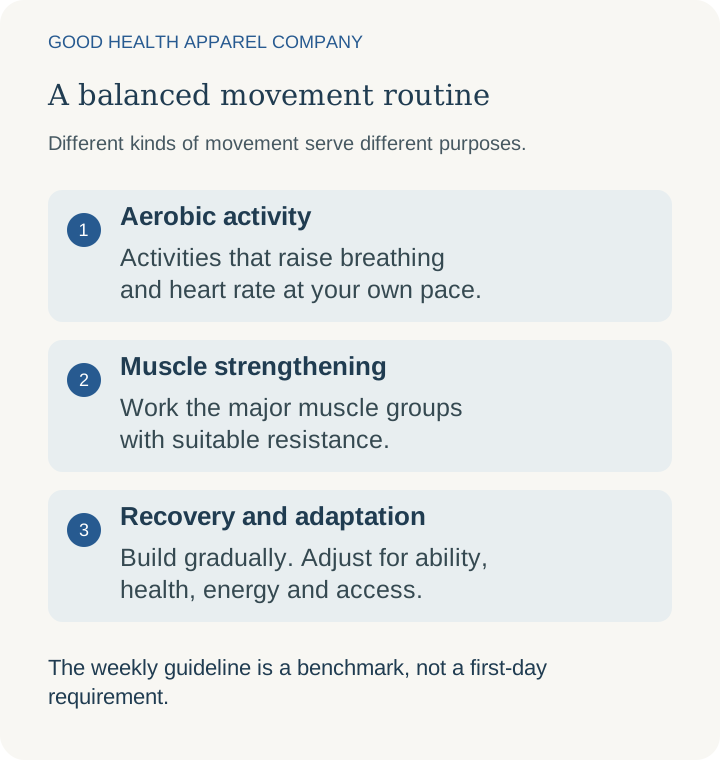
Aerobic activities raise your breathing and heart rate. Music-led movement, swimming, cycling, and adapted seated activity offer different ways to participate. The CDC’s talk test describes moderate effort as being able to talk but not sing. A movement’s name does not determine its intensity for every person.
For a home option, you might choose a few favorite songs and move to them in a clear space, starting gently and slowing toward the end. At a community center, a beginner pool class might offer a more comfortable environment. A stationary bike may suit someone who prefers a predictable setting.
The practical comparison is between options you can use. Consider travel, fees, changing facilities, sensory comfort, and whether you enjoy the activity enough to return. A popular workout across town may be less useful than an ordinary option that fits between existing commitments.
Give strength work its own place
NIDDK’s starting-activity guide describes strengthening as pushing or pulling against resistance and highlights working the whole body. Resistance can come from machines, bands, weights, or body weight. Choosing an easier version while learning a movement is a legitimate starting point.
For an introductory session, a qualified instructor can help you explore a supported sit-to-stand, a wall push-up, and a suitable pulling movement. These are examples of movement patterns, not a complete whole-body program. Ask how the session covers the legs, hips, back, abdomen, chest, shoulders, and arms.
A beginner class should leave space for questions: Where should I feel this? How can I make it easier? What should I change if my grip or balance is limited? Clear coaching is more useful than trying to copy a fast video whose movements you cannot comfortably follow.
Sketch a flexible first week
One possible planning sketch is a brief dance or cycling session on Monday, an introductory strength session on Tuesday, another aerobic session on Thursday, and strength practice on Saturday. The remaining days can hold ordinary movement, rest, or an activity you enjoy. This is an organizational example, not a required schedule.
The short sessions in that sketch will not necessarily meet the full weekly aerobic recommendation. They offer a way to test what is feasible. The next decision depends on how the week felt, rather than on whether you matched somebody else’s workout calendar.
A useful backup is specific and small. If the pool is closed, perhaps you have a comfortable home activity available. If a long workday makes the planned session unrealistic, a shorter version may preserve the appointment with yourself. Missing a session does not create an exercise debt.
Change one part when the routine feels familiar
Consider keeping a simple note: activity, approximate time, how demanding it felt, and how you felt afterward. You might discover that an early class is enjoyable but the travel is difficult, or that two short sessions fit more comfortably than one long block. Those are useful planning results.
When the current amount feels manageable, one option is to add a little time to one aerobic session while leaving the rest of the week familiar. Another is to ask an instructor about a suitable progression in strength work. Changing duration, difficulty, and frequency together makes it harder to understand what suits you.
Make room for individual advice
NIDDK recommends discussing activity options with a health professional when conditions such as heart disease, diabetes, or high blood pressure affect your needs, or when a disability requires adaptations. Pregnancy, recent surgery, injury, or a history of falls may also change what an appropriate starting plan looks like.
Sharp pain, dizziness, or unusual symptoms are reasons to stop and seek advice rather than push through. Chest pain, fainting, or severe breathlessness can require urgent medical attention. Exercise is not a test of how much discomfort you can ignore.
A routine can be worthwhile without a dramatic transformation photo. Learning an activity, finding a welcoming class, or recognizing when you need a modification all help make movement more understandable. The first week can simply provide information for the next one.
About this article
This original GHAC article was inspired by WebMD’s fitness how-to topic, used as topic inspiration.
Information here is educational and does not replace personalized medical advice.
Frequently asked questions
Does exercise have to last 30 minutes to count?
No. Shorter periods can contribute to weekly activity. A brief starting session can be useful even before you reach the full weekly recommendation.
Do I need a gym for strength training?
No. Bands, weights, body weight, and other suitable resistance can be used. Instruction can help you choose movements and adaptations that fit your needs.
How hard should beginner aerobic activity feel?
The CDC’s moderate-intensity talk test is being able to talk but not sing. Start with a manageable effort and follow individual medical advice when it applies.
Should every week be harder than the last?
No fixed weekly increase suits everyone. Repeating a comfortable amount while learning, resting, or adjusting the schedule can be appropriate.
Give the first week a useful job
A first week can help you discover one activity you enjoy, one strength option you understand, and a time that fits. That is useful information for shaping a routine.
