
HEALTH JOURNAL
Fad Diet Claims: Questions to Ask Before You Buy
Look past dramatic diet promises with practical questions about evidence, restrictions, safety, costs, and what everyday eating would actually involve.

A diet advertisement can promise a fresh start at exactly the moment life feels complicated. A simple rule, a convincing testimonial, and a limited-time discount can make the decision seem urgent. Being interested in that promise is understandable. It does not mean you lack knowledge or willpower.
A useful way to assess the offer is to turn it into ordinary questions. What is being promised? What evidence supports it? What would you eat on a busy Wednesday? What does it cost after the introductory period? The aim is to make the claim easier to examine, without judging anyone’s body or past choices.
Write down the promise in plain language
NIDDK’s program-selection guide flags promises of very rapid loss, weight loss from one specific body part, or results without changes in eating or activity as warning signs. These claims deserve scrutiny before money changes hands.
Imagine a fictional offer called a seven-day reset. The advertisement shows an impressive transformation and says the plan works for everyone. On paper, separate that into several claims: a short time frame, a body change, a special mechanism, and a guarantee across different people. Each claim needs its own support.
This small exercise can change the conversation. Instead of debating whether the advertisement feels inspiring, you can ask whether a study tested the actual program, whether participants resembled its intended customers, and whether the outcome being advertised was measured.
Ask what the evidence can really show
A personal account can describe one person’s experience, but it cannot establish what caused the change. A photo may leave out the time involved, other treatments, or people who tried the plan without similar results. Those gaps matter even when the person sharing the story is sincere.
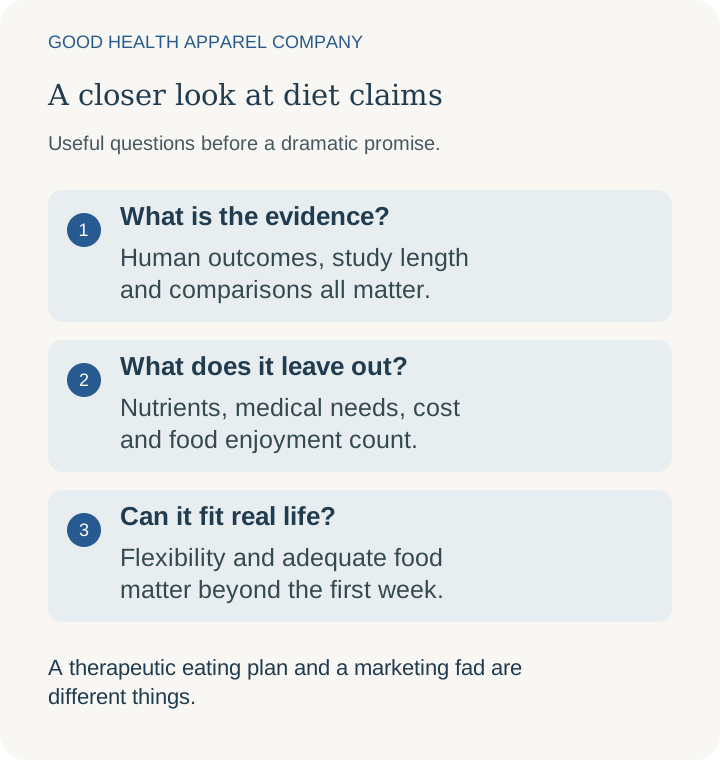
Useful study questions include: Was there a comparison group? How long were participants followed? How many stopped participating? Were side effects recorded? A result measured after a few weeks answers a different question from a result maintained over a year. A study of an ingredient also does not automatically validate a complete branded program.
For the fictional reset, a practical request might be: “Please show the published research on this exact plan and explain what happened after the initial week.” If the response offers only more testimonials, the original evidence question remains unanswered.
Look closely at detox and cleansing language
NCCIH’s detox and cleanse review reports limited, low-quality human research and no compelling evidence supporting detox diets for removing toxins or managing weight. Its guidance also describes safety concerns, including dehydration with laxative use and dangerous electrolyte imbalances with extreme fluid intake and no food.
A useful follow-up is to ask which substance the product supposedly removes, how that substance was measured, and whether a meaningful health outcome improved. “Feeling lighter” and a laboratory measurement of a named substance are different claims. Medical treatment for a specific toxic exposure is also different from a commercial cleanse.
Distinguish a restriction from a medical need
A plan may frame bread, fruit, or another broad category as the single explanation for health problems. NIDDK’s nutrition-myth guide explains that whole grains can contribute fiber and important nutrients, and that avoiding foods containing gluten has a specific role for people with conditions such as celiac disease.
A medically necessary restriction, an ethical preference, and a marketing rule are different reasons for excluding food. One person’s diagnosis does not establish a universal food ban. Conversely, a medically prescribed eating plan should not be dismissed simply because it has rules. Context matters.
For an unfamiliar plan, picture a meal you already enjoy and ask what would change. Would you still have enough practical choices? Would shared meals become difficult? Is there a reason for each exclusion, and who can help replace the nutrients or foods that disappear?
Price an ordinary month, not the introductory offer
A small starter payment can distract from the ongoing commitment. A realistic comparison includes required foods, delivery charges, supplements, meetings, app access, and renewal terms. A plan can be unaffordable even when its headline fee looks modest.
For the fictional reset, write two shopping lists: the products it requires and the groceries you would still need. Then add the time for preparation and the terms for stopping. If a meal replacement is mandatory, ask whether ordinary-food alternatives are available and what happens when the subscription ends.
This is also a question of convenience and dignity. A useful eating plan needs to coexist with work shifts, cultural foods, household preferences, and changing resources. Difficulty following an expensive or impractical plan is information about its fit, not a moral verdict on the person.
Ask what support looks like after the excitement fades
NIDDK emphasizes ongoing support and a maintenance plan when evaluating weight-management programs. Relevant questions include staff qualifications, evidence, personalization, and total costs. A program’s response to setbacks deserves as much attention as its launch-week enthusiasm.
Someone may want help with meal planning without pursuing weight loss. Someone else may discuss weight treatment with a clinician. Both deserve respectful, individualized support. A commercial advertisement cannot decide which goal is appropriate for a particular reader.
Bring the actual offer to a conversation
For a useful professional discussion, a screenshot, ingredient list, sample menu, and medication list provide more context than a program name alone. Questions can focus on whether the proposal fits your health needs, whether restrictions require monitoring, and what alternatives exist.
Major eating changes deserve particular care with diabetes, kidney disease, pregnancy, or a history of an eating disorder. If food rules bring growing fear, secrecy, or distress, support is more useful than another set of rules. The goal of reviewing a diet claim is clearer information and a more suitable choice, not a perfect performance.
About this article
This original GHAC article was inspired by WebMD’s fad-diet topic, used as topic inspiration.
Information here is educational and does not replace personalized medical advice.
Frequently asked questions
Is every popular diet a fad?
No. Popularity alone does not tell you whether an approach has evidence or fits an individual. Examine its claims, restrictions, safety, and practical requirements.
Do before-and-after photos prove that a plan works?
No. They show selected experiences and cannot establish the cause of a change or the typical result for people who try the plan.
Is a commercial detox necessary for healthy eating?
NCCIH reports no compelling research supporting detox diets for removing toxins or managing weight. Some approaches also carry safety risks.
What can I ask before paying for a program?
Ask for research on the actual program, staff qualifications, the complete cost, required purchases, cancellation terms, and the support available over time.
Turn a promise into a clear question
One advertisement is enough to practice on. Writing down its promise, evidence, everyday requirements, and full cost can make the choice easier to understand.

FEATURED NUTRITION DESIGN
Wear a message that matters to you.
Health Matters Nutritious Fruit Basket Unisex Soft Style T-Shirt
Explore this designFind more designs that speak to you. Browse all Nutrition designs →
