
HEALTH JOURNAL
Strength After 60: Starting With One Dumbbell
Explore a seated dumbbell curl, complementary bodyweight movements, and ways to choose resistance and support after 60 without treating one weight as a complete program.

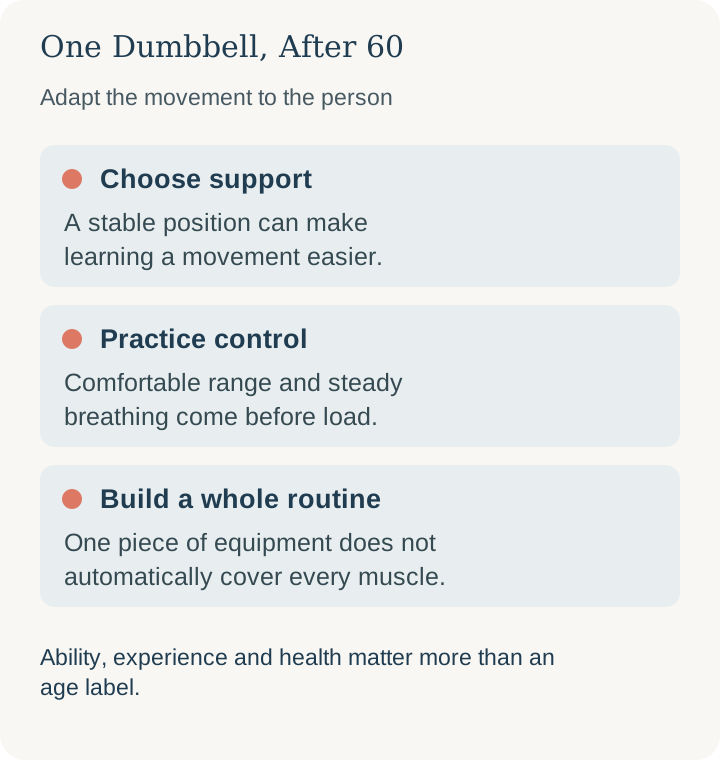
One dumbbell can make strength training feel more approachable: less equipment to choose, less space to clear, and a chance to learn one movement at a time. The useful question is how that weight fits your abilities and everyday goals, rather than how many exercises a video can squeeze into a session.
After 60, experience varies enormously. Someone returning after surgery and someone who has lifted for decades need different starting points. These examples explain options to discuss or explore with suitable guidance. They are not a personalized workout or a promise that one piece of equipment covers every need.
Begin with the task you care about
Carrying a shopping bag, rising from a chair, and lifting an object onto a shelf involve different abilities. Choosing a practical goal can make a conversation with an instructor more specific: which movements support this task, and what adaptation would make practice manageable?
The National Institute on Aging describes strength work as muscles working against resistance. That resistance can come from weights, bands, or body weight. Equipment is a tool, rather than a ranking system. A supported version that you understand can be more useful than a complicated lift you cannot control.
For example, someone interested in handling a light bag might ask about arm and grip work. Someone finding low chairs difficult may want leg-strength and transfer advice. Neither goal requires starting with an impressive-looking exercise.
Choose a weight by control, not age
There is no universal starting dumbbell weight for everyone over 60. Health history, previous training, grip, joint comfort, and the movement itself matter. A weight that feels manageable in one exercise may be too demanding in another. Starting with the motion alone can reveal whether the setup feels secure.
The NIA’s strength safety tips emphasize warming up with less resistance, breathing throughout the movement, and learning technique. A useful cue is breathing out during the lifting effort and in while returning, without straining or holding your breath.
A trainer or physical therapist can help distinguish an appropriate muscular challenge from a movement that needs changing. A smaller weight, a seated version, or another tool may solve a practical problem without abandoning strength work.
Explore a seated curl with one dumbbell
The NHS strength guide includes curls and a seated option. In a stable chair with feet supported, hold a light dumbbell in one hand, palm facing forward. Keep the upper arm close to your side while bending the elbow to bring the weight toward your shoulder, then lower slowly.
Rest before changing arms. Keep the wrist comfortable and avoid swinging your body to lift the weight. The range can be smaller, or the motion practiced without a weight. If maintaining your grip or positioning the weight is difficult, individual instruction is more useful than forcing the exercise.
Give the legs and pushing muscles another option
A dumbbell does not need to appear in every movement. The NHS also demonstrates sit-to-stand and wall push-ups. For sit-to-stand, use a stable chair on a nonslip surface, place feet comfortably apart, lean forward slightly, and rise with control before sitting slowly. Hand support or a higher seat may make practice more accessible.
For a wall push-up, face a sturdy wall, place hands around chest height, and bend the elbows to bring your body gently toward it before pressing away. Standing nearer the wall reduces the challenge. These examples complement a curl, but they still do not constitute a complete program for every major muscle group.
Leave room for recovery and the wider week
The CDC’s guidance for adults 65 and older combines aerobic movement, strengthening on at least two days each week, and balance activity. People whose conditions or abilities limit activity can work within those limits. Turning 60 does not suddenly make everyone’s exercise needs identical.
A few practice movements are an introduction. A broader plan considers the legs, hips, back, abdomen, chest, shoulders, and arms. NIA advises recovery between sessions for the same muscle groups. Balance practice may also require support or supervision, particularly after falls.
One way to organize the learning process is to record the movement, the weight used, and whether it felt controlled. That gives an instructor useful information when considering the next adjustment. More repetitions or more weight are possibilities, not obligations after every session.
Know when the example needs individual advice
The MedlinePlus injury-prevention guide recommends appropriate instruction, gradual progression, and attention to pain. Recent surgery, an injury, an ongoing condition, or uncertainty about balance can change which movements make sense.
Pain during exercise is a reason to stop and reassess. Persistent symptoms deserve professional advice. Chest pain during or after activity requires urgent medical attention. A comfortable starting point leaves room for learning, recovery, and the option to change the plan.
About this article
This original GHAC article was inspired by Health’s one-dumbbell strength after 60 topic, used as topic inspiration.
Information here is educational and does not replace personalized medical advice.
Frequently asked questions
Can one dumbbell build strength after 60?
It can provide useful resistance for suitable exercises. The benefit depends on appropriate challenge, practice, progression, and a broader routine that covers the major muscle groups.
What weight should I choose?
There is no single weight for an age group. A suitable load lets you perform the chosen movement with control and normal breathing; individual guidance can help establish that starting point.
Do all my strength exercises need the dumbbell?
No. Supported bodyweight exercises, bands, or machines may suit some movements better. One dumbbell is an option, rather than a complete exercise plan.
Make the equipment serve your goal
A useful starting conversation connects one everyday task with a movement you understand, an appropriate resistance, and the support you need. The rest of the routine can develop around that information.
More everyday wellbeing reading

Posture Exercises: More Comfort, Less Chasing Perfection
Understand what posture exercises can offer, explore gentle seated movements, and consider everyday comfort without chasing a single ideal position or a guaranteed pain fix.
Read article →
GLP-1 Medicines and the New FDA Eye Warning: Understanding NAION
What the November 2026 FDA warning means, how rare NAION differs from diabetic retinopathy, and why absolute risk and sudden vision symptoms deserve context.
Read article →