
RECALLS & HEALTH ALERTS
GLP-1 Medicines and the New FDA Eye Warning: Understanding NAION
What the November 2026 FDA warning means, how rare NAION differs from diabetic retinopathy, and why absolute risk and sudden vision symptoms deserve context.

A headline linking a medicine to blindness can overwhelm everything else a reader knows about treatment. The useful questions are more specific: What eye condition is involved? What changed in the warning? How common was it in the evidence, and what remains uncertain?
The FDA announced a new NAION warning on November 9, 2026. This overview distinguishes that U.S. action from earlier semaglutide reviews. Sources checked November 13, 2026. Individual treatment decisions require clinical advice.
What the U.S. announcement says
The FDA communication requires a warning about potential NAION risk across GLP-1 receptor agonist medicines. Its list includes semaglutide products and tirzepatide, which also acts on GIP receptors. This is a labeling action, not a recall.
A warning gives patients and prescribers information for decisions. It does not, by itself, tell every person taking a medicine that the treatment has become unsuitable. The relevant comparison includes the condition being treated, available alternatives, and that person’s history.
What NAION means
The American Academy of Ophthalmology explains that ischemic optic neuropathy involves inadequate blood flow to the optic nerve, the connection carrying visual information toward the brain. Damage can be lasting. The nonarteritic form is distinguished from a form involving inflamed arteries.
An eye examination matters because a description such as “blurry vision” is not a diagnosis. An ophthalmologist may examine the optic nerve after dilating the pupils, test peripheral vision, and consider blood tests when an inflammatory cause is possible. Different causes require different assessment.
The Academy describes low-vision aids and assistive technology as options for managing daily activities when vision loss persists. Discussing those supports recognizes the seriousness of the condition without assuming that every affected person has the same degree of sight loss.
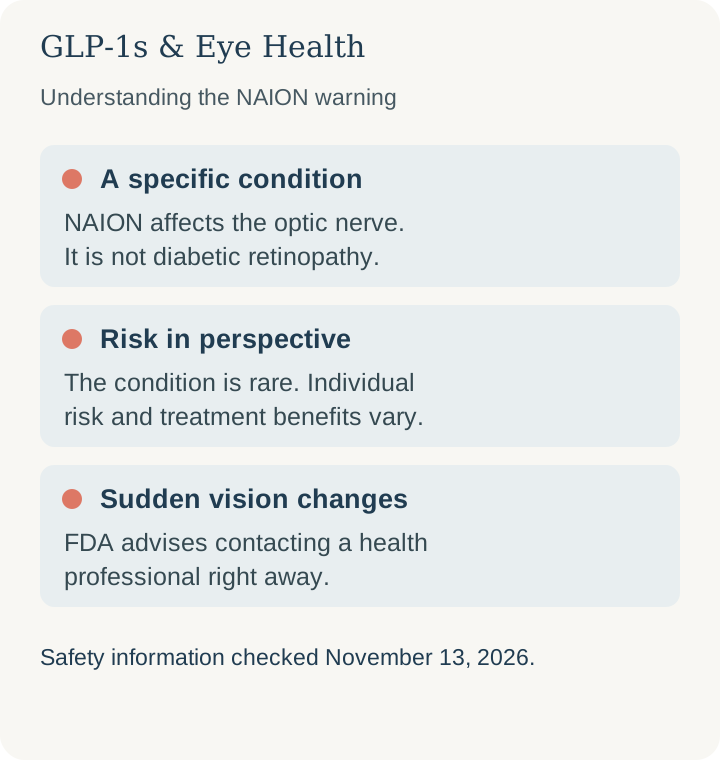
Reading the trial numbers without inflating them
The FDA pooled 126 randomized trials: NAION rates were 6.4 per 100,000 person-years with GLP-1 medicines versus 3.8 with comparison treatment. The numerical difference is 2.6 per 100,000 person-years. These are event rates, not the percentage of users who will become blind.
A person-year is a measure of time observed: 100 people followed for one year contribute 100 person-years. Event rates help compare groups with different follow-up. They are not a personalized forecast, and the same rate cannot automatically be assigned to every age, diagnosis, dose, or product.
Two questions belong beside any risk number: Who was studied, and what was the comparison? A number taken from one population should retain that population’s description when repeated elsewhere. Otherwise, a precise-looking figure can convey more certainty than the evidence supports.
Why earlier semaglutide reports use different numbers
The UK MHRA’s February 2026 update addressed semaglutide specifically. It described very rare NAION and cited a European assessment in adults with type 2 diabetes: approximately double the relative risk, corresponding to about one additional case per 10,000 treated people per year.
That estimate comes from a different evidence base than the pooled U.S. trial rate. The figures should not be added together or presented as interchangeable. The UK review also noted conflicting evidence and that other GLP-1 medicines were outside that review’s scope.
Type 2 diabetes itself increases NAION risk. This overlap is one reason a report occurring after treatment does not, on its own, establish that the medicine caused it. A safety review considers patterns across evidence rather than relying only on timing.
NAION is different from diabetic retinopathy
The National Eye Institute describes diabetic retinopathy as damage involving the retina’s blood vessels. The retina is the light-sensitive tissue at the back of the eye. NAION concerns the optic nerve. Both can affect vision, but their names cannot be swapped when discussing a warning.
Diabetic retinopathy may have no early symptoms. A scheduled dilated examination can therefore have a different purpose from an urgent assessment of a new visual change. An ordinary appointment calendar does not explain a sudden symptom.
For a discussion with an eye-care professional, useful background can include previous retinal disease, a previous optic-nerve problem, and the date of the last dilated examination. Being specific about an existing diagnosis helps keep several different eye-health issues from becoming one frightening label.
The symptom message and the treatment conversation
The MHRA advises urgent assessment for sudden vision loss or rapidly worsening eyesight during semaglutide treatment. Sudden loss of vision deserves urgent medical attention, even when there is no pain or the change affects only part of what someone can see.
The FDA says people who have experienced NAION should discuss continuing or stopping the medicine with their health professional. That decision requires clinical assessment rather than a headline or an online risk calculator.
A calm conversation can still be concrete: What eye condition is suspected? Which medicine and dose are involved? What benefit is the treatment providing? What alternatives are relevant to this particular person? Those questions preserve both the seriousness of a rare event and the value of informed care.
About this article
This original GHAC article was inspired by Health.com’s GLP-1 eye-risk topic, used as topic inspiration.
Information here is educational and does not replace personalized medical advice.
Frequently asked questions
Does the new warning mean every GLP-1 medicine has the same risk?
A class-wide warning does not establish an identical risk for every product, dose, or person. The individual discussion still matters.
Is NAION another name for diabetic retinopathy?
No. NAION involves the optic nerve; diabetic retinopathy involves blood vessels in the retina. An eye examination distinguishes causes of visual change.
Can a lack of pain rule out a serious eye problem?
No. Sudden vision loss can be painless. Urgent assessment matters rather than waiting to see whether pain develops.
Make the discussion specific
A medication and eye-history summary can help organize a conversation about benefits, uncertainty, and any symptoms. A sudden change in vision belongs in urgent medical care.
More everyday wellbeing reading

Women’s Vitamins and Minerals: What Changes With Life Stage?
A food-first look at iron, folate, calcium, vitamin D, and B12 across adulthood, pregnancy, menopause, and later life, without a one-size-fits-all supplement list.
Read article →
Probiotic Foods: What Live-Culture Labels Really Mean
Understand fermented foods, probiotic strains, and supplement labels without assuming every cultured food offers the same benefit.
Read article →