
CASE STUDIES
Unsure About Perimenopause? What a Survey Reveals
A survey explores uncertainty about perimenopause. Understand its findings, the limits of an app-based sample, and what to discuss with your healthcare team.

Changes in periods, sleep, or temperature can raise a difficult question: is this perimenopause, or something else? A survey of US women suggests that uncertainty is common, including among people experiencing substantial symptoms.
This case study examines a population survey, not an individual patient story. Its value is in understanding a gap in recognition and support. It does not offer a symptom checklist that can diagnose every reader.
The research question and the finding
The peer-reviewed study published July 14, 2026, in Menopause examined uncertainty about reproductive stage. In the survey, 34% of participants selected unsure. Researchers also analyzed 409 free-text responses to understand what made the question difficult.
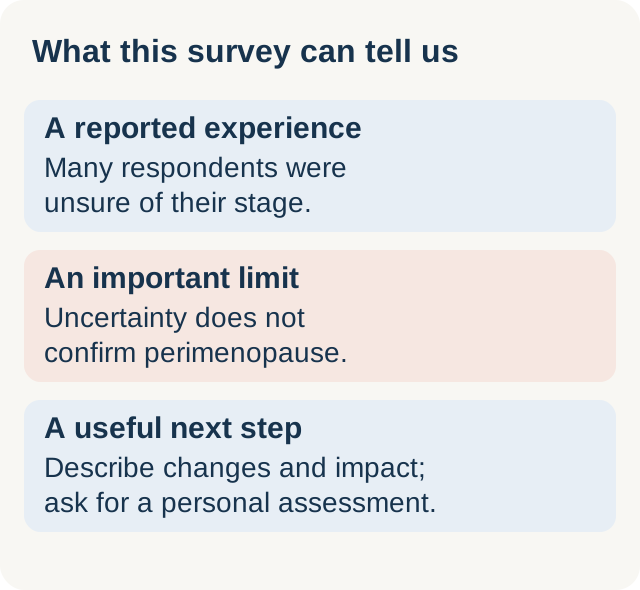
The analysis identified confusion about symptoms, gaps in knowledge, and barriers to confirmation and care. The study measured reported uncertainty. It did not establish that every unsure participant was in perimenopause or that a particular symptom proves the transition has begun.
Who answered matters
The published methods describe recruitment from the Flo app and data collection from December 2024 to May 2025. The analysis excluded incomplete surveys and participants currently using hormonal birth control. Several authors were affiliated with Flo Health.
This was a self-selected app-user sample, not a random sample of all US women. Its percentages should not be read as a national diagnostic count. A snapshot survey also cannot determine whether better information would cause symptoms or outcomes to improve.
Uncertainty deserves a useful response
The Menopause Society’s study explanation emphasizes the need for clearer information and better recognition. A person can need help with symptoms before feeling confident about a label. Waiting for certainty can make an already confusing experience harder.
For a healthcare conversation, you do not need to arrive with a diagnosis. You can say, “These changes are affecting my day, and I would like to understand possible causes.” That creates room to investigate the changes rather than deciding in advance that everything is hormonal.
Know the terms without using them as a test
The Office on Women’s Health describes perimenopause as the transition before menopause, when hormones and periods can change. Menopause is generally recognized after 12 consecutive months without a period. Pregnancy can still occur during perimenopause.
The same guidance notes that a clinician can usually assess the transition using age, symptoms, and menstrual changes; blood hormone tests are not usually needed. That does not mean every new symptom should be attributed to the transition, or that personal medical circumstances never call for testing.
Prepare a short account of what changed
Choose the two or three changes that interfere most with ordinary life. Record when they began, how often they occur, and what they make difficult. If practical, note changes in periods alongside sleep, hot flashes, or other concerns.
Bring a list of medicines, supplements, and contraception. You do not need a paid app or an elaborate spreadsheet for this conversation. A few clear notes can help you explain your experience without having to remember everything during a short appointment.
Ask for a plan, including a review point
Useful questions include: What else could explain these changes? What options might address my most disruptive symptom? What should prompt another appointment? When should we review whether the plan helped? These questions remain useful even if the diagnosis is not settled at the first visit.
If you feel dismissed, explain the specific effect on daily life and ask what evaluation or follow-up is appropriate. Seeking a second opinion is an option when concerns remain unresolved. The survey cannot tell you which treatment fits; that requires your medical history and preferences.
Do not let a label delay necessary care
New or concerning symptoms deserve medical attention even when perimenopause seems plausible. The Office on Women’s Health specifically advises prompt evaluation of vaginal bleeding after menopause. An educational article cannot assess the cause of an individual change.
The practical lesson is to make uncertainty discussable. You can ask for support before knowing exactly which stage you are in. The goal is a clearer explanation and an appropriate plan, rather than proving that you fit a headline.
About this article
This original GHAC article was inspired by Health.com’s topic on uncertainty about perimenopause.
Information here is educational and does not replace personalized medical advice.
Frequently asked questions
Does being unsure mean I am in perimenopause?
No. The study measured uncertainty, not a clinical diagnosis. A clinician can review your symptoms, menstrual history, age, and other possible explanations.
Did the survey represent all US women?
No. Participants were recruited through a health app and chose to respond. The results describe this sample and may not generalize to the whole population.
Do I need a hormone test before asking for help?
Not necessarily. Routine hormone tests are usually not required to assess the transition, but personal circumstances can change the evaluation. Ask a clinician what is appropriate for you.
Bring the changes, even without a label
Write down your two most disruptive concerns and ask a healthcare professional what assessment and support would be appropriate.
