
RESEARCH & GUIDELINES
Lowering Cancer Risk: Practical Steps Without the Promise of Certainty
Understand evidence-based cancer prevention, from tobacco and alcohol to vaccines, sun protection, movement, and a personal screening plan.

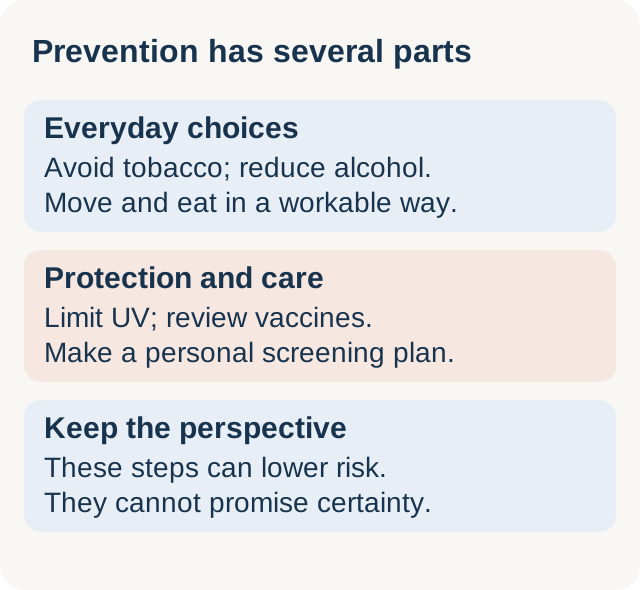
Cancer-prevention advice can become an overwhelming list of things to do perfectly. A more useful approach is to identify actions supported by evidence, find the support that makes them possible, and remember that risk reduction is never a guarantee.
People who follow healthy routines can still develop cancer. A diagnosis is not proof that someone made the wrong choices. Prevention information should help people protect their health, not assign blame for an illness.
Start with the meaning of risk
The National Cancer Institute explains that cancer risk reflects many factors, including age, family history, exposures, and behaviors. Some are changeable; others are not. We usually cannot identify a single reason one person develops cancer and another does not.
Think of prevention as improving the odds across time. It does not offer a personal scorecard or a way to predict who will become ill. A useful plan makes a few important actions easier, rather than demanding certainty from every decision.
Get support for avoiding tobacco
The CDC’s healthy-choices guidance identifies tobacco avoidance and protection from secondhand smoke as cancer-prevention priorities. If you smoke, asking for help to quit is a practical health step at any age.
Tell a clinician what has made previous attempts difficult and ask about counseling and approved quit-smoking medicines. Someone who has tried before has useful information about barriers. A support plan can address those barriers more directly than relying on willpower alone.
Consider alcohol separately from diet quality
The NCI alcohol fact sheet describes strong evidence that drinking alcohol causes several cancers. Even light drinking can increase the risk of some cancers. Wine does not become a cancer-prevention measure because it is served with a nourishing meal.
For cancer prevention, avoiding alcohol is the lowest-risk choice. If you drink, reducing the amount is a reasonable topic to discuss. If cutting back causes withdrawal symptoms or you may be dependent, seek medical help to make the change safely.
Build habits around foods and movement
The American Cancer Society guideline recommends a dietary pattern with vegetables, fruit, whole grains, and beans, while limiting red and processed meat and sugary drinks. The pattern matters more than treating one ingredient as protective.
For adults, the guideline recommends 150 to 300 minutes of moderate activity or 75 to 150 minutes of vigorous activity weekly, or an equivalent combination. Adapt activity to your abilities and medical needs. A manageable starting routine can be more useful than a demanding plan you cannot sustain.
Weight is also associated with risk for several cancers. Seek respectful, individualized advice when needed. Restrictive eating, shame, or promises attached to a target weight do not make prevention more reliable.
Use sun protection and review vaccines
The CDC advises protecting skin from ultraviolet radiation and avoiding tanning beds. Build protection around shade, clothing, and appropriate sunscreen instead of waiting for a sunburn to change your plans.
HPV and hepatitis B vaccines can prevent infections that cause certain cancers. Ask a healthcare professional which vaccines are recommended for you or your child based on age, vaccination history, and other relevant factors.
Keep prevention and screening connected, but distinct
Cancer screening looks for disease before symptoms appear. Some tests find cancer earlier; certain cervical and colorectal screening approaches can also identify precancerous changes. Screening does not replace prevention, and prevention does not remove the need for appropriate screening.
There is no single schedule that fits every reader. Age, organs present, previous results, family history, and other risks can change the recommendation. Ask which tests you need, when to repeat them, and what a result might lead to. New symptoms require medical evaluation rather than waiting for the next routine screen.
Choose one action and name the barrier
You might book a preventive visit, put sun protection where you will actually use it, or ask a family member for details about a cancer diagnosis that occurred at a young age. Choose the action that matters for your circumstances.
If access, cost, transport, or caregiving makes the action difficult, name that obstacle when asking for help. A prevention plan should account for real life. Completing one useful step is a sensible beginning, even when everything else is still a work in progress.
About this article
This original GHAC article was inspired by Health.com’s topic on lowering cancer risk.
Information here is educational and does not replace personalized medical advice.
Frequently asked questions
Can healthy habits guarantee I will not get cancer?
No. Risk reduction improves the odds for some cancers, but age, inherited factors, exposures, and other influences remain. Cancer is not a measure of someone’s effort or character.
Should everyone have the same screening tests?
No. Recommendations depend on age, medical and family history, organs present, and the specific test. Discuss your personal plan and evaluate new symptoms promptly.
Is there a single food that prevents cancer?
No single food guarantees protection. Established guidance focuses on an overall eating pattern, activity, avoiding tobacco, limiting alcohol, and other proven prevention measures.
Make one prevention conversation specific
At your next appointment, ask which preventive action or screening decision deserves attention first, and explain any practical obstacle to carrying it out.
More everyday wellbeing reading
Mediterranean Eating and IBS: What a Small Trial Can Tell Us
A small 2025 trial explored Mediterranean eating for IBS. Understand the findings, the limits, and how to discuss a flexible food plan with your care team.
Read article →
Light at Night and Heart Health
A large study linked brighter nights with cardiovascular disease. Understand the limits and consider practical sleep changes without sacrificing safety.
Read article →
Hormone Therapy and Dementia
Understand conflicting hormone-therapy and dementia findings, current FDA labeling changes, and why symptom treatment differs from dementia prevention.
Read article →