
CASE STUDIES
Shingles Vaccines and Heart Health
Explore research linking shingles vaccination with heart outcomes, why vaccine type matters, and what remains uncertain.

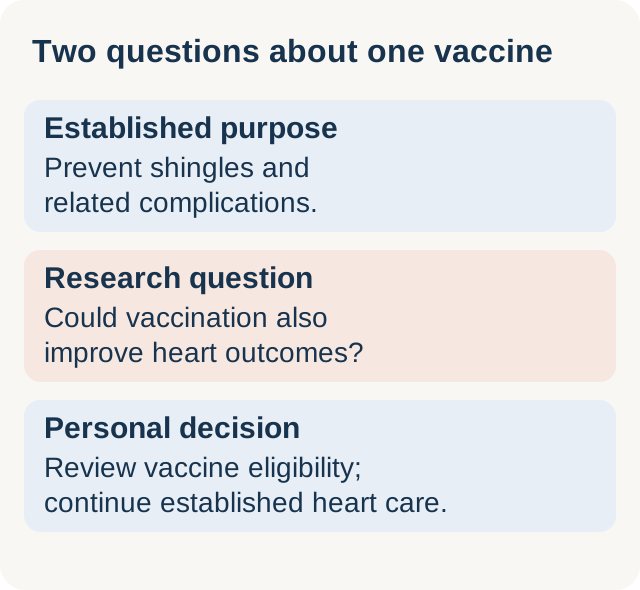
A shingles vaccine protects against a painful infection. Could it also help protect the heart? That question has prompted several studies, but a promising association is different from a proven new use for a vaccine.
This case study examines published research, rather than an individual patient’s story. It separates what researchers measured from what a reader can reasonably conclude, while keeping established vaccination guidance in view.
The first case: a large health-record comparison
A 2025 European Heart Journal study examined South Korean records. Its overlap-weighted cohort included 1,271,922 adults aged at least 50, with median follow-up of six years. Live shingles vaccination was associated with a lower hazard of cardiovascular events: hazard ratio 0.77, with a 95% confidence interval of 0.76 to 0.78.
That is a relative comparison of event hazards, often summarized as 23% lower. It is not a 23-percentage-point reduction in someone’s personal risk. The study examined a live vaccine, which differs from Shingrix, the recombinant vaccine used in the United States.
The second case: comparing vaccine periods
A Nature Medicine paper published August 26, 2026 used the US transition from live to recombinant vaccination as a natural experiment. It matched 36,460 adults aged at least 60 in each of two vaccination periods, predominantly receiving different vaccine types.
The recombinant-dominated cohort had lower cardiovascular burden over seven years, with a restricted mean time lost ratio of 0.91. The combined endpoint included ischemic heart disease, heart failure, and ischemic stroke. That time-based result is not the same statistic as the earlier hazard ratio. The authors called for clinical trials and research into possible mechanisms.
Why the numbers need their labels
Putting 23% beside 9% does not establish which vaccine is better for the heart. The studies compared different groups, used different endpoints, and summarized outcomes differently. A number becomes meaningful only after you name its comparison and measurement.
Absolute risk asks a further question: how many people experience an outcome over a defined period? A relative statistic alone cannot answer that. Neither finding gives this article a reliable way to calculate your individual benefit or promise how many events vaccination would prevent.
A large sample does not erase confounding
People who receive preventive care can differ from people who do not. Access, medical history, and other health behaviors may influence later outcomes. Statistical adjustment helps with measured differences, but cannot guarantee that every relevant difference has disappeared.
Comparing people who both chose vaccination is a useful design choice. Yet a natural experiment still needs careful scrutiny of assumptions, calendar effects, and the people included. More precise estimates do not automatically turn an association into proof of cause.
The established reason to consider vaccination
CDC vaccination guidance recommends two doses of Shingrix for adults aged 50 and older, and adults aged 19 and older with weakened immune systems because of disease or treatment. The established benefit is preventing shingles and its complications, including persistent nerve pain.
Ask a provider about your previous doses, current medicines, and individual suitability. Mention severe allergies and any current illness. A possible extra benefit should not become a reason to ignore eligibility, personal precautions, or the need to discuss timing.
Bring a clear question to the appointment
Try: “I read about shingles vaccination and heart health. Am I due for vaccination under current recommendations?” Bring any vaccination record you have, rather than relying on a memory of having had a shot years ago.
Before leaving, clarify the practical next step. You may need a second appointment, confirmation of an earlier dose, or a conversation with the clinician managing an immune-affecting treatment. A written plan is more useful than trying to turn a headline into your own schedule.
Keep proven heart care in the foreground
The CDC heart-disease prevention guide emphasizes avoiding smoking, regular activity, nourishing food choices, and managing blood pressure, cholesterol, and diabetes. Continue prescribed treatment and discuss concerns with your care team.
The research offers another question to follow. It does not replace cardiovascular medicines, an individualized exercise plan, or follow-up. A fair way to share the story is to describe a possible added benefit under investigation, alongside the established protection against shingles.
About this article
This original GHAC article was inspired by Health.com’s article on shingles vaccination and heart health.
Information here is educational and does not replace personalized medical advice.
Frequently asked questions
Does the shingles vaccine prevent heart attacks?
Research suggests a possible cardiovascular benefit, but the studies described here do not establish vaccination as a proven treatment to prevent heart attacks. Shingles vaccination is recommended to prevent shingles and its complications.
Was the large South Korean study about Shingrix?
No. It studied a live zoster vaccine. Shingrix is a recombinant vaccine. A newer 2026 study examined the transition between vaccine types, but used a different comparison and outcome measure.
Does a 23% lower risk mean my risk falls by 23 percentage points?
No. The estimate was a relative hazard comparison in a study population, not a personal prediction or an absolute percentage-point reduction. Your starting risk and the limits of observational evidence matter.
Review your preventive care, one question at a time
Bring your vaccination record to your next healthcare or pharmacy conversation. Ask what you are due for under current recommendations and keep established heart care on track.
