
HEALTH JOURNAL
Chest Pain: Why the Cause Needs Medical Assessment
Chest discomfort can involve the heart, lungs, digestive tract, or chest wall. Understand emergency warning signs and why symptoms alone cannot establish the cause.

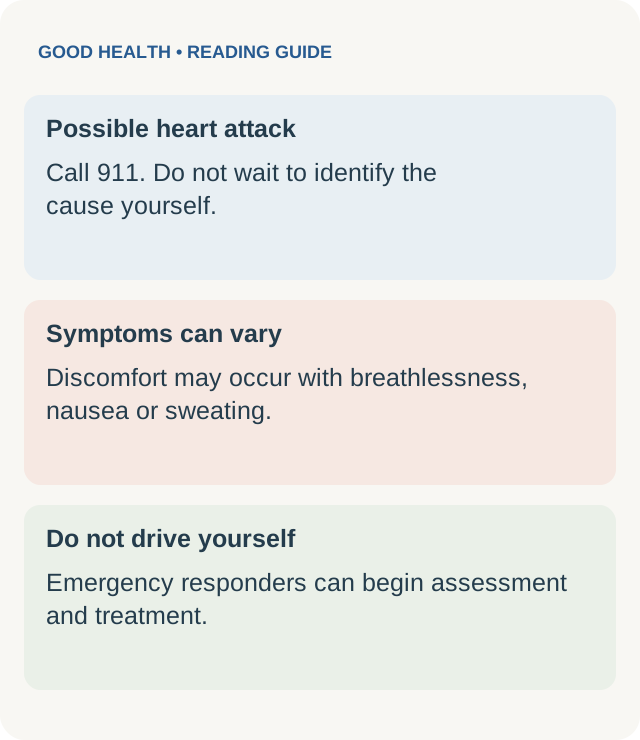
If you have new or unexplained chest pain now, particularly pressure or tightness with shortness of breath, sweating, nausea, faintness, or discomfort spreading to an arm, jaw, back, or neck, call 911. Call even if you are unsure whether it is a heart attack. Do not drive yourself or delay help to finish this article.
Chest pain has several possible causes, and some are emergencies. Learning about them can make a later conversation with a clinician clearer. It cannot provide a safe way to rule out a heart attack or another urgent condition at home.
Heart attack warning signs are not always dramatic
The American Heart Association describes chest discomfort that may feel like pressure, squeezing, fullness, or pain. It may persist or disappear and return. Breathlessness, a cold sweat, nausea, unusual fatigue, lightheadedness, or discomfort elsewhere in the upper body can occur as well. A person does not need every symptom for the situation to be serious.
Chest discomfort remains the most common heart attack symptom in women and men. Other symptoms can be prominent, so a familiar image of someone clutching the left side of the chest is too narrow. An emergency should not have to match a television scene before it deserves attention.
This is why the question is not whether a person can prove that the pain comes from the heart. The urgent question is whether an emergency could be happening. Uncertainty is a valid reason to call 911.
Mild symptoms or improvement do not provide an all-clear
The National Heart, Lung, and Blood Institute explains that heart attack symptoms can begin gradually and may be mild. Some people have few noticeable symptoms, and symptoms can differ from a previous heart attack. Older adults and people with diabetes are more likely to experience a silent heart attack.
Ambulance teams can begin assessment and treatment during transport. Calling 911 is safer than driving yourself when a heart attack is possible. The dispatcher can give situation-specific instructions. Looking for an antacid, trying a breathing exercise, or waiting for another person to decide should not postpone that call.
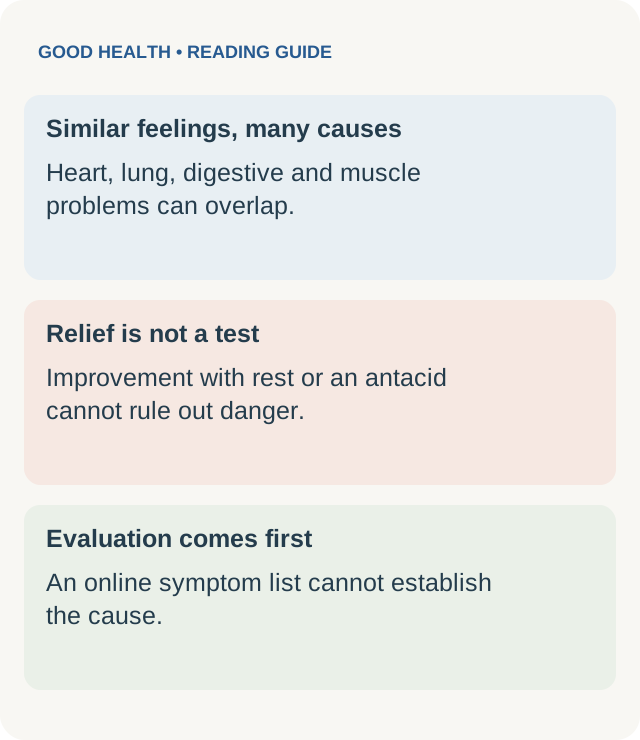
Improvement is information to report, not proof of safety. A symptom that comes and goes can still matter. There is no useful home experiment in which a person deliberately exercises or waits for worsening pain to test whether a symptom is dangerous.
Why several parts of the body can cause chest discomfort
MedlinePlus’s chest-pain overview lists heart, digestive, lung, and musculoskeletal causes. The chest contains several organs and tissues, and pain can also be felt away from its source. Understanding that range explains why medical assessment is needed; it does not make the less dangerous possibilities a safe default.
For example, heartburn and esophageal disorders can cause chest discomfort, as can strained muscles or inflammation where ribs meet the breastbone. Lung conditions include pneumonia, inflammation around the lungs, and a clot in a pulmonary artery. These conditions differ in urgency and treatment.
A list of causes is therefore best read as background for an examination. It should not become a menu from which a reader chooses the explanation that feels least worrying. The same description can mean different things in different clinical circumstances.
Sharp pain and pain with breathing still need context
MedlinePlus’s clinical overview includes blood-vessel emergencies such as aortic dissection and lung emergencies such as a pulmonary embolism or collapsed lung. Sudden severe chest or upper-back pain, or sudden chest pain with shortness of breath, can require emergency care. A swollen leg, recent surgery, prolonged immobility, or a long trip may add important context.
A clinician also asks about fever, coughing, swallowing, position, exertion, and whether pressure on the chest changes the discomfort. These details help guide testing. None is a dependable standalone home rule for excluding a dangerous cause.
Known angina does not make every later episode routine. Discomfort that is more intense, occurs with less activity, lasts longer, or appears at rest can signal a change requiring emergency assessment. A previous diagnosis explains history; it does not guarantee the meaning of a new symptom.
What an emergency assessment may involve
The NHLBI’s diagnosis guide describes an electrocardiogram, often called an ECG or EKG, as an early test when a heart attack is suspected. It records the heart’s electrical activity. Blood tests can measure proteins such as troponin that enter the bloodstream when heart muscle is injured.
Testing may be repeated to look for changes over time. That is one reason an evaluation is a process rather than a single number or a quick glance at a monitor. The medical team interprets results alongside when symptoms began, their pattern, the examination, and relevant history.
If clinicians recommend continued observation or additional tests, asking what they are checking can make the process easier to understand. It is reasonable to want a clear explanation. A general online article cannot interpret an individual test result or replace the team’s assessment.
After urgent causes have been assessed
The American College of Gastroenterology uses the term noncardiac chest pain for a diagnosis made after heart disease has been appropriately evaluated. Reflux, abnormal esophageal muscle function, and heightened esophageal sensitivity can be involved. Noncardiac does not mean imaginary, and treatment depends on the identified explanation.
Stress and panic symptoms can overlap with other chest symptoms and deserve respectful care. An anxiety history should not be used to dismiss a new episode without assessment. Conversely, once an appropriate evaluation identifies a noncardiac condition, understanding that condition can support a more useful treatment discussion.
A clinician may consider reflux treatment or further digestive testing after the cardiac assessment. Trying a reflux medicine at home is not a substitute for that sequence when urgent symptoms are present.
Make follow-up concrete without delaying emergency care
After an assessment, useful questions include: What causes were evaluated? What is the working diagnosis? Which changes mean I should call 911? What follow-up is needed? Is there an individualized plan for recurrent symptoms? A written explanation can reduce uncertainty after a stressful visit.
A short account of timing, associated symptoms, current medicines, and previous relevant diagnoses can help a clinician. Gathering records should never delay an emergency call. Details can be supplied once help is on the way.
Finally, a past reassuring assessment is not a permanent guarantee about future symptoms. A new or changed episode needs to be considered on its own circumstances. The purpose of health information here is to support understanding and communication, not to put the burden of emergency diagnosis on the person experiencing pain.
About this article
This original GHAC article was inspired by WebMD’s chest-pain topic, used as topic inspiration; the linked page was not independently reviewed.
Information here is educational and does not replace personalized medical advice.
Frequently asked questions
Can a heart attack feel like indigestion?
Yes. Symptoms can overlap with indigestion and other conditions. New or unexplained chest discomfort with concerning symptoms needs emergency assessment rather than a home trial of treatment.
Does chest pain that goes away rule out a heart attack?
No. Heart attack symptoms may come and go. Call 911 for possible heart attack symptoms even if you are unsure or the discomfort improves.
Can anxiety cause chest symptoms?
Anxiety and panic can cause chest symptoms, but their presence does not exclude another cause. New or changed symptoms need appropriate medical assessment.
Why might blood tests be repeated?
Clinicians may repeat tests such as troponin measurements to look for changes over time and interpret them alongside symptoms, examination, and other test results.
Keep emergency decisions separate from later learning
Possible heart attack symptoms belong with 911 and emergency assessment. Once urgent causes have been evaluated, a clear explanation and follow-up plan can make the next conversation more useful.
More everyday wellbeing reading

CPAP Comfort: Mask Leaks, Dryness, and Better Follow-Up
Understand common CPAP comfort problems, useful observations to share, cleaning considerations, and which questions belong with your sleep-care team.
Read article →
A Stye on Your Eyelid: Gentle Care and Signs to Get Help
What a stye is, how it differs from a chalazion, why squeezing can make things worse, and which symptoms need an eye-care professional.
Read article →