
HEALTH JOURNAL
A Stye on Your Eyelid: Gentle Care and Signs to Get Help
What a stye is, how it differs from a chalazion, why squeezing can make things worse, and which symptoms need an eye-care professional.

A tender bump on an eyelid can make blinking, reading, and ordinary routines uncomfortable. A stye is a common explanation, but a photograph or a familiar-looking lump cannot establish a diagnosis. Changes in vision, spreading swelling, or substantial pain deserve prompt assessment rather than assuming that every eyelid problem is minor.
This guide explains the difference between a stye and a blocked-gland lump, what conservative care is intended to do, and where its limits lie. It is general education for readers and caregivers, not a replacement for an eye examination.
What a stye actually involves
A stye, also called a hordeolum, is a tender inflamed bump involving an eyelid gland or eyelash follicle. It may sit near the lashes or farther inside the lid. The NHS stye overview describes a localized painful lump, sometimes with watering or surrounding swelling. Skin redness can be less obvious on darker skin, so color alone is an incomplete guide.
The location matters because an irritated eyelid and a painful eyeball are different descriptions. Someone seeking advice can explain whether the discomfort is centered in a small lump, involves the whole lid, or feels deeper in the eye. That detail helps the professional asking questions; it does not make home diagnosis reliable.
An ordinary stye should not reduce vision. New blurring or another change in sight is a reason for prompt evaluation, even when a visible bump seems to offer an easy explanation.
A stye and a chalazion can look similar
Moorfields Eye Hospital describes a chalazion as a lump caused by a blocked oil-producing gland. It is often firmer and less painful than a stye, although an early chalazion can be irritated. A lump may persist for weeks or occasionally months, and appearances overlap enough that an examination can be useful.
These names describe different processes rather than different levels of cleanliness. A blocked gland does not mean a person has failed at hygiene. Likewise, a lump that becomes less tender is not automatically proof that it has fully resolved.
A persistent or repeatedly returning lump belongs in an eye-care discussion. Moorfields notes that a clinician may investigate a recurrent chalazion further, sometimes with a tissue sample. This does not mean that most eyelid lumps are dangerous. It explains why repeatedly giving the same lump a familiar name is not a substitute for assessment.
What warm compresses are intended to do
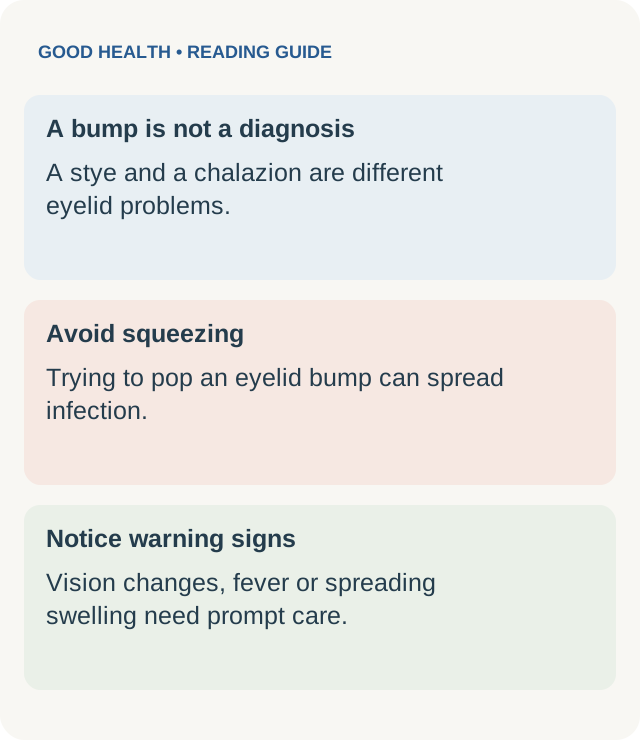
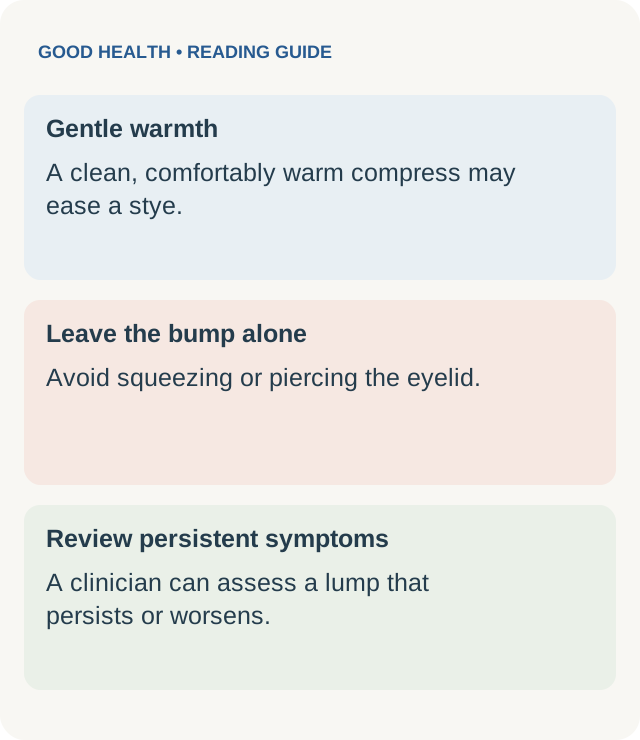
The NHS describes warm compresses as a conservative approach for a stye. The aim is gentle warmth, not pressure that forces a lump open. A clean cloth and comfortably warm water are a simple option. The cloth rests against a closed eyelid; heat that burns or hurts has no place in the routine.
NHS guidance describes five to ten minutes, two to four times daily. These are general patient instructions rather than a reason to keep heating an irritated eyelid indefinitely. An eye-care professional’s advice for the particular condition takes priority.
More effort is not necessarily more helpful. The goal is a repeatable, comfortable approach with clean hands and materials. If touching the area becomes increasingly painful or swelling spreads, that changes the situation from routine comfort care to a need for medical advice.
Why squeezing and improvised treatments are poor shortcuts
MedlinePlus guidance on eyelid bumps warns against squeezing a stye or opening it at home. An eyelid is not a useful place to experiment with a needle, tweezers, or forceful pressure. Manipulation can spread infection, and a person cannot tell from a bathroom mirror how far inflammation extends.
Contact lenses and eye makeup are generally paused until the area has healed. This reduces interference around an already irritated lid. A professional can advise on returning to usual products if symptoms are lingering or a contact lens wearer also has a painful red eye.
Kitchen ingredients, leftover prescription drops, and someone else’s ointment are not interchangeable with a treatment selected after an examination. The fact that a product is described as natural does not establish that it belongs near an eye.
When the care plan needs a professional
A stye that is very painful or swollen, affects vision, or appears to be spreading needs prompt medical assessment. Sudden loss of vision, severe eye pain, or rapidly worsening symptoms warrant urgent evaluation. A small eyelid lump should not distract from a change in the eye itself.
MedlinePlus also recommends assessment when a bump worsens, does not improve after a week or two of self-care, becomes unusually large, bleeds, or returns soon after treatment. These are useful reasons to call rather than repeatedly extending the same home routine.
An examination may lead to continued conservative care, a prescribed medicine, or drainage by a qualified professional. Antibiotics are not automatically the answer to every eyelid lump, particularly a blocked gland without an infection. A treatment decision depends on what is present, not simply how inconvenient the bump has become.
Repeated styes may be part of a broader eyelid issue
The National Eye Institute’s blepharitis guide explains that chronic eyelid inflammation can cause crusting, irritation, burning, and watery or dry-feeling eyes. It can also contribute to styes and chalazia. Bacteria, oil-gland problems, and conditions such as rosacea can be involved.
That context helps explain why treating a single bump may not address a recurring pattern. A clinician can examine the lashes and lid margins, identify contributing conditions, and describe an appropriate cleaning routine or other treatment. The routine for an established eyelid condition may differ from advice for a single new bump.
For an appointment, useful observations include when the lump appeared, whether it is in the same location as a previous one, any vision changes, contact lens use, and other eyelid symptoms. A short, accurate history is more useful than a long list of remedies already tried.
About this article
This original GHAC article was inspired by WebMD’s stye topic, used as topic inspiration; the linked page was not independently reviewed.
Information here is educational and does not replace personalized medical advice.
Frequently asked questions
Can I pop a stye to make it heal faster?
No. Squeezing, piercing, or trying to drain an eyelid lump can spread infection. Drainage, when needed, belongs with a qualified professional.
Is a painless eyelid lump always a chalazion?
No. A chalazion is one possibility, but appearance and pain level cannot confirm the diagnosis. Persistent or recurring lumps deserve an examination.
When should an eyelid bump be checked urgently?
Vision changes, severe pain, or spreading redness and swelling need prompt medical assessment. Sudden vision loss or rapidly worsening eye symptoms require urgent evaluation.
Make the eye-care conversation specific
The location of the lump, its duration, recurrence, and any change in vision help frame an assessment. Gentle care has a role, and knowing its limits is part of using it well.
More everyday wellbeing reading

CPAP Comfort: Mask Leaks, Dryness, and Better Follow-Up
Understand common CPAP comfort problems, useful observations to share, cleaning considerations, and which questions belong with your sleep-care team.
Read article →
Chest Pain: Why the Cause Needs Medical Assessment
Chest discomfort can involve the heart, lungs, digestive tract, or chest wall. Understand emergency warning signs and why symptoms alone cannot establish the cause.
Read article →