
HEALTH JOURNAL
Women’s Vitamins and Minerals: What Changes With Life Stage?
A food-first look at iron, folate, calcium, vitamin D, and B12 across adulthood, pregnancy, menopause, and later life, without a one-size-fits-all supplement list.

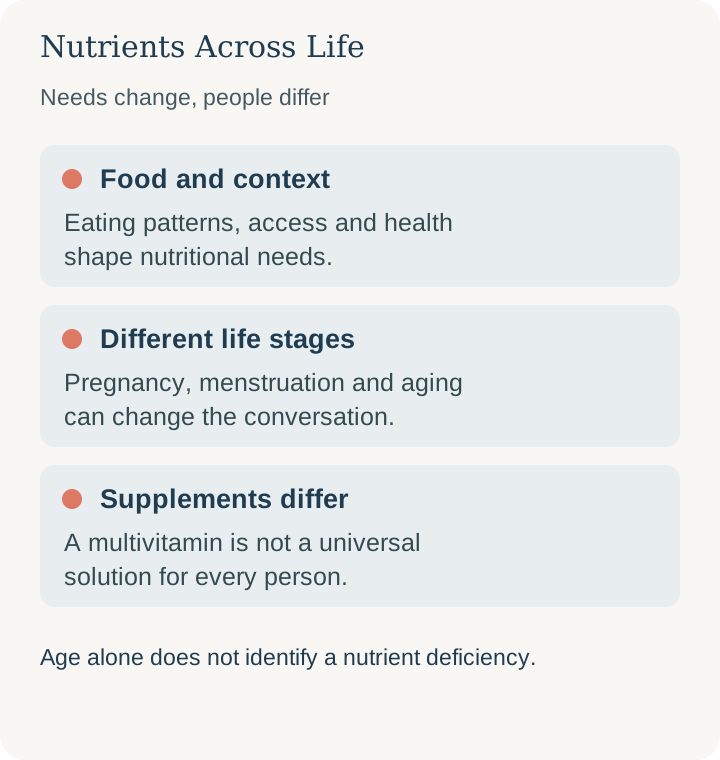
A birthday can trigger a surprising amount of supplement marketing. One bottle is for women in their twenties, another promises support after fifty, and a third bundles almost every nutrient into a daily routine. A label’s age range is less informative than understanding which needs actually change.
Nutrition across adulthood depends on food choices, menstruation, pregnancy, medical conditions, medicines, and absorption as well as age. This overview uses U.S. nutrient reference amounts to explain several common transitions. Those amounts describe total intake from relevant food and supplement sources, not a shopping list of pills.
Start with the question a supplement would answer
Before comparing bottles, the useful question is whether there is an identified gap. A person eating a limited selection of foods may have a different concern from someone with an absorption problem, heavy menstrual bleeding, or a pregnancy-related need. Similar ages do not guarantee similar diets or medical histories.
The National Institute on Aging explains that supplements can provide missing nutrients, but excess amounts and interactions can be harmful. “Natural” does not establish safety. A review of foods, fortified products, medicines, and existing supplements can make the discussion more useful.
This is also why a general vitamin article cannot diagnose tiredness, hair changes, or other symptoms. Symptoms can have several explanations. A targeted assessment may answer a more useful question than choosing the bottle with the longest ingredient list.
Menstruating years: iron is part of the picture
According to NIH’s iron fact sheet, the recommended amount for adult women ages 19 to 50 is 18 milligrams daily, compared with 8 milligrams for adults age 51 and older. Iron is a mineral, even though discussions often bundle it under “vitamins.”
Those age categories are reference groups. Someone with ongoing periods after fifty, heavy bleeding, or a condition affecting iron status may need a more individual assessment. A lower reference amount after fifty should not be treated as a diagnosis that an existing deficiency has disappeared.
Food sources include meat, seafood, beans, lentils, and iron-fortified cereals. Vitamin C in foods such as peppers or citrus helps the body absorb plant-source iron. A lentil dish with tomatoes or a bean meal with peppers illustrates that pairing without requiring a special product.
High-dose iron is not a universal energy remedy. NIH notes that excess supplemental iron can cause harm, and iron products need secure storage away from children.
Pregnancy potential and pregnancy have distinct folate guidance
NIH’s folate guidance lists 400 micrograms of dietary folate equivalents, or DFE, for adults, rising to 600 during pregnancy and 500 while breastfeeding. DFE accounts for differences in absorption between food folate and folic acid.
NIH separately recommends 400 micrograms of folic acid daily from supplements, fortified foods, or both for people who could become pregnant, in addition to folate in a healthy eating pattern. This prevention guidance is different from saying every adult needs an all-purpose supplement.
The numbers use different units and purposes, so simply adding them together can be misleading. A prenatal-care discussion can clarify a label, individual history, and whether another recommendation applies. Pregnancy also changes needs beyond folate, making a single-nutrient checklist incomplete.
Midlife: calcium and vitamin D have different age thresholds
The NIH calcium reference amounts are 1,000 milligrams daily for adults ages 19 to 50 and 1,200 for women ages 51 to 70. Adults over seventy also have a 1,200-milligram recommendation. These are total daily amounts, not automatic supplement doses.
Calcium foods include dairy, canned fish with edible bones, and some fortified beverages or calcium-set tofu. Fortification is not uniform. Two plant beverages that look similar may contribute different amounts, so their labels answer a more useful question than the front-of-package name.
Vitamin D guidance follows another schedule: 600 international units daily for adults through age seventy, including pregnancy and breastfeeding, and 800 after seventy. Vitamin D helps calcium absorption. Neither nutrient’s role means that increasing intake indefinitely produces stronger bones.
Later life and plant-based eating: consider B12 access
The NIH B12 fact sheet lists 2.4 micrograms daily for adults. That adult amount does not rise just because someone turns fifty. However, some older adults have difficulty absorbing the B12 naturally present in food.
B12 occurs naturally in animal foods, including fish, eggs, dairy, and meat. Plant foods are not reliable natural sources. Fortified nutritional yeast or breakfast cereal can contribute B12 when the label confirms it is added. A vegan eating pattern therefore needs a reliable fortified-food or supplement strategy.
The practical distinction is between how much a person needs and how that person obtains and absorbs it. Medicines and digestive conditions can also affect the conversation. An individualized plan may involve testing or a particular form of treatment rather than simply choosing an age-branded multivitamin.
Turn life-stage information into a useful food conversation
A simple meal review can be more revealing than a cupboard inventory. Where does iron come from? Is there a regular calcium source? Does a plant-based pattern include dependable B12? Which foods are fortified, and how often are they actually eaten?
For example, one person may already use a fortified cereal and fortified soy beverage each morning. Another may avoid both dairy and fortified alternatives. Their supplement needs cannot be inferred from sharing the same birthday decade.
Bringing current labels and a realistic description of meals to a clinician or registered dietitian makes the discussion concrete. The aim is to understand a relevant gap, an evidence-based prevention need, or an absorption issue. A growing collection of bottles is not itself a measure of better nutrition.
About this article
This original GHAC article was inspired by WebMD’s vitamins-for-women topic, used as topic inspiration.
Information here is educational and does not replace personalized medical advice.
Frequently asked questions
Does every woman need a daily multivitamin?
There is no single answer based only on gender or age. Diet, life stage, specific prevention guidance, medical history, and identified gaps matter.
Do calcium recommendations mean taking that amount in tablets?
No. The reference amount is for total daily intake. Food and fortified beverages may provide some or all of it; an individual review can identify any gap.
Do vitamin D and B12 needs increase at fifty?
The adult B12 reference amount remains 2.4 micrograms, although absorption may become an issue. The vitamin D recommendation rises after seventy, not automatically at fifty.
Give the nutrition review a clear purpose
A few days of typical meals and current supplement labels can support a focused discussion of intake, life stage, and absorption. The useful outcome is a plan that addresses a real need.

FEATURED NUTRITION DESIGN
Wear a message that matters to you.
Health Matters Nutritious Fruit Basket Unisex Soft Style T-Shirt
Explore this designFind more designs that speak to you. Browse all Nutrition designs →
More everyday wellbeing reading

Probiotic Foods: What Live-Culture Labels Really Mean
Understand fermented foods, probiotic strains, and supplement labels without assuming every cultured food offers the same benefit.
Read article →
Foods for Circulation: A Heart-Healthy Pattern, Not a Quick Fix
Explore what food can support in cardiovascular health, why no ingredient clears a clot, and how to compare everyday meal options.
Read article →