
HEALTH JOURNAL
Probiotic Foods: What Live-Culture Labels Really Mean
Understand fermented foods, probiotic strains, and supplement labels without assuming every cultured food offers the same benefit.

A yogurt carton, a jar of pickles, and a probiotic capsule can all appear in a conversation about gut health. They are different products with different jobs. Sorting out the language makes shopping easier without turning an ordinary meal into a treatment plan.
This guide focuses on foods, labels, and the questions behind a benefit claim. It does not rank brands or identify a universal best probiotic. Enjoying a fermented food and choosing a product for a particular medical purpose are separate decisions.
Start with three different terms
NCCIH distinguishes probiotics from prebiotics: probiotics are live microorganisms intended to offer a health benefit, while prebiotics are food components used by desirable microorganisms. Products combining the two are called synbiotics. These terms describe different things, even when they appear together on a package.
A fictional snack bar might advertise prebiotic fiber, while a refrigerated drink advertises live cultures. Neither label answers the whole question of whether that particular product has demonstrated a useful benefit. Reading the name is the beginning of a comparison, not its conclusion.
It can help to finish the sentence: “I am choosing this because…” Enjoyment, convenience, and a specific symptom are different answers. They call for different information, and none requires buying every product in the gut-health aisle.
Separate fermentation from a proven probiotic benefit
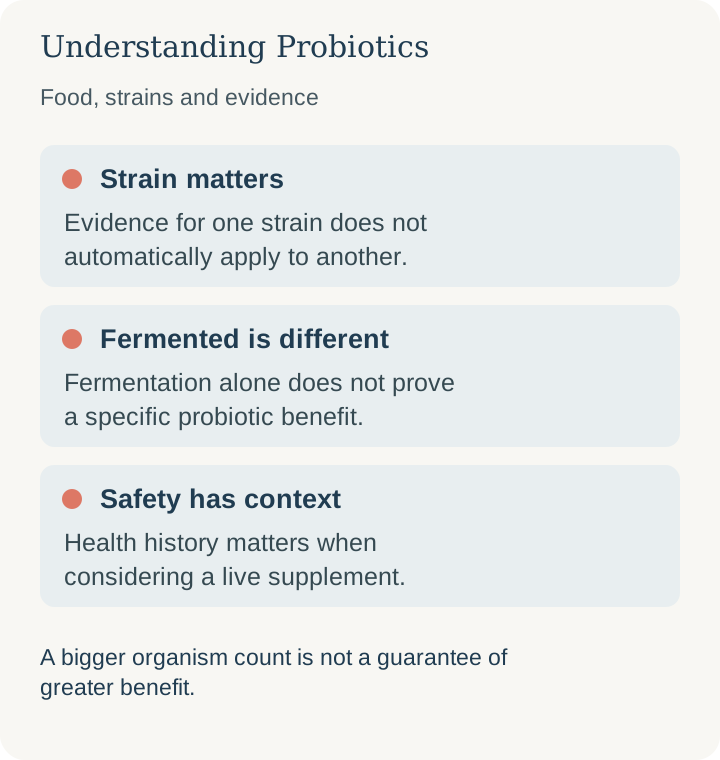
NIH’s detailed probiotic fact sheet explains that fermented foods may contain live cultures without containing microorganisms with a demonstrated probiotic benefit. Processing matters too: sourdough bread and many commercial pickles do not contain live cultures when eaten.
That distinction does not make bread or pickles disappointing foods. It means the reason to enjoy them need not be a promised change in gut bacteria. A label can accurately describe fermentation without establishing an effect on a particular illness.
For a refrigerated yogurt or kefir, the packaging may describe its cultures and storage needs. For a shelf-stable fermented food, the processing may be different. A familiar category name cannot replace the information on the actual container.
Read the organism name, not just the front of the carton
NIH’s consumer guide describes probiotic names as a genus, species, and strain. A strain identifier can look like letters and numbers after the organism name. Evidence about one strain does not automatically apply to another product bearing a similar broad name.
Imagine two products that both say “digestive support.” One provides a full strain name; the other offers only a blend name. The first makes a research question easier to ask. It still needs evidence for the claimed benefit, but at least the product can be identified.
A useful question is: Was this exact strain, in this kind of product, studied for the outcome being advertised? That question is more informative than whether the packaging looks scientific or the brand has enthusiastic reviews.
Put large numbers into context
CFU stands for colony-forming units, a measure of viable microorganisms. NIH notes that higher CFU counts do not necessarily mean greater benefit. Counts can fall over time, so whether a label describes manufacture or the use-by date also matters.
A comparison sheet could contain four short entries: organism, amount, storage, and date. A product that needs refrigeration also needs to fit the journey home and your storage space. Paying extra for a larger printed number does not resolve those practical details.
When information is missing, that is a reason to ask a clearer question. It is not proof of harm, and it is not evidence of effectiveness either. A label should help you understand the product rather than require guesswork.
Make room for ordinary meals
Food examples can stay simple: yogurt beside fruit, a spoonful of a fermented condiment with a meal, or a cultured option you already enjoy. These are serving ideas, not probiotic doses. There is no need to construct an elaborate daily lineup.
Compare the complete product as well as the culture claim. Cost per serving, added ingredients, allergens, flavor, and whether you actually want to eat it all influence its usefulness in your household. A food that repeatedly goes uneaten is not a practical bargain.
People whose cultural foods include fermentation do not need to replace those traditions with fashionable products. People who dislike fermented foods do not need to force them into every meal to demonstrate that they care about digestion.
Keep treatment decisions separate
NCCIH’s evidence overview emphasizes that benefits vary by organism and condition, with important uncertainties remaining. Research about one digestive problem cannot be assumed to establish a treatment for another.
NIH’s safety discussion notes that gas can occur and that serious illness or a weakened immune system can change the risk. There is no blanket recommendation that all healthy people take probiotics.
For a symptom-related discussion, the product label and the symptom you hope to address give a clinician or pharmacist something concrete to evaluate. The most useful outcome may be a clearer understanding of the problem rather than another product on the shopping list.
About this article
This original GHAC article was inspired by WebMD’s probiotics slideshow, used as topic inspiration only.
Information here is educational and does not replace personalized medical advice.
Frequently asked questions
Are all fermented foods probiotics?
No. Fermentation does not establish that a food contains live microorganisms with a demonstrated health benefit. Processing and the specific cultures matter.
Does a higher CFU count mean a better product?
No. The strain, intended benefit, amount studied, and product handling matter more than ranking products by the biggest number.
Do healthy adults need a probiotic supplement?
NIH describes no official recommendation covering probiotic use by all healthy people. A specific medical goal calls for an individual discussion.
A clearer question for the label
A useful comparison starts with what the product contains, what benefit has actually been studied, and whether the food or product fits your needs.

FEATURED NUTRITION DESIGN
Wear a message that matters to you.
Health Matters Nutritious Fruit Basket Unisex Soft Style T-Shirt
Explore this designFind more designs that speak to you. Browse all Nutrition designs →
More everyday wellbeing reading

Women’s Vitamins and Minerals: What Changes With Life Stage?
A food-first look at iron, folate, calcium, vitamin D, and B12 across adulthood, pregnancy, menopause, and later life, without a one-size-fits-all supplement list.
Read article →
Foods for Circulation: A Heart-Healthy Pattern, Not a Quick Fix
Explore what food can support in cardiovascular health, why no ingredient clears a clot, and how to compare everyday meal options.
Read article →