
HEALTH JOURNAL
Green Tea vs. Black Tea: Beyond the Antioxidant Contest
Compare green and black tea through preparation, caffeine, evidence limits, and everyday preferences, without turning either cup into a cure.

A cup of tea can be a comforting ritual before it becomes a health debate. Green tea is often presented as the antioxidant champion, while black tea is treated as the ordinary alternative. That framing asks a cup of tea to do more than the evidence can reliably promise.
A more useful comparison includes what you enjoy, how you prepare it, how caffeine affects you, and what a study actually measured. Neither color needs to win for tea to have a place in your day.
Begin with what the two teas share
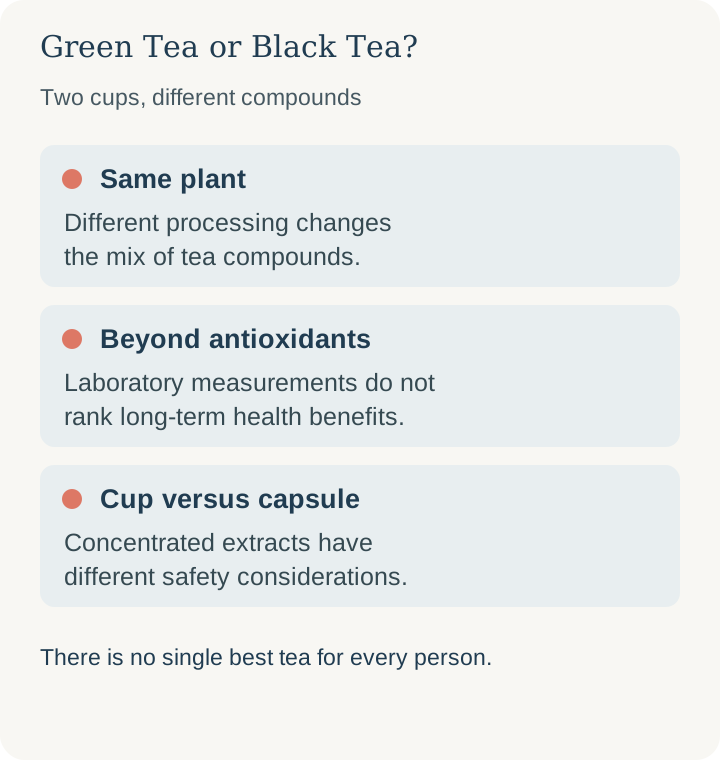
NCCIH explains that green, black, and oolong teas come from Camellia sinensis. Different processing methods produce different teas. Green tea is heated and dried with less oxidation, while black tea undergoes more extensive oxidation.
That common origin helps explain why the comparison is more nuanced than healthy versus unhealthy. Both are plant-derived drinks, and a tea’s name alone does not tell you everything about a finished cup.
A breakfast mug with milk, a small cup served alongside a meal, and a bottle of iced tea are also different experiences. Comparing them fairly means noticing the serving and preparation rather than treating every drink with the word tea as identical.
Ask what an antioxidant comparison can establish
“Higher in antioxidants” may refer to a chemical test, a particular compound, or the contents of a concentrated sample. Before treating that as a health ranking, ask what was measured and whether the research actually compared outcomes in people drinking ordinary tea.
A result from a test tube cannot show how someone will feel after months of drinking a beverage. Likewise, finding a compound in a leaf does not establish how much reaches the body from a particular brew. Those are additional questions requiring additional evidence.
This does not mean antioxidant research is useless. It means the distance between a measurement and a health promise needs to stay visible. A thoughtful comparison can describe differences without declaring a universal winner.
Separate promising research from a promise for your cup
NCCIH’s green-tea overview describes uncertainty for many promoted uses. Cancer-study findings have been inconsistent, and studies of cholesterol often tested extracts rather than the beverage. Those findings do not establish that green tea is a substitute for treatment.
Observational research can also compare people who already drink different amounts of tea. Such groups may differ in meals, smoking, income, and other habits. An association is useful for generating questions, but by itself it cannot establish that tea caused the difference.
For a headline that declares one tea superior, a useful follow-up is: superior for which outcome, in which people, and in what form? If those details are absent, the ranking is less informative than it first appears.
Make caffeine part of the comparison
The FDA’s caffeine guide lists typical amounts of about 37 milligrams for green tea and 71 milligrams for black tea per 12 fluid ounces, while emphasizing that products vary. These are reference examples, not fixed amounts for every cup.
A large travel mug and a small teacup should not be counted as equivalent servings. Preparation and the product matter too. Packaging information, when available, can be more useful than assuming every green tea is lower in caffeine than every black tea.
The FDA also notes that sensitivity varies and that decaffeinated drinks still contain some caffeine. Someone who enjoys tea late in the day may care more about sleep comfort than an antioxidant ranking. Pregnancy, medicines, or health conditions can make an individual caffeine discussion relevant.
Compare everyday versions of the drink
One person might enjoy plain green tea, another black tea with a little milk, and another an unsweetened iced version. Taste can help determine whether the drink is something you actually want. A healthy routine does not require selecting the cup you least enjoy.
For bottled tea, a label comparison can include bottle size, added sugar, and any caffeine information. A sweetened bottle sold as several servings deserves a different comparison from a small unsweetened brew. The front label does not describe the whole drink.
A simple tasting comparison could use the same cup size and the preparation directions on each package. Notes about bitterness, aroma, and whether you enjoy it plain may be more useful for your next purchase than a broad health score. This is a preference exercise, not an experiment proving a medical effect.
Keep tea extracts in a separate category
NCCIH distinguishes drinking green tea from taking concentrated extracts. Liver injury has been reported with some green-tea products, primarily extracts in tablets or capsules. Interactions with medicines are another consideration.
A supplement can deliver ingredients in a different form and amount from an ordinary drink. Evidence or reassurance about a brewed cup cannot simply be transferred to a concentrated product marketed for weight loss or metabolism.
For everyday tea, the useful choice can remain modest: a drink you enjoy, prepared in a way that fits your preferences and caffeine needs. There is room for both green and black tea without expecting either to compensate for the rest of a person’s meals or medical care.
About this article
This original GHAC article was inspired by Health’s green-tea and black-tea comparison, used as topic inspiration only.
Information here is educational and does not replace personalized medical advice.
Frequently asked questions
Is green tea always healthier than black tea?
There is no universal winner across health outcomes. Preparation, caffeine needs, product ingredients, and personal preferences all affect the comparison.
Does black tea always contain more caffeine?
FDA reference values are higher for black tea, but individual products and preparation vary. The tea color alone does not establish an exact amount.
Are green-tea capsules equivalent to drinking tea?
No. Concentrated extracts differ from ordinary brewed tea and can carry additional safety and interaction concerns.
Compare the cup you actually drink
The most useful comparison includes serving size, taste, caffeine, and additions. A favorite cup can stay an enjoyable part of the day without becoming a health competition.

FEATURED NUTRITION DESIGN
Wear a message that matters to you.
Health Matters Nutritious Fruit Basket Unisex Soft Style T-Shirt
Explore this designFind more designs that speak to you. Browse all Nutrition designs →
More everyday wellbeing reading

Women’s Vitamins and Minerals: What Changes With Life Stage?
A food-first look at iron, folate, calcium, vitamin D, and B12 across adulthood, pregnancy, menopause, and later life, without a one-size-fits-all supplement list.
Read article →
Probiotic Foods: What Live-Culture Labels Really Mean
Understand fermented foods, probiotic strains, and supplement labels without assuming every cultured food offers the same benefit.
Read article →