
HEALTH JOURNAL
Outdoor Exercise for Older Adults: Options, Comfort, and Safety
Explore outdoor walking, supported strength, balance practice, and gardening, with ways to adapt the setting, weather, and effort to your abilities.

An outdoor exercise plan can begin with something ordinary: a familiar path, a sturdy chair on a patio, or a community class in the park. Fresh air can make movement appealing, but being outdoors does not automatically make an activity suitable for every body or every day.
The most useful question is which combination of movement, setting, and support fits your current abilities. This guide explores options for older adults without assuming that age alone determines fitness. Someone recovering from a fall and someone who hikes regularly may need very different plans.
Start with an everyday goal
An exercise name is less informative than a goal. Perhaps you want to walk comfortably to a neighbor’s home, spend more time tending plants, or join family at a park. Those examples point toward different questions: how far is the route, where can you sit, and what makes the task difficult now?
A useful planning note describes the activity you would enjoy, one barrier, and one possible adjustment. For example: I would like to visit the park, the hill is difficult, and the flatter entrance may be easier. This is a way of organizing choices, rather than a promise that a different entrance solves every health concern.
The CDC’s guide to adding activity includes working with a healthcare professional when chronic conditions affect activity. New symptoms, repeated falls, or uncertainty about a recent operation deserve a more individual conversation than an exercise article can provide.
Understand the different jobs movement can do
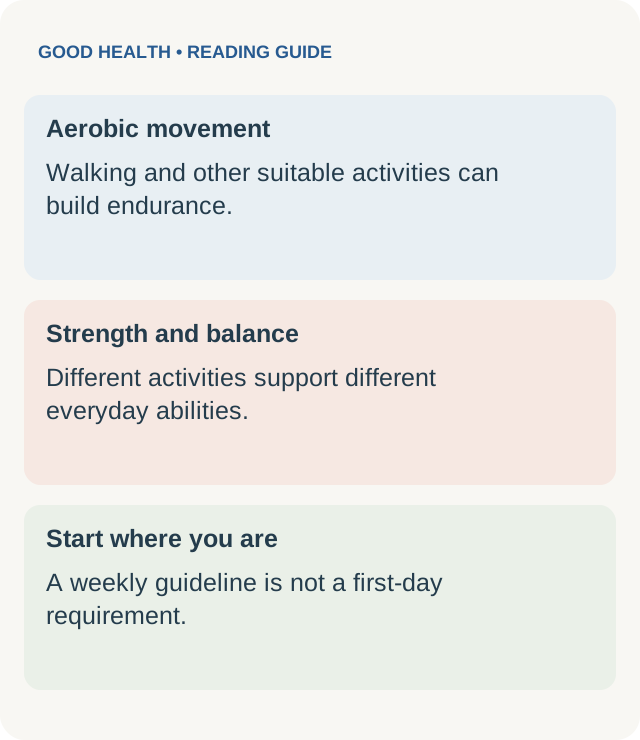
The CDC’s recommendations for adults 65 and older combine aerobic activity, muscle strengthening, and balance. The weekly aerobic target is at least 150 minutes at moderate intensity, or an equivalent combination with vigorous activity. Strength work belongs on at least two days. People unable to meet those targets can work within their abilities and conditions.
Those are population guidelines, not a starting assignment for every reader. Walking around a courtyard, practicing a supported movement, and joining a suitable class may each contribute something different. A long walk does not automatically train every muscle group or replace focused balance work.
For planning purposes, it may help to give your options three simple labels: moving for endurance, working against resistance, and practicing steadiness. The labels explain why variety matters without requiring a complicated tracking system or a perfect week.
Make walking routes easier to adapt
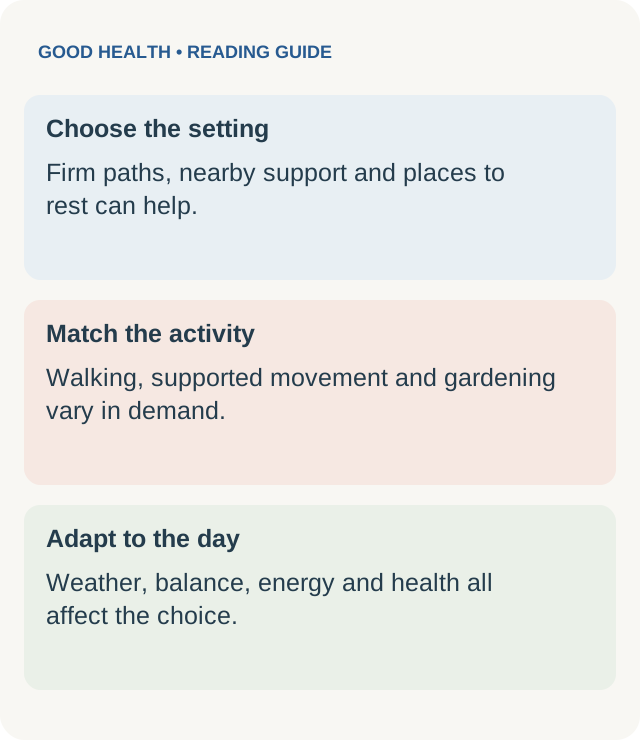
A flat, familiar route can be easier to adjust than a trail that carries you farther from home before you discover the difficult part. A loop near a building, or a short out-and-back route with a clear turning point, offers choices about distance. Availability of benches, accessible entrances, and restrooms can matter as much as scenery.
The National Institute on Aging’s outdoor safety guidance recommends watching for uneven surfaces, choosing routes with rest opportunities, carrying identification and a phone, and letting someone know your plans. Suitable footwear and daylight visibility also belong in the preparation.
Imagine two possible outings: a scenic path with loose gravel and no seating, and a paved route with several places to stop. The second may be the better fit for someone uncertain about endurance or footing. That comparison is about the day’s practical needs, rather than whether one route counts as real exercise.
Use effort, rather than someone else’s speed
The CDC describes the talk test as one way to judge aerobic effort: at moderate intensity, people can generally talk but not sing. A vigorous effort makes speaking more than a few words difficult without pausing for breath. This is a guide to intensity, not a test to push through symptoms.
A neighbor’s brisk pace may be an uncomfortable effort for you, while your usual pace may feel easy for them. Describing how the walk feels can be more useful than comparing minutes per mile. A companion who is willing to match your pace may make the outing more enjoyable.
One practical agreement is to decide in advance that either person can request a pause or turn back. That removes the pressure to keep up merely because the other person looks comfortable. If breathlessness is new, unusual, or disproportionate, it needs assessment rather than a faster training schedule.
Explore supported strength in a suitable space
The NHS strength-exercise guide includes sit-to-stand and wall push-ups. A stable chair without wheels, placed on a firm nonslip surface, offers a different setup from a loose garden chair on grass. For sit-to-stand, the example involves rising with control and returning slowly. A higher seat or hand support may be appropriate adaptations.
An outdoor location should meet the same basic needs as an indoor one. A chair that sinks into soil, a damp patio, or a wall with poor hand placement changes the exercise. Moving indoors is a reasonable solution when the setup is unreliable.
These examples introduce options, rather than provide a complete strength program. A physical therapist or qualified instructor can help select movements, resistance, and support, particularly with joint pain, osteoporosis, recent surgery, or difficulty getting up from a chair. The useful goal is a repeatable movement you understand.
Keep balance practice close to dependable support
The NHS balance guide demonstrates controlled movements such as sideways walking and heel-to-toe walking, with support where needed. An outdoor class with an instructor may offer a more appropriate setting than trying an unfamiliar balance challenge alone beside a curb.
A sturdy fixed support and a level surface are different from a lightweight fence or a chair that can tip. Someone who needs supervision indoors still needs it outside. Closing the eyes, standing on unstable surfaces, or removing a usual walking aid does not become a necessary progression simply because a video suggests it.
It may help to describe a specific concern to a professional: turning feels unsteady, stepping over a threshold is difficult, or looking around while walking changes your balance. That detail gives the discussion a practical focus. Repeated falls or a new change in steadiness warrant assessment rather than a harder self-test.
Consider gardening and everyday outdoor tasks
For someone who dislikes formal workouts, an outdoor task can make movement feel purposeful. Watering plants, tending a raised bed, or gathering lightweight garden tools creates a reason to change position and spend time moving. The demands vary considerably, however. Carrying a heavy bag of soil and trimming a pot of herbs are not interchangeable activities.
An adaptable setup might place frequently used items within easy reach, divide a project into smaller tasks, or provide a stable seat. Those are practical examples of reducing barriers, not a treatment for a medical condition. Kneeling, lifting, gripping, and reaching each have their own demands.
It is useful to ask what the task leaves out as well as what it includes. Enjoying gardening does not establish that you have covered every strength or balance need. The outdoor activity can be one part of a varied routine without having to become the entire routine.
Make heat a separate planning decision
The CDC explains that older adults are more vulnerable to heat-related illness because temperature regulation, chronic conditions, and some medicines can change risk. A day that feels tolerable to a younger companion may still require a different plan for you.
The decision is broader than remembering a bottle of water. An indoor walk, a shorter outing, or a different time of day may be more workable. People with fluid restrictions need individual advice about hydration rather than a universal instruction to drink a particular amount.
Dizziness, unusual weakness, nausea, or headache during heat deserve attention, rather than being treated as proof of a productive workout. Confusion, collapse, or suspected heatstroke is an emergency requiring 911. A plan that includes who to contact and where to cool down is more useful than relying on willpower to finish a route.
Check air quality, not just the temperature
AirNow’s information for older adults explains why air pollution deserves attention, especially with heart or lung conditions. Local air-quality reports provide information that a glance at the sky cannot reliably supply. A comfortable temperature does not guarantee that outdoor air is a good choice for a longer or harder outing.
An example of flexible planning is keeping the same social appointment but changing the setting: meeting a friend in an indoor walking space when local advice recommends limiting outdoor exertion. Another is postponing a more demanding task rather than trying to squeeze it in before conditions change.
The appropriate response depends on the pollutant, local advice, symptoms, and individual health needs. Someone with an asthma or other respiratory action plan can use that plan alongside local information. An exercise article cannot supply a single air-quality cutoff that safely covers every reader and every condition.
Allow cold, rain, and daylight to change the plan
The attractive route in mild weather may become a different proposition when leaves are wet, sidewalks are icy, or darkness arrives earlier. Seasonal changes affect footing, visibility, and the availability of places to rest. Keeping a familiar indoor option makes the decision less of an all-or-nothing choice.
A practical comparison can focus on the whole trip: getting from the front door to the car, crossing the parking area, reaching the path, and returning home. The exercise itself may be manageable while one of those transitions is not. A class in a warm building can still involve an icy walk from the parking lot.
It can help to identify alternatives before the difficult day arrives. That might mean a supported routine at home, an accessible indoor venue, or a different day with a companion. Changing location is a way to continue making thoughtful choices about movement.
Build a routine around options, not a rigid streak
A useful weekly outline can contain a preferred option, a shorter version, and an indoor alternative. For example, the preferred outing may be a park walk with a friend; the shorter version may be a nearby loop; the alternative may be an indoor walk followed by an already familiar supported exercise. These are organizational examples, not prescribed sessions.
Afterward, a brief note can capture what worked: the path felt level, the bench was available, or the return trip was harder than expected. That information helps you choose the next outing more realistically. It also offers useful detail if you are working with a clinician or instructor.
Progress need not mean adding distance every time. Finding a dependable place to move, asking for needed support, or choosing a more comfortable schedule can make the routine more sustainable. The important comparison is whether the plan continues to fit your circumstances.
Know when an outing needs to stop
Chest pain, fainting, severe or unusual breathlessness, or sudden neurological symptoms are not exercise goals to work through. Possible heart attack or stroke symptoms require emergency care and a call to 911. Persistent pain, a new balance problem, or recurrent dizziness deserves a healthcare discussion before repeating the same challenge.
For an ordinary planning conversation, specific observations are helpful: the symptom appeared on a hill, it began after a recent medication change, or it happened twice while turning. Avoid assuming that age alone explains a new limitation. A professional can consider the pattern alongside your history.
Outdoor exercise can offer enjoyment, variety, and connection. It works best as a set of adaptable choices, with room for rest, companionship, assistance, and a different setting. A plan that respects those details is easier to return to than one built around proving what you can tolerate.
About this article
This original GHAC article was inspired by WebMD’s outdoor exercise topic, used as topic inspiration.
Information here is educational and does not replace personalized medical advice.
Frequently asked questions
Is walking enough exercise for an older adult?
Walking can contribute aerobic activity. General guidance also includes muscle strengthening and balance activity, adapted to abilities and health conditions.
Are outdoor balance exercises safe for everyone?
No activity is safe for every person or setting. Recent falls, new unsteadiness, and the need for support or supervision should shape the choice of exercise and location.
Does gardening count as exercise?
Gardening involves movement, but its intensity and demands vary. Light potting, digging, lifting, and carrying do not provide identical exercise, and gardening does not automatically cover every activity recommendation.
Should I exercise outside when the weather is very hot?
Older adults have increased heat-related risk. Local heat advice, medical conditions, medicines, and access to cooling matter. An indoor alternative may be more appropriate.
Choose a setting that makes movement easier
A familiar route, dependable support, and a realistic alternative can make outdoor activity more approachable. Questions about symptoms, falls, or restrictions are best brought to a healthcare professional who knows your circumstances.
More everyday wellbeing reading

Breakfast Ideas for Diabetes: Build a Meal That Fits Your Morning
Explore adaptable diabetes breakfast ideas, carbohydrate labels, convenient options, and questions that help a morning meal fit your individual care plan.
Read article →
Cholesterol Supplements: What the Evidence Can and Cannot Promise
Understand cholesterol supplement claims, plant sterols, psyllium, red yeast rice, and niacin, with practical questions about benefits, medicines, and safety.
Read article →