
HEALTH JOURNAL
Cholesterol Supplements: What the Evidence Can and Cannot Promise
Understand cholesterol supplement claims, plant sterols, psyllium, red yeast rice, and niacin, with practical questions about benefits, medicines, and safety.

A supplement bottle can make cholesterol management look like a straightforward shopping decision. Words such as natural and clinically studied suggest a clear route from buying a product to protecting the heart. The evidence is usually more specific: a particular ingredient, amount, preparation, group of participants, and measured outcome.
This guide explains how to read that evidence without turning it into a recommendation to start a product. It focuses on common categories and the questions behind their claims. A supplement is not a substitute for prescribed cholesterol treatment, and a lower laboratory number does not tell the whole story about long-term cardiovascular health.
Start with the outcome behind the promise
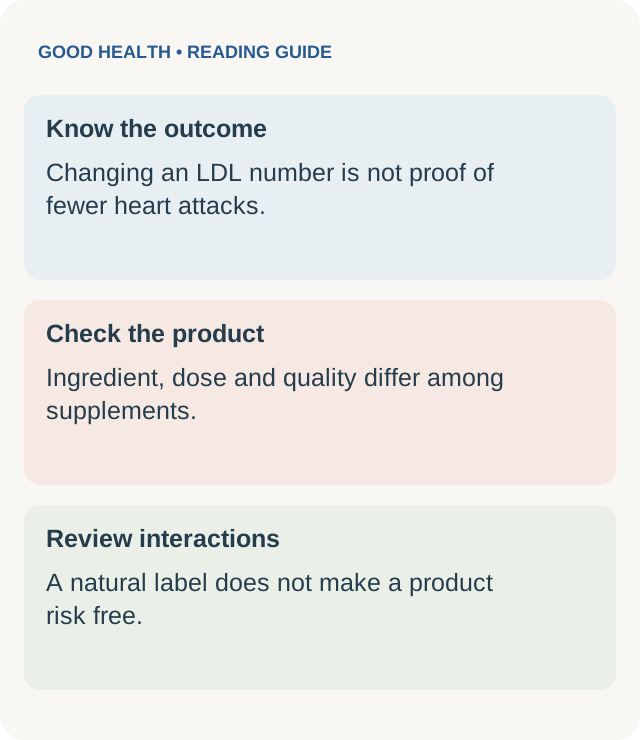
A cholesterol claim may concern LDL cholesterol, HDL cholesterol, triglycerides, or a combination of measurements. These are not interchangeable targets. A study showing an effect on one measurement does not establish an equal effect on another, and a product promoted for heart health may not clearly identify which result it is promising.
The next distinction is between a laboratory change and a health outcome. A trial can measure cholesterol after a relatively short period. Showing whether a treatment reduces heart attacks, strokes, or deaths requires a different kind of evidence. A headline that jumps between those questions can make a modest result sound much more decisive.
When comparing claims, a useful sentence is: This exact preparation was studied in these people for this length of time and changed this outcome. Missing pieces do not automatically mean a product is ineffective. They mean there is less information available to support the conclusion being offered.
Keep the established care plan in view
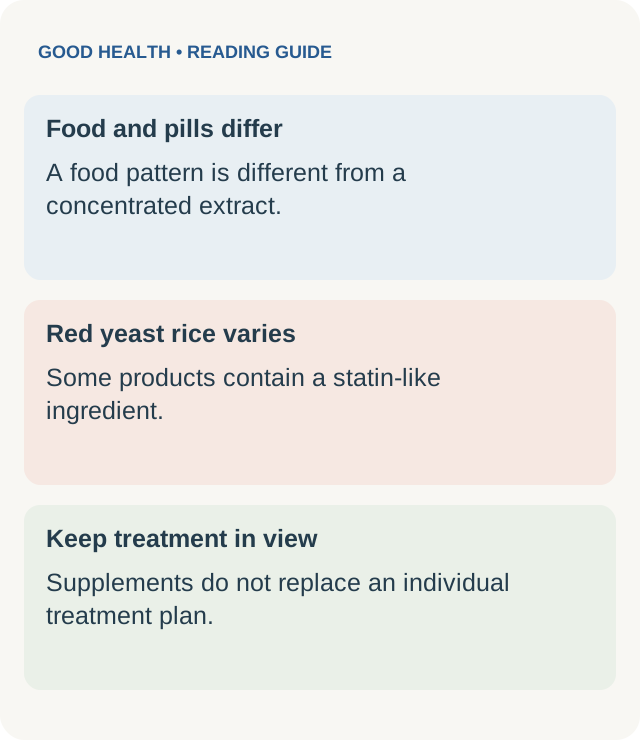
NHLBI’s Therapeutic Lifestyle Changes program places cholesterol within an ongoing plan that includes food, physical activity, and individual goals followed with a healthcare professional. Its dietary framework includes soluble fiber and plant sterols or stanols. A bottle cannot show whether an individual’s overall risk has been adequately addressed.
That larger picture also prevents a false choice between food and medicine. Someone may eat thoughtfully and still need prescribed treatment. Family history, existing cardiovascular disease, and other conditions can matter. Needing a medicine is not evidence that a person has failed to choose the right breakfast or supplement.
For readers who want the basic terminology first, our guide to cholesterol numbers explains the measurements. The question here is narrower: what additional evidence and safety information would justify considering a particular nonprescription product?
Plant sterols and stanols: pay attention to the form
NCCIH’s cholesterol evidence overview describes LDL-lowering evidence for plant sterols and stanols, including fortified foods and supplements. The supplement evidence is less extensive than the food evidence. That is a reason to identify the actual preparation rather than treating every product bearing the ingredient name as equivalent.
A spread, fortified drink, capsule, and multi-ingredient blend are different shopping decisions. Serving directions, added ingredients, storage, and cost can change how a product fits daily life. A person who rarely uses the suggested food may find the advertised serving impractical even before considering the evidence.
An illustrative comparison could put two labels beside each other and record the named ingredient, amount per serving, and number of servings the directions describe. This is a way to prepare a question for a clinician or pharmacist, not an instruction to combine products until a target from an advertisement is reached.
Soluble fiber and psyllium: useful context matters
Soluble fiber occurs in familiar foods, including oats and beans. MedlinePlus explains that psyllium may also be prescribed for high cholesterol, although it is commonly sold as a bulk-forming laxative. The reason for use, formulation, and directions matter when discussing a product that can appear in more than one aisle.
MedlinePlus describes important fluid instructions and precautions, including swallowing problems and potential medicine interactions. A powder should not be treated as something to swallow dry. A pharmacist can explain the product’s own directions and whether spacing from a particular medicine is needed. There is no single spacing rule that answers every combination.
For a practical discussion, the useful details are the full label, your medicines, and any difficulty swallowing or following fluid instructions. Someone under a fluid restriction needs individual guidance. A generic recommendation to drink more with every dose may conflict with another part of that person’s care.
Red yeast rice: the active ingredient changes the question
NCCIH’s red yeast rice guide explains that monacolin K is chemically identical to lovastatin, a prescription statin. Products can contain very different amounts, and the amount is generally not clear from labels. That makes a claim that this is simply a gentle food-based alternative misleading.
NCCIH also describes statin-like side effects and interactions, as well as possible contamination with citrinin, which can harm the kidneys. Products with added or enhanced lovastatin cannot legally be marketed as dietary supplements in the United States. A natural-looking label does not resolve the medicine or quality questions.
For someone who had symptoms while taking a prescribed statin, switching independently to red yeast rice does not establish a safer solution. The useful conversation is about what happened, which treatment was used, and what alternatives or adjustments can be evaluated. A clinician can address the reason for a change instead of leaving the person to guess at an unlabeled exposure.
Niacin: a vitamin name can obscure a treatment dose
NIH’s niacin fact sheet distinguishes ordinary nutritional needs from high-dose nicotinic acid used in medical care. Although high doses can change lipid levels, studies have not shown additional cardiovascular benefit when added to statins for people with cardiovascular disease, and important adverse effects can occur.
The word vitamin can make this distinction easy to miss. A nutrient needed in everyday food is not automatically safe in the much larger amounts used to influence a laboratory result. Forms of niacin also differ, so two bottles with similar wording may not describe the same product or purpose.
An existing multivitamin, a B-complex product, and a separate niacin bottle can create an incomplete picture if only one is mentioned at an appointment. Bringing the whole list helps the clinician or pharmacist see overlapping ingredients. No one needs to remember every technical name to make that conversation worthwhile.
Garlic, soy, and flaxseed do not form a single category
NCCIH’s cholesterol review describes small or preparation-dependent effects for several products. Garlic supplements may have a modest effect, soy foods differ from isolated isoflavones, and flaxseed findings depend on the preparation. The broad phrase plant-based supplement does not establish a shared result across these ingredients.
A food can also have a place in a meal for reasons other than a cholesterol claim. Tofu can be dinner, ground flaxseed can be an ingredient someone enjoys, and garlic can season a dish. The amount used in ordinary cooking does not establish the effect of a concentrated product used in a trial.
It is useful to decide which question you are asking. Do you want another enjoyable food option, a more convenient source of a nutrient, or treatment for an elevated measurement? Those goals can overlap, but they require different evidence. A recipe suggestion cannot answer the same question as a treatment study.
Read a study claim before comparing the price
An advertisement may say clinically tested without saying whether it means the complete product or only one ingredient. It may cite a study using another dose or a preparation manufactured differently. Finding those distinctions is more useful than counting the number of scientific-looking references printed beneath a testimonial.
A simple reading framework has four parts: who participated, what they received, what the comparison group received, and what actually changed. A study without a comparison group leaves different uncertainties from a randomized trial. Even a well-designed trial can be too short to answer questions about long-term benefit or uncommon harms.
Absolute changes can be easier to interpret than a dramatic percentage by itself. It also matters whether the result describes an average or every participant. A group average cannot promise an identical response for the next person who buys the product. If the advertisement will not identify its study, uncertainty remains part of the purchasing decision.
Make the product list complete
A supplement review is easier when the list includes prescription medicines, nonprescription products, vitamins, herbal preparations, and blends. A photo of both sides of each bottle can be useful. The front label provides the marketing name; the back label may identify ingredients, amounts, warnings, and directions that matter to the discussion.
For a blend, an advertised total amount may not reveal how much of each ingredient it contains. Buying several products also makes it harder to identify which one caused a new symptom or changed a measurement. A plan should make the products and follow-up understandable, rather than creating an expanding collection with no clear purpose.
Budget belongs in the conversation too. The relevant comparison is the recurring cost at the labeled serving pattern, not just the price per bottle. A less expensive option is not a bargain if it replaces a treatment that was helping or leaves important safety questions unanswered. Conversely, an expensive label does not prove stronger evidence.
Separate quality information from proof of benefit
A product quality check and a clinical effectiveness study answer different questions. Knowing whether a product contains a stated ingredient is useful. It does not, by itself, show that the ingredient prevents cardiovascular disease or is appropriate for someone with a particular medication list.
The same distinction applies to customer reviews. A person may sincerely like a product, its packaging, or how easy it is to take. Their experience cannot establish what caused a change in cholesterol, especially if food, medicines, or other circumstances changed at the same time. Testimonials can describe an experience without proving a treatment effect.
When the claim is unclear, a short question can help: What independent evidence supports this exact use? A helpful answer should make the outcome and limitations easier to understand. Pressure to buy immediately is not a substitute for that explanation, whether the product is sold in a store or through an appealing online story.
Plan the follow-up before adding another product
If a product is being considered with your healthcare team, it helps to understand the intended goal and how the result would be assessed. Otherwise a supplement can become a permanent expense without anyone knowing whether it is doing what was expected. Follow-up also creates a place to review tolerability and interactions.
Useful questions include whether the proposed product adds anything meaningful to the current plan, whether another condition changes its safety, and what would prompt reconsideration. These are questions for an individual discussion, not a universal testing schedule or recommendation to start a trial on your own.
The decision may be to use a product, choose a food-based option, adjust established care, or leave the plan unchanged. Each can be a reasonable outcome of a careful discussion. The value lies in understanding the expected benefit and the limits, rather than feeling that a thoughtful approach must end with another purchase.
A simple written record can identify the product under discussion, the reason for considering it, and the professional who is reviewing it. That makes a later appointment easier, especially when several people help manage medicines. The record is a communication aid, rather than evidence that the product works or a substitute for the agreed care plan.
About this article
This original GHAC article was inspired by WebMD’s cholesterol supplements slideshow, used as topic inspiration only.
Information here is educational and does not replace personalized medical advice.
Frequently asked questions
Can cholesterol supplements replace a prescribed statin?
They should not be used as a self-directed replacement. Expected benefit, cardiovascular risk, side effects, and alternatives need an individual discussion with the prescribing clinician.
Is red yeast rice safer because it is natural?
Natural does not establish safety. It can contain a substance identical to lovastatin in uncertain amounts and may carry statin-like risks or contaminants.
Does improving a cholesterol number prove fewer heart attacks?
Not by itself. A study measuring a lipid change and a study demonstrating fewer cardiovascular events answer different questions.
Are foods and capsules containing the same ingredient equivalent?
Not automatically. The preparation, amount, other ingredients, and evidence can differ. A shared ingredient name is a starting point for comparison.
Give the claim a specific question
A complete product label, a medicine list, and the benefit you hope to understand can turn a vague supplement discussion into a useful review with a clinician or pharmacist.

FEATURED NUTRITION DESIGN
Wear a message that matters to you.
Health Matters Nutritious Fruit Basket Unisex Soft Style T-Shirt
Explore this designFind more designs that speak to you. Browse all Nutrition designs →
More everyday wellbeing reading

Breakfast Ideas for Diabetes: Build a Meal That Fits Your Morning
Explore adaptable diabetes breakfast ideas, carbohydrate labels, convenient options, and questions that help a morning meal fit your individual care plan.
Read article →
Outdoor Exercise for Older Adults: Options, Comfort, and Safety
Explore outdoor walking, supported strength, balance practice, and gardening, with ways to adapt the setting, weather, and effort to your abilities.
Read article →