
HEALTH JOURNAL
Types of Pain: Understand the Terms, Describe Your Experience
Understand acute and chronic pain, tissue-related and nerve-related pain, and altered pain processing, with practical questions for your next appointment.

“Sharp,” “burning,” “constant,” and “comes and goes” all say something useful about pain. But they do not answer the same question. Some words describe the feeling, some describe timing, and medical terms may describe processes thought to contribute to the experience.
Understanding the differences can make a clinical conversation clearer. It does not let you diagnose yourself from a word list. Two people with similar symptoms may need different assessments, and a single person may have more than one pain condition at the same time.
First describe the timing
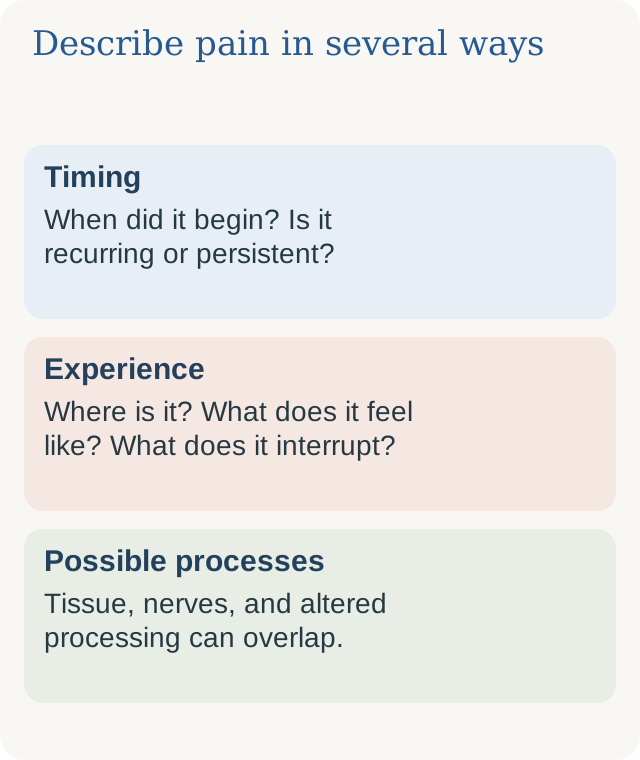
The National Institute of Neurological Disorders and Stroke distinguishes acute, episodic, and chronic patterns. Acute pain begins suddenly and often improves as an injury or other cause resolves. Episodic pain recurs. Chronic pain generally continues beyond three months or expected healing. These labels describe a pattern, not how serious it feels.
For your own notes, begin with dates and changes: when it first appeared, whether it is present every day, how long an episode lasts, and what is different now. “It began after a fall last week” and “it returns several times a month” tell different stories even if both experiences are described as aching.
Understand the three broad process descriptions
Nociceptive pain refers to pain associated with actual or threatened damage to non-nerve tissue. Neuropathic pain involves disease or damage affecting the somatosensory nervous system. Nociplastic pain describes altered pain processing when clear tissue damage or a nerve lesion does not adequately explain the pain. UCSF’s pain education resource explains these distinctions.
Think of these as concepts that help organize clinical reasoning. They are not three boxes a reader must sort themselves into. More than one process can contribute, and an assessment may leave some uncertainty. A clinician considers your history, examination, and any appropriate investigations together.
Avoid diagnosing a mechanism from one sensation
Burning or electric sensations can be relevant when discussing nerve-related pain, while aching can appear in many conditions. But a description alone does not establish what is happening. The European Pain Federation emphasizes that no single symptom, questionnaire, examination finding, or investigation can establish a pain mechanism.
The same resource describes these terms as mechanistic descriptors rather than diagnoses or stand-alone treatment instructions. That distinction prevents an easy mistake: reading a familiar symptom, choosing a category, and assuming a particular treatment must follow. Assessment still matters.
When you are unsure which word fits, ordinary language is enough. You can say that a sock brushing the skin hurts, that turning in bed wakes you, or that discomfort travels from one area to another. Specific examples can be more useful than trying to sound medically precise.
Keep the reality of pain separate from test results
An unclear cause does not make the experience less real. MedlinePlus notes that some chronic pain has no clear cause and can affect daily activity, sleep, mood, and relationships. A test result and a person’s experience supply different kinds of information.
Ask your clinician what a test can answer and what it cannot. If a result does not explain your symptoms, ask what happens next: a different assessment, follow-up, symptom management, or another professional’s input. You deserve an understandable plan even when there is no simple explanation.
Prepare a description that connects symptoms to life
Before an appointment, jot down the location, timing, sensation, and impact. You might write: “The discomfort starts after I stand at the sink, spreads toward my hip, and makes me stop preparing dinner.” This is an illustrative description, not a sign of one particular condition.
Add what you have tried, what happened afterward, and any medicines or supplements you use. Ask: What explanations are being considered? What changes should I watch for? What is the immediate plan, and when should we review it? You do not have to settle every possible mechanism before agreeing on a useful next step.
Seek prompt assessment for new or changing symptoms. Back pain with loss of bladder or bowel control, loss of feeling around the genitals, or weakness or numbness in both legs requires emergency evaluation. NHS back-pain guidance lists these warning signs. Call 911 in the United States when emergency help is needed.
For practical support after assessment, explore our daily chronic-pain planning guide. Our food and pain article explains why advice should remain specific to the condition.
Sources and further reading
This original GHAC article was inspired by WebMD’s pain-types topic, used as inspiration.
- NINDS: Pain: Timing patterns and broad pain processes.
- UCSF: Types of pain: Definitions and overlapping pain processes.
- European Pain Federation: Types of pain: Limits of mechanism labels and the importance of clinical assessment.
- MedlinePlus: Chronic pain: Pain without an identifiable cause and daily-life effects.
- NHS: Back pain: Emergency warning signs.
Information here is educational and does not replace personalized medical advice.
Frequently asked questions
Does chronic mean severe?
No. Chronic describes persistence or duration, rather than a specific intensity. Both acute and chronic pain can have a major effect on daily life.
Does burning pain prove nerve damage?
No. It is an important symptom to describe, but a sensation on its own does not establish the diagnosis or mechanism. A clinician considers the wider picture.
Can pain involve more than one process?
Yes. Tissue-related, nerve-related, and altered-processing contributions can overlap, and their relevance may change over time.
Does an unclear test result mean pain is imaginary?
No. Pain is a real experience. Ask what the result does and does not show and what the next assessment or management step will be.
Bring your own description
Write a few sentences about when the pain occurs, what it feels like, and one activity it disrupts. Bring those observations and your questions to a clinician rather than choosing a diagnosis from a list.
More everyday wellbeing reading

Food and Chronic Pain: What the Evidence Says
A practical look at food, inflammation, and chronic pain, with realistic expectations, simple meal ideas, and cautions about supplements.
Read article →
Living With Chronic Pain: Build a More Manageable Day
Practical ways to pace activities, discuss movement and sleep, prepare for appointments, and build support while living with chronic pain.
Read article →