
HEALTH JOURNAL
After-Dinner Habits for Long-Term Heart Health
Build an evening routine with manageable movement, satisfying food choices, sleep, and consistent care to support long-term heart health.

The time after dinner can feel like the only quiet stretch in a busy day. It can also be a useful place to build a small heart-supporting habit: a short walk, a more satisfying snack when you are hungry, a little preparation for tomorrow, or an earlier start to winding down. None needs to become an elaborate evening program.
These choices work through the patterns they help you repeat. They do not erase a meal or lower cholesterol overnight. If you are working on high cholesterol, think of your evening as one part of a larger plan that includes food, activity, sleep, blood tests, and any prescribed treatment. Start with the part that would make your real life easier.
Keep cholesterol and meal timing in perspective
Cholesterol is a substance your body needs, but high LDL cholesterol can increase the risk of heart disease and stroke. Its management depends on your overall risk and your longer-term pattern, not whether you perform a particular task immediately after the last bite of dinner. A single evening cannot tell you whether your LDL has improved.
The CDC’s cholesterol treatment guidance describes lifestyle changes, prescribed medicines, and follow-up testing as parts of care. That provides a more useful framework than looking for a nightly trick. Evening habits can make those parts easier to follow, but they do not replace an individual treatment plan or show what your next blood test will find.
Post-meal blood sugar and cholesterol also deserve separate conversations. Movement after a meal may affect the immediate glucose response, but that is not evidence that the same walk immediately lowers LDL. Our guide to walking after eating explores that different question. For this article, the aim is consistency: a little movement, useful food choices, and practical support for the next day.
Start with movement that feels manageable
The CDC recommends at least 150 minutes of moderate activity a week for adults, plus muscle-strengthening activity on at least two days. Activity can be spread through the week. That means an evening walk can contribute to a broader pattern, without requiring you to complete a long workout after dinner or wait until you have a perfect block of free time.
Begin with an amount that suits your current ability. A few minutes around your home, a short outdoor route, or another comfortable movement option may be a reasonable start. If you want your walk to count as moderate activity, the pace usually needs to feel more purposeful than a casual stroll. An easy stroll can still help you break up sitting and establish a routine.
Our walking after eating guide offers practical ways to begin. Pick a route with a safe surface, suitable lighting, and somewhere to turn back. Indoor walking can be useful in heat, cold, or poor air quality. If you have symptoms, mobility concerns, a new health problem, or activity restrictions, use guidance from your care team. Stop for chest pain, faintness, or unusual breathlessness and seek appropriate help.
Make an evening snack a choice, not a rule
You do not need to eat after dinner just because a food is described as heart healthy. If you are comfortably satisfied, there may be no need for a snack. If you are hungry, choose something you enjoy that helps meet that need. Fruit with plain yogurt, whole-grain toast, or a suitable portion of nuts are examples to consider, not compulsory combinations.
Look at patterns before judging a single evening. Perhaps dinner was too small, lunch was rushed, or a long shift changed your timing. A snack may be useful information about what your day needs. Trying to ignore hunger every night can make a routine harder to follow. Equally, eating directly from a large package while distracted can make it harder to notice whether you are enjoying the food.
For cholesterol-conscious choices, consider the saturated fat in foods you eat often. The American Heart Association explains the value of replacing saturated fats with unsaturated fats. You could sometimes choose fruit and nuts instead of a snack rich in butter or cream. That is a flexible swap, not a demand to give up every dessert. Food still needs to feel enjoyable and familiar.
Prepare one useful food for tomorrow
After dinner can be a convenient time to remove a small obstacle from tomorrow. Put oats where you will see them, pack a piece of fruit with lunch, or decide how you will use a can of beans. You do not have to cook a week of meals. Preparing one component can be enough to make the next meal easier.
Choose a task that genuinely reduces work. If elaborate meal preparation leaves you tired and resentful, it is unlikely to last. A short shopping note may be more useful than another container in the refrigerator. A ready-to-use frozen vegetable may solve the same problem as a large batch of chopped produce. Convenience can support a good routine when it helps you eat consistently.
The NHLBI’s Therapeutic Lifestyle Changes program includes soluble fiber and lower saturated-fat choices within a broader plan. Turning that idea into tomorrow’s breakfast or lunch is more useful than saving a long list you never use. Try one meal that includes oats, beans, or fruit, then build from there. Our high-fiber food guide offers practical meal ideas.
Choose drinks for enjoyment and your own needs
Water or an unsweetened drink can be a simple evening option. There is no special drink that flushes cholesterol out of your bloodstream. Herbal teas, lemon water, and other familiar drinks may be pleasant, but they should not be presented as cholesterol treatments. Check with a pharmacist if a herbal product could interact with your medicines.
Alcohol deserves its own decision. NHLBI’s heart-healthy eating guidance notes that alcohol can raise triglycerides and blood pressure and advises people who do not drink not to start. A nightly glass of wine is not a heart-health requirement. If you do drink, discuss what is appropriate for your health and medicines. Choosing an alcohol-free evening can be a practical habit without making a promise about the next cholesterol result.
Give sleep a place in the evening
Sleep belongs in the heart-health picture, although it is not a direct substitute for cholesterol treatment. The American Heart Association includes sleep in its cardiovascular health checklist and recommends seven to nine hours for most adults. Your schedule and circumstances may make that difficult. The useful step is to protect what rest you can, rather than treating bedtime as another performance target.
Start by noticing the transition between activity and sleep. Is work continuing until the moment you get into bed? Does a late task regularly push sleep aside? A brief closing routine might include preparing for morning, dimming lights, and choosing a quiet activity. Keep the sequence small enough that it does not become another reason to stay up later.
Sleep evidence needs careful language. An AHA scientific statement on sleep and cardiovascular risk describes links between multiple aspects of sleep and heart health, while identifying gaps in what research can prove. It does not establish that an earlier bedtime will lower your LDL by a predictable amount. Persistent insomnia, loud snoring, breathing pauses, or major daytime sleepiness are reasons to seek care rather than simply trying harder at a routine.
Take medicine at the time you were given
An evening routine can help you remember a prescribed medicine, but the correct timing depends on the medicine and your instructions. Some cholesterol medicines may be taken at different times; others have more specific directions. Do not move every medicine to bedtime because an article calls the evening important. Ask your pharmacist if the timing is unclear.
If your prescribed dose belongs in the evening, a reminder linked to an existing task may help. Choose an arrangement that is safe for your household and follows storage instructions, particularly around children or pets. If you miss a dose, use the medicine’s instructions or ask a pharmacist. Do not automatically double the next dose.
New side effects, costs, or trouble remembering doses are useful things to discuss with your care team. A workable plan may need an adjustment, and that conversation is more useful than quietly stopping treatment. Food and activity remain worthwhile when medicine is needed. Needing medicine does not mean you failed at lifestyle changes or that your daily efforts have no value.
Give your evening a simple sequence
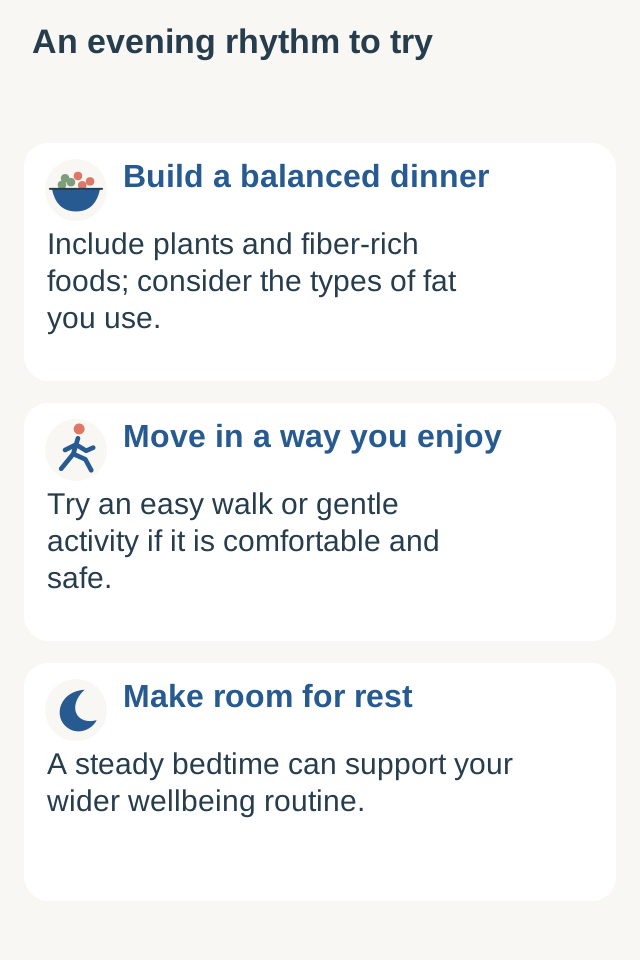
Try using dinner as a cue for one action you choose in advance. Once the dishes are settled, put on suitable shoes and take your short walk. Or, if movement happens earlier in your day, prepare tomorrow’s breakfast and begin winding down. The cue helps remove a repeated decision. It is only useful if the action fits your household.
You could use a three-part sequence: a few minutes of comfortable movement, one task that makes tomorrow easier, and a quieter transition toward sleep. That is an example, not a minimum. If you have limited energy, choose only one. On a difficult evening, a smaller version can keep the habit familiar without making you feel you must finish a program.
Let other people know what would help. A family member might join a walk, handle one evening task, or agree on a quieter period before bed. Shared routines can be supportive, but they do not have to look identical. One person may walk while another uses an indoor movement option. The goal is a household rhythm that leaves room for different needs.
Adapt the idea to shifts, caregiving, and changing energy
“After dinner” is not the same time for everyone. A shift worker may eat the main meal at an unusual hour. A caregiver may have only short breaks. Someone managing fatigue may need to rest after eating. The principle is to place a manageable habit somewhere in your day, not to force it into an evening that is already full.
If your safest opportunity to walk is at lunchtime, use that. If cooking feels easier on a day off, prepare a useful ingredient then. If you need a snack close to sleep because of your schedule or medical plan, follow advice that fits you. A routine becomes useful through repeatability and appropriate choices, not because it happens at a fashionable hour.
Have a backup version for the days your first plan fails. Bad weather might mean moving indoors. A late shift might mean setting out breakfast instead of taking a walk. A poor night might mean choosing gentle movement and seeking rest. Adapting a habit is part of keeping it realistic. It does not require starting again from nothing each time life changes.
Review habits without guessing at cholesterol
For a week, track one behavior in a simple way. You could note whether you walked, prepared a useful food, or began winding down when planned. There is no need to record every bite or grade your evening. Choose information that helps you solve a practical problem, especially if detailed tracking makes you anxious or preoccupied.
At the end of the week, ask what made the habit easier and what interrupted it. A shorter route, a better pair of shoes, a different reminder, or a simpler breakfast might help. Keep the part that worked and change one obstacle. Pay attention to enjoyment and energy as well as completion. A supportive routine should earn its place in your life.
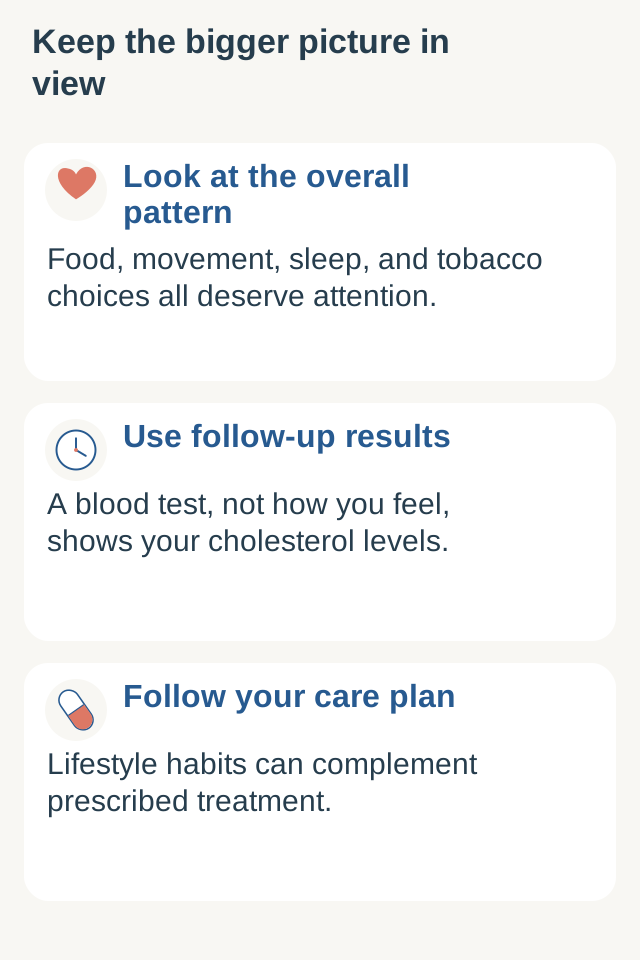
Keep medical progress separate from the habit log. Feeling lighter after a walk or sleeping well does not reveal your LDL level. Use blood tests on the schedule your care team recommends, and discuss your overall risk, family history, and treatment goals. If your result remains high, the next step is a care conversation, not blaming yourself for an imperfect week.
Let the next step stay small
Choose one action for tonight that would be useful even without a dramatic promise: a comfortable walk, a snack that meets your hunger, or a task that makes tomorrow easier. Repeat it often enough to see whether it fits. You can add another habit later, or choose a different one if this version does not serve you.
At GHAC, we share everyday wellbeing ideas that leave room for real schedules and different starting points. Our Health Blog brings food, movement, and rest into the same practical conversation. A heart-supporting evening is one you can live with, alongside the professional care that helps you understand and manage your own health.
About this article
This original GHAC article was inspired by Health.com’s coverage of after-dinner habits and cholesterol.
Information here is educational and does not replace personalized medical advice.
Frequently asked questions
Can a walk after dinner lower cholesterol immediately?
No. A short walk can contribute to regular activity and reduce time spent sitting, but it does not provide an immediate measure or guaranteed reduction in LDL cholesterol. Cholesterol management is assessed over time with your care team and blood tests.
Should I eat a bedtime snack to lower cholesterol?
A bedtime snack is not required. If you are hungry, choose a food that fits your overall eating pattern and personal needs. The timing of a snack does not turn it into cholesterol treatment.
Should all cholesterol medicine be taken at night?
No. Timing depends on the specific medicine and your prescription. Follow the instructions you were given, and ask your pharmacist before changing the time or responding to a missed dose.
What if I work nights or cannot walk after dinner?
Put suitable movement and food preparation where they fit your actual schedule. There is no need to force an evening walk. Use an appropriate indoor or adapted option, and follow your care team’s advice when you have limitations.
Keep the next step simple
Small, repeatable choices are often the ones that last. Explore the Health Blog for more everyday wellbeing reading, or visit the Fitness collection for apparel that celebrates movement in real life.
More everyday wellbeing reading

Gut Health After Antibiotics: A Practical Care Guide
Understand gut changes after antibiotics, food and probiotic choices, and the symptoms that need medical advice.
Read article →
High-Fiber Foods for Heart Health: Everyday Meal Ideas
Find practical ways to enjoy high-fiber foods for heart health, with familiar ingredients, meal ideas, and guidance on gradual changes.
Read article →
Exercises for Stronger Bones: A Practical Start
Build a balanced bone-health routine with weight-bearing movement, simple strength exercises, balance practice, and clear safety guidance.
Read article →