
HEALTH JOURNAL
Exercises for Stronger Bones: A Practical Start
Build a balanced bone-health routine with weight-bearing movement, simple strength exercises, balance practice, and clear safety guidance.

Stronger bones are a long-term project, but your next step can be simple. A walk, a few well-chosen strength movements, and safe balance practice each bring something different to the task. You do not need to turn every day into a workout or start with exercises that make you nervous.
The useful question is not which single move is best. It is how to build a routine that fits your body and that you can keep doing. This guide explains the main pieces, offers practical starting options, and helps you recognize when personal advice matters more than a general exercise list. It is general health information, not an individualized osteoporosis treatment plan.
Give each kind of movement a clear job
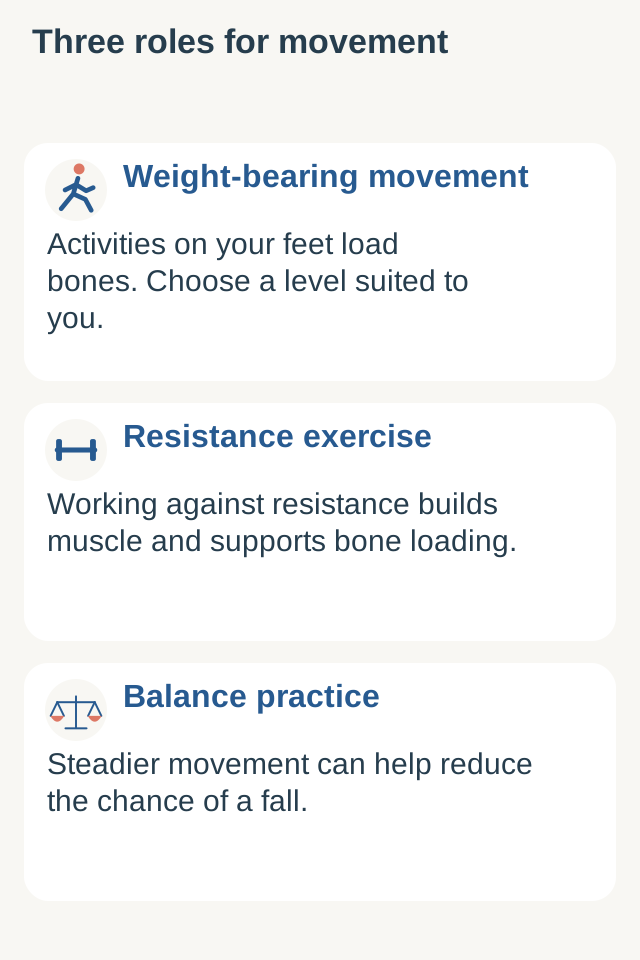
Think of a bone-health routine as a team. Weight-bearing activity means moving while supporting your body against gravity, as you do when walking or climbing stairs. Resistance work asks your muscles to push or pull against a load. Balance practice helps you stay steady. A routine can include all three without making any one session long or complicated.
NIAMS explains the roles of weight-bearing, resistance, and balance exercise in supporting bone health. Balance work has a particularly practical job: helping reduce falls. A supported standing exercise may not feel like a demanding workout, yet practicing control can matter for daily tasks such as dressing, turning, or stepping around a chair.
These categories also help you spot gaps. Walking is valuable, but a walking-only week leaves out focused strength work. Swimming and cycling may be enjoyable aerobic choices, but they do not provide the same weight-bearing activity as standing and walking. Keep activities you enjoy, then consider what would make the overall routine more complete.
1. Check that the starting point fits you
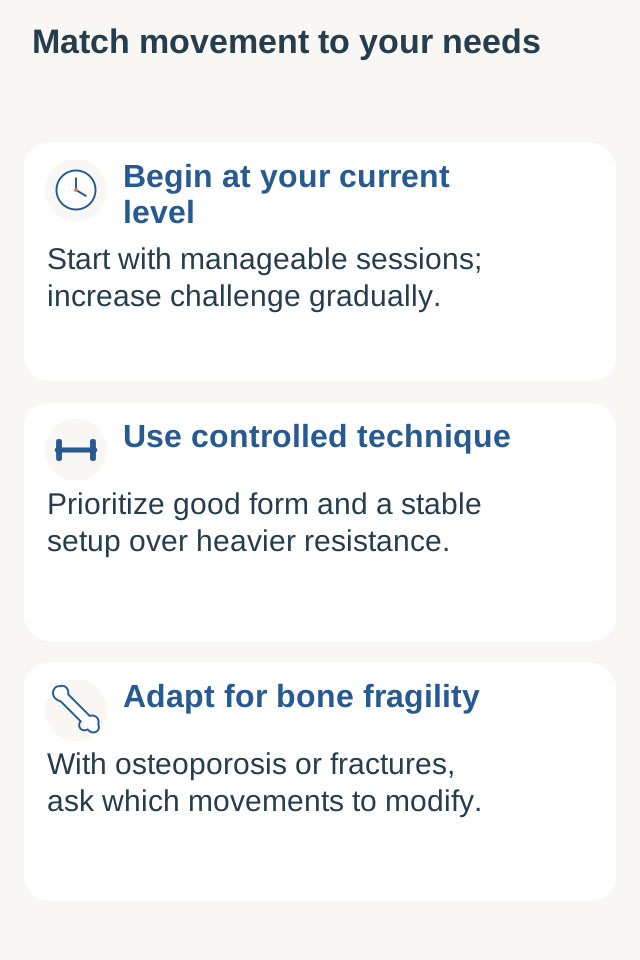
Before adding unfamiliar exercises, take stock of your situation. Have you been told you have osteoporosis or low bone density? Have you had a fracture, recent surgery, repeated falls, or unexplained back pain? Those details can change which movements and loads are suitable. Tell your clinician what you hope to do rather than simply asking whether exercise is allowed.
The Bone Health & Osteoporosis Foundation exercise guidance distinguishes lower-impact from higher-impact weight-bearing options and recommends professional advice about suitability. People with fragile bones or previous fractures may need to avoid some bending, twisting, or impact movements. A physical therapist can help turn broad advice into positions and exercises that match your needs.
Prepare the space as carefully as the plan. Choose a firm, stable chair, a clear floor, and shoes that feel secure. Keep a counter or wall within easy reach for standing practice. Do not use furniture that rolls or a towel rail that cannot safely support you. If you use a walking aid, ask how it should fit into your exercise routine.
2. Make walking a repeatable part of the week
Choose a route you can manage comfortably and return from without feeling stranded. A short loop near home may be a better first choice than a long out-and-back route. Check the surface, lighting, and weather before you leave. The goal for a first walk is to finish feeling able to do it again, not to prove how far you can go.
If you are already walking comfortably, you can discuss a gradual increase in duration or effort with a qualified professional. There is no need to add hills, weighted vests, or ankle weights simply because an article calls them more challenging. Each changes the task, and more difficulty does not automatically mean a better choice for your bones or balance.
Our guide to walking a mile a day can help you think about building a habit. Distance is optional. A familiar route, a comfortable pace, and a reliable cue, such as going after breakfast, may be the parts that make walking happen. Keep room in your week for strength and balance as well.
3. Learn a controlled chair rise
A chair rise practices a movement you already use throughout the day: standing up and sitting down. The NHS strength exercise guide demonstrates sit-to-stand and other accessible movements with clear starting positions. Use its illustrated instructions or ask a professional to demonstrate if you are unsure how the movement should look.
Choose a sturdy chair that will stay in place. Sit toward the front, place your feet on the floor, and rise slowly using the support you need. Lower yourself with control rather than dropping into the seat. The useful skill is a smooth, steady movement. If you must throw your body forward, hold your breath, or grip hard to complete it, ask about an easier starting option.
You do not need to remove hand support on a deadline. Chair height, leg strength, pain, and balance all affect the difficulty. A professional may suggest a different seat height or a modified exercise. Treat needing support as information about the right setup, not as a reason to rush. Stop if the movement causes pain, dizziness, or a sense that you might fall.
4. Add an upper-body pushing movement
A wall push-up can introduce pushing against resistance without getting down to the floor. Stand facing a solid wall, with enough clear space around your feet. Place your hands against it and keep your body comfortably aligned as you bend your elbows to move toward the wall, then press away. Use the NHS illustrated guide linked above to check the setup.
The distance between your feet and the wall affects how demanding this feels. Begin with a position that lets you move smoothly and breathe normally. Do not move farther away just to match someone else. If your wrists, shoulders, or back are uncomfortable, stop and ask for an alternative rather than adjusting repeatedly through pain.
This is one movement pattern, not a full strength program. Pulling movements, leg work, and other exercises may also belong in your plan. Our beginner back exercise guide introduces other options, but suitability still depends on your own health. A short, balanced routine chosen with help is more useful than collecting a long list of exercises you are unsure how to perform.
5. Practice a supported heel raise
Heel raises are another standing option shown in the NHS guide. Stand near a stable support, lift your heels slowly, and lower them with control. Keep the movement comfortable. Your hands can help you stay steady while you learn the task. Avoid bouncing, leaning far forward, or trying to lift higher than you can control.
A small range may be the appropriate starting point. If the effort feels uneven between your legs, your ankles hurt, or you cannot lower smoothly, pause and ask for advice. You do not have to turn this into a single-leg exercise or stand on a stair edge. Those are different tasks with different demands.
Build the session around quality rather than a fixed number that you feel obliged to finish. Note whether the exercise felt steady and whether you needed more support as you became tired. That information helps you plan a sensible next session. It is fine to end a set early when control starts to slip. Fatigue is a useful signal to respect, especially in standing exercises.
6. Give balance its own safe practice time
Balance deserves attention even when your main goal is stronger bones. Think about where steadiness matters in your day: stepping into a shower, turning in a kitchen, or reaching for clothes. A useful exercise plan makes those everyday demands part of the conversation, rather than focusing only on how much weight you can lift.
Ask a physical therapist about supported balance exercises suited to you, especially if you have fallen or often feel unsteady. Practice beside a secure surface, with enough space around you. Do not close your eyes, stand on an unstable cushion, or remove support to make a home exercise look more advanced. Those changes can increase risk without solving the problem you came to work on.
Some people enjoy a suitable tai chi class or a supervised balance group. Tell the instructor about your needs before the class begins. Watching a session first may help you judge whether the pace, support, and room layout feel right. The class should let you ask questions and adapt, not pressure you to follow every movement.
Build a week with room for recovery
The CDC adult activity guidelines recommend at least 150 minutes of moderate activity weekly and muscle strengthening on at least two days. These are broader health goals, not a promise that a particular number of minutes will increase your bone density. If you are currently inactive, work toward an appropriate amount gradually.
A practical planning example is to mark two possible strength days on a calendar with recovery time between them. Add comfortable walks where they fit, and place short, safe balance practice at a time when you feel alert. This is an organizational example rather than a prescription. The amount and exercises should reflect your health and professional advice.
Leave a little room for ordinary life. If a planned session disappears because of an appointment, move it to another suitable day instead of doubling the next one. Keep your first version small enough to repeat. A plan that requires perfect weather, a completely clear schedule, and unusually high motivation is likely to need revision.
Progress one part at a time
Once the routine feels familiar, resist changing everything at once. A longer walk, a new exercise, and heavier resistance in the same week make it hard to tell what caused a problem. Choose one change, keep the rest stable, and notice how you feel during the session and afterward. Ask for help deciding what a useful next step looks like.
Write down simple observations. You might note that standing from the chair felt smoother, that you needed a break sooner than expected, or that a route felt too uneven. These are practical signs to discuss. They are not measurements of bone density, and they should not be presented as proof that an exercise is rebuilding bone.
Be cautious about challenges that promise visible bone results in a few days. Bone health is assessed over time, and treatment decisions involve more than exercise. Continue any prescribed treatment and follow-up. If a routine is uncomfortable or confusing, changing the plan with guidance is a sensible response. Continuing simply because you have already started is not a goal.
Make the rest of the day easier to move through
Your exercise plan lives inside a home and a daily routine. Clear the walkway you use most. Put frequently used items where you do not need to climb or stretch awkwardly for them. Make sure the place where you practice has enough light, and keep pets, loose cords, and small obstacles out of the movement space.
Consider the transition into and out of a session. Have the chair ready before you begin. Keep water nearby without placing it on the floor where you might trip. If floor exercises are part of a professional plan, make sure getting down and back up has been addressed too. A movement is only useful when its whole setup is manageable.
Share concerns with your care team instead of treating them as minor details. New pain, repeated near-falls, and dizziness can change what is appropriate. Seek urgent assessment for severe new pain or a suspected fracture. Chest pain, fainting, or severe shortness of breath during activity also need prompt medical attention.
Keep the goal bigger than a workout
The most useful outcome may be feeling more capable in daily life: getting out of a seat, carrying out familiar tasks, and moving with greater confidence. Exercise can support bone health, but it is only one part of care. Nutrition, medical history, fracture risk, and prescribed treatment also matter. Avoid using a workout as a reason to stop medication or skip a recommended assessment.
At Good Health Apparel Company, we value movement that fits real life. Comfortable clothing can make a session easier to start, but these activities do not require a purchase. Browse our health-minded apparel if a simple reminder would help you keep wellbeing visible in your day. The important step is choosing a safe routine that you can return to.
About this article
This original GHAC article was inspired by Health.com’s article on moves for stronger bones.
Information here is educational and does not replace personalized medical advice.
Frequently asked questions
Is walking enough to keep bones strong?
Walking can be a helpful weight-bearing activity, but a balanced routine also includes appropriate resistance and balance work. Walking alone does not replace an osteoporosis assessment or prescribed treatment. Ask your clinician what combination fits your health and fracture risk.
Can I do these exercises if I have osteoporosis?
Some may be suitable with changes, but a general article cannot choose them for you. Previous fractures, pain, balance, and other conditions matter. Ask a clinician or physical therapist to help select the movements, resistance, and support you need.
Do I need heavy weights to start?
No. A starting routine may use a wall, chair, bands, or body weight. The right resistance is individual. Learn controlled movement first, then ask how to progress. A heavier load is useful only when it is appropriate and you can manage it safely.
How quickly will exercise change my bone density?
There is no reliable short deadline that applies to everyone. Bone health changes over time, and individual responses vary. Use medical follow-up to assess bone density and treatment needs. Easier daily movement or better exercise control does not itself prove a bone-density increase.
Keep the next step simple
Small, repeatable choices are often the ones that last. Explore the Health Blog for more everyday wellbeing reading, or visit the Fitness collection for apparel that celebrates movement in real life.
More everyday wellbeing reading

Morning or Evening Walks for Blood Sugar?
Choose a practical walking time for blood sugar, with guidance on morning routines, after-meal walks, and diabetes safety.
Read article →
High-Fiber Foods for Heart Health: Everyday Meal Ideas
Find practical ways to enjoy high-fiber foods for heart health, with familiar ingredients, meal ideas, and guidance on gradual changes.
Read article →
After-Dinner Habits for Long-Term Heart Health
Build an evening routine with manageable movement, satisfying food choices, sleep, and consistent care to support long-term heart health.
Read article →