
HEALTH JOURNAL
Everyday Agility: Start With Steady Movement
Build a practical foundation for changing direction with supported balance practice, slow steps, and a careful approach to progression.

Turning around a kitchen counter, changing direction on a walk, or adjusting your steps in a busy room all involve more than moving straight ahead. Agility usually refers to changing direction or speed while maintaining control, often in response to something happening around you. It is a useful idea, but a fast footwork video is not necessarily a good starting point.
For someone returning to movement, the first priority is a steady foundation. Balance, strength, and comfortable stepping can support that foundation without racing a timer. The examples here are cautious ways to explore movement, not a tested agility treatment or a substitute for an individualized fall-prevention program.
Balance is a foundation, not the whole of agility
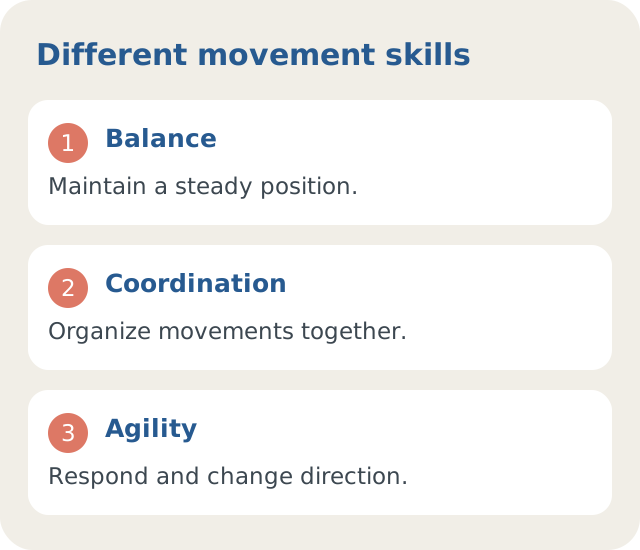
Balance means controlling your body’s position, whether you are still or moving. Agility adds the challenge of changing movement, sometimes quickly and in response to a cue. Standing on one leg may challenge balance, but it does not by itself measure your ability to react and change direction.
The distinction matters because a program can improve one skill without proving an improvement in another. CDC guidance on balance and multicomponent activity supports combining balance work with other movement for older adults. It does not establish that a particular home drill will prevent a fall or make every person more agile.
Think about three separate questions: Can I remain steady? Can I place my feet where I intend? Can I change what I am doing when the situation changes? A controlled home exercise may explore the first two. It cannot recreate all the distractions, decisions, surfaces, and unexpected events involved in the third. That is why this guide describes foundations rather than promising a complete agility solution.
Your purpose also changes the appropriate practice. Someone hoping to return to tennis has different demands from someone who wants to feel more comfortable moving around a kitchen. Write your purpose in ordinary words before selecting an exercise. “I want to discuss safer turning with my physical therapist” is a more useful starting goal than trying to beat an online fitness challenge.
The examples below are options to consider, not a sequence that every reader should complete. You can use the information to ask better questions even if independent standing practice is currently unsuitable. Learning which skill a movement challenges can help you choose a class or professional program more thoughtfully.
Make the setting easier before making the movement harder
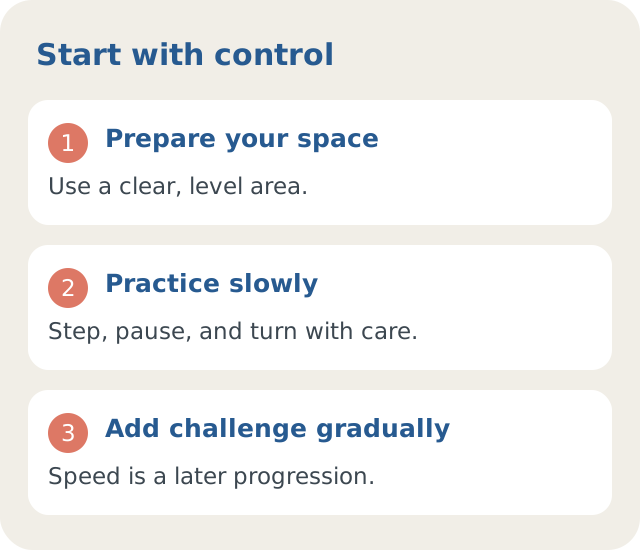
Choose a level, uncluttered surface with good light and secure footwear. Move loose rugs, pets, cords, and small objects away from the practice area. Keep a fixed counter or other dependable support within reach. Avoid a chair that swivels, rolls, or slides when you lean on it.
If you have fallen recently, feel unsteady during ordinary walking, or use a walking aid, ask a physical therapist or healthcare professional which movements fit your needs before adding direction changes. Keep your usual aid available. A safe version may involve supervision or a different starting exercise rather than simply doing fewer repetitions.
Check the support itself before starting. A counter should be fixed in place, within comfortable reach, and clear of hot items or sharp edges. If you need substantial help to stay upright, do not assume a light fingertip touch will be sufficient. Choose the level of assistance that actually keeps you steady, and ask for guidance if you are uncertain.
Consider the room as part of the plan. Is there enough space to step without striking furniture? Can you see where your feet are going? Is a phone available if you need help? You should not have to carry exercise equipment into position while already feeling unsteady. Set up first, then decide whether the day is suitable for practice.
Clothing and footwear should let you move without catching on furniture or sliding. Skip practice when the available setting makes you improvise around hazards. A crowded kitchen during meal preparation is different from the same kitchen when counters and floor space are clear. Convenience is useful only when it comes with a workable setup.
Explore a slow sideways step
The NHS balance exercise guide includes controlled sideways walking near support. Face forward and take a small step to one side, then bring the other foot toward it without crossing your feet. Pause when needed and keep each step deliberate. Use a stable support if you need it.
Begin with only a few comfortable steps in each direction, rather than aiming to cross an entire room. Notice whether you can place each foot without rushing or catching it on the floor. This is a way to practice controlled lateral movement, not a speed test. If it feels unstable, stop and choose a supported exercise with professional guidance.
For an illustrative first attempt, stand beside your chosen support and check that you can comfortably shift enough weight to move a foot. Take a small step, bring the other foot along, and come to a complete stop. You can stop there. The point is to discover whether the movement is controlled, not to reach a predetermined total.
If that movement is comfortable and appropriate for you, repeat only while the quality remains similar. Notice whether one direction feels more difficult or whether you begin taking hurried steps to keep up. Such observations are useful information to bring to a professional; they are not a diagnosis or a reason to push through a difficult side.
Keep your attention on the movement instead of looking down at a timer or checking your phone. Avoid adding objects to step over or asking another person to surprise you with commands. Those changes add demands that this simple introduction is deliberately not designed to address. An uncomplicated exercise is easier to understand and adjust.
Choose a supported balance option
Another option in the NHS guide is a brief one-leg stand near a wall. If appropriate for you, keep your hands at support and lift one foot only as far as feels manageable, then set it down gently. There is no need to close your eyes, stand on a cushion, or compete for a longer hold.
You can also simply explore standing comfortably with both feet on the floor and support available before trying a narrower stance. The useful question is whether you remain in control. Keep breathing normally and stop before fatigue changes your movement. The NHS page provides illustrated instructions if you want to review the setup first.
Choose between options according to your current control, not according to how impressive they look. Standing with both feet comfortably placed can be the right place to begin. A one-leg stand creates a different challenge and is not a required next step for everyone. If an exercise depends on releasing support before you are ready, choose another version.
It can help to decide your stopping point before you begin. You might choose to stop after one comfortable attempt on each side, or sooner if the setup no longer feels secure. That is an example of organizing practice, not a recommended dose. Holding on longer is not automatically better, especially if you are leaning or gripping harder to compensate.
If standing practice is not currently accessible, a physical therapist can help identify seated or assisted work that matches your goals. A seated movement should not simply be called an equivalent balance exercise without explanation. Ask which skill it addresses and how it relates to the daily task you hope to improve.
Progress one feature at a time
For an initial practice, choose one suitable movement after a little easy walking and keep the session brief. Rest, then decide whether the movement still feels comfortable. These are practical starting suggestions, not a research-tested prescription for a particular number of minutes or sessions.
If you later progress, change just one feature, such as adding a few steps while keeping the same support. Do not simultaneously remove support, add speed, and introduce obstacles. Jumping, fast ladder drills, abrupt pivots, and reacting to unpredictable cues belong to a different level of demand. They are unnecessary in this beginner plan.
Use a simple decision check after a session: Was I comfortable? Could I stop on purpose? Did I keep the support I needed? If the answers are yes, repeating the same level may be enough. Progress does not need to occur at every session. Familiarity with a safe setup is valuable in its own right.
If you want to change something later, describe the change specifically. Adding one controlled step is different from stepping faster. Reducing hand support is different from increasing distance. Keeping the other features stable makes it easier to notice what became more difficult and to return to the previous version if necessary.
Practicing reactions is a possible later topic for an appropriate professional or instructor. Ask how a task will be made predictable enough to learn, what assistance will be available, and how the challenge will be adjusted. Do not create a home obstacle course or introduce sudden directional commands simply because a video labels them functional training.
Keep the larger movement plan in view
For adults 65 and older, CDC recommendations include aerobic activity, muscle strengthening, and balance activities. A few minutes of stepping practice do not replace that broader mix. If you cannot meet the general targets, work within your abilities and build gradually.
Review practical progress: Are the steps comfortable? Is the support dependable? Can you stop whenever you intend to? Avoid treating a home stopwatch score as proof of lower fall risk. Stop if you develop pain, dizziness, or unusual breathlessness. New or persistent unsteadiness deserves assessment rather than increasingly difficult drills.
Build practice around a routine you already recognize. You might review the room after your usual morning walk or keep a short note of an exercise your therapist has already taught you. The habit cue should make the movement easier to remember without pressuring you to do it when you feel unwell or the space is unsuitable.
A useful record can be just a sentence: “Side steps felt comfortable beside the counter; stopped before getting tired.” Another might read, “Unsure about the turn; will ask at my appointment.” This kind of note preserves context that a repetition count misses. It also helps keep a small exercise from becoming a competition.
Revisit the purpose regularly. If your real difficulty is getting out of a chair, managing dizziness, or using stairs, a generic agility routine may not address the cause. Bring that exact difficulty to your care team. The strongest takeaway is to practice an appropriate skill in an appropriate setting, while recognizing what the exercise cannot tell you.
To put these skills in a broader routine, read our guide to combining strength training and cardio and our introduction to core control. Choose related reading to answer a question, rather than stacking every suggested exercise into one session.
About this article
This original GHAC article was inspired by Health.com’s article on agility exercises.
Information here is educational and does not replace personalized medical advice.
Frequently asked questions
Is balance training the same as agility training?
No. Balance concerns body control; agility also involves changing movement or direction, often in response to a cue. Balance practice can provide a foundation without proving an improvement in reactive agility.
Do I need an agility ladder or cones?
No. A clear space and reliable support are more useful for the cautious starting movements described here. Equipment is not a requirement for practicing controlled steps.
Should beginners add jumping?
Jumping is not needed in this beginner approach. Establish controlled movement first and seek appropriate guidance before adding faster, higher-impact tasks.
What if I have already fallen?
Discuss an appropriate starting plan with a healthcare professional or physical therapist. These examples are not a fall-risk assessment or an individualized treatment program.
Keep the next practice steady
Choose one suitable movement in a clear space with dependable support. Notice your control and comfort before considering a harder version.
More everyday wellbeing reading

Deep Core Exercises: Start With Control, Not Intensity
Understand deep core training, explore gentle bridge and hands-and-knees options, and learn when individual guidance matters.
Read article →
Carbohydrate Timing and Blood Sugar: What Matters Most
Explore what meal timing and food order may mean for blood sugar, with practical meal ideas, study limitations, and questions for your care team.
Read article →
Strength Training and Cardio: Make Room for Both
Understand how strength training and cardio complement each other, what adult activity guidelines recommend, and how to start with a manageable week.
Read article →