
HEALTH JOURNAL
Carbohydrate Timing and Blood Sugar: What Matters Most
Explore what meal timing and food order may mean for blood sugar, with practical meal ideas, study limitations, and questions for your care team.

Is there a better time to eat bread, rice, fruit, or other carbohydrate foods? It is a reasonable question, especially when headlines suggest that moving a food to another part of the day could transform blood sugar. Timing deserves attention, but it belongs beside food quality, portions, and the realities of your daily routine.
Two different ideas often get mixed together: when you eat during the day, and the order in which you eat the foods on your plate. Research has explored both. This guide separates those questions and explains why a promising short-term glucose result is not the same as a universal rule for every person or every meal.
Start with what is on the plate
Carbohydrate foods are not all interchangeable. A meal of vegetables, beans, and a modest serving of rice brings a different combination of nutrients and texture from a large sweetened drink. The CDC’s meal-planning guidance explains that carbohydrates raise blood sugar, while eating them with protein, fat, or fiber slows how quickly it rises.
The same guidance offers a visual starting point: half a plate of nonstarchy vegetables, one quarter lean protein, and one quarter carbohydrate foods. This is a planning tool, not a prescription for every appetite or health condition. A registered dietitian can help adapt portions and ingredients to your needs.
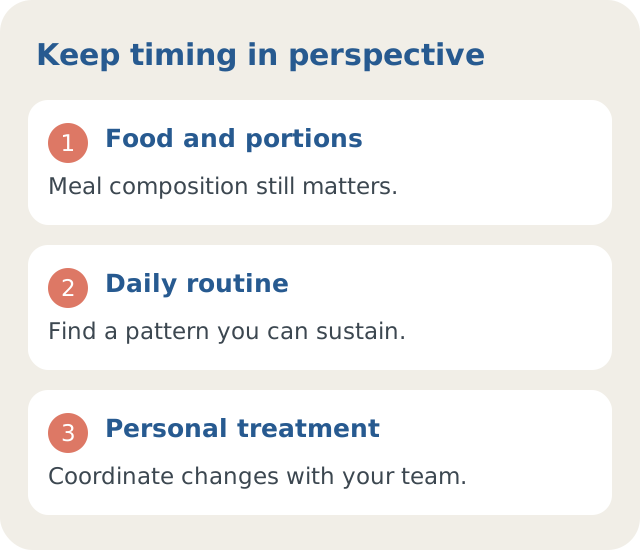
Think of portion, food choice, and timing as three separate questions. Portion asks how much of a food is in the meal. Food choice asks what else it brings, such as fiber. Timing asks when it is eaten. Changing the clock does not automatically change either of the first two. An appealing meal can still deserve a closer look at all three.
The ADA’s guide to carbohydrate foods includes beans, lentils, whole grains, fruit, and starchy vegetables among carbohydrate choices. These foods need not be treated as a single category to avoid. For a conversation with a dietitian, write down the actual foods you enjoy rather than simply asking whether carbohydrates are good or bad.
For a closer look at familiar grain choices, see our brown rice and quinoa comparison. For movement around meals, our post-meal walking guide explains both the practical options and the limits of timing research.
Separate the clock from food order
Clock timing asks whether dinner at one hour produces a different response from the same dinner later. Food order asks whether beginning with vegetables and protein produces a different response from beginning with the carbohydrate portion. Neither question means carbohydrate foods must disappear.
These distinctions matter when reading a headline. Evidence about eating vegetables before rice does not establish that everyone should avoid rice after a particular hour. Evidence about a late laboratory dinner does not automatically apply to a shift worker whose waking and sleeping times differ from those of the study participants.
A third approach, restricting the hours in which any food is eaten, is different again. This article does not provide a fasting program. A study about one meal cannot tell us which daily eating window someone should follow, and trying several changes together makes it difficult to understand which part helped or became hard to sustain.
When you read a proposed tip, translate it into a specific question. Is the author suggesting a different meal time, a different order within the meal, a different carbohydrate amount, or all three? If the study changed multiple things, a headline that credits only the clock may leave out important context. A clear question is the first step toward a useful answer.
What food-order research actually tested
In a 2017 randomized crossover study, 16 people with type 2 diabetes ate the same meal on separate days in different orders. One condition put carbohydrate first; another put protein and vegetables first; a third combined the foods. The separated conditions included a 10-minute interval between components. Eating carbohydrate last produced lower post-meal glucose and insulin responses than eating it first.
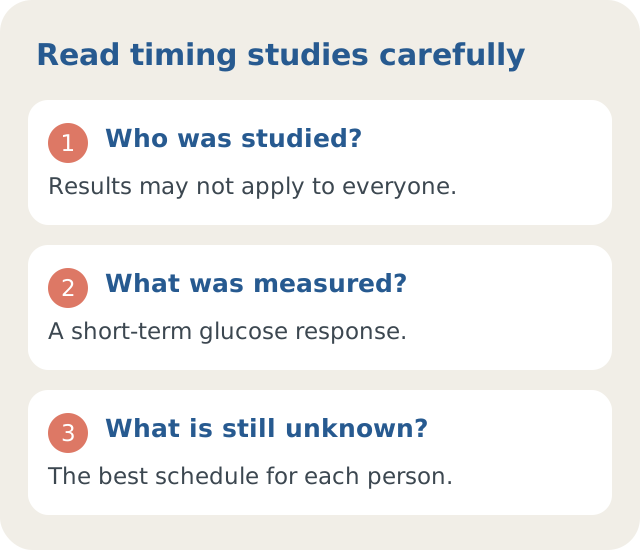
That is useful evidence that meal sequence can affect an immediate response in a selected group. It is not proof that everybody needs a timer at dinner, that the same result applies to all foods, or that this strategy replaces diabetes treatment. The study was small and measured the hours after a meal rather than long-term complications.
The phrase randomized crossover means the participants tried different conditions, with the order assigned randomly. Comparing responses within the same participants helps address some person-to-person differences. It does not make the sample representative of every age, diabetes treatment, or health condition. The carefully arranged meal also differs from an ordinary week of changing ingredients and schedules.
A practical interpretation is to ask whether food order is worth discussing for your usual meals. It is not a reason to separate every ingredient in soup, a casserole, or a mixed rice dish. A routine that depends on disassembling familiar food may add effort without evidence that this exact approach will benefit you.
What a late-dinner study can tell us
A 2020 randomized crossover trial compared dinner at 6 p.m. with dinner at 10 p.m. in 20 healthy volunteers. Sleep was fixed from 11 p.m. to 7 a.m., and the diets supplied the same calories. The later dinner led to higher post-meal glucose, with effects especially pronounced among people who usually slept earlier.
The result supports taking the relationship between meals and sleep seriously. It does not establish a universal dinner deadline, prove weight gain from a single late meal, or show that people should skip food when their schedule runs late. The volunteers were young, and the experiment was a short laboratory comparison.
The sleep schedule is an important part of interpreting the dinner experiment. A 10 p.m. meal immediately before an 11 p.m. bedtime is not the same situation as a 10 p.m. meal during the middle of a night shift. This comparison does not establish a precise interval between dinner and bed for everyone. It leaves a question to explore in the context of actual waking hours.
Also notice what the trial measured. Blood samples during a laboratory visit can show an immediate metabolic response. They cannot directly demonstrate fewer strokes, less kidney disease, or better health decades later. Those outcomes require different evidence. Looking at the endpoint, the result actually measured, helps keep a useful finding from becoming a much larger promise.
Keep regular meals practical and personal
The American Diabetes Association’s meal-planning resources emphasize regular meal times and identifying an eating pattern with your healthcare team. They also recognize that snacks can fit a meal plan. A workable approach respects hunger, food access, work, culture, and family routines instead of treating a perfect clock schedule as the goal.
Choose one planning question: Are long, unplanned gaps making meals difficult? Could lunch be easier to prepare? Would a more balanced dinner fit the foods you enjoy? These are useful conversation starters. They avoid turning a research finding into another rigid food rule.
For someone with changing shifts, a useful preparation step is to describe a typical workday and a typical day off. Include waking time, the opportunities available to eat, and when sleep usually begins. A care team can work with that information more readily than with a request to follow a conventional breakfast, lunch, and dinner schedule that is impossible at work.
If food access is the difficulty, put that on the agenda too. A shift with no reliable meal break calls for a different conversation from an evening spent snacking despite a comfortable dinner. The first task is to identify the problem you want to solve. There is no need to redesign every meal to act on a single interesting headline.
Use familiar meals as the starting point
For illustration, bring a few real meal combinations to a nutrition conversation: rice with tofu and vegetables; beans with a tortilla and salad; lentil dal with rice and a vegetable dish; or fish with potatoes and greens. These examples are not interchangeable carbohydrate portions or individualized prescriptions. They show why discussing an entire meal can be more useful than debating one ingredient in isolation.
A 2019 ADA nutrition consensus report explains that there is no ideal percentage of calories from carbohydrate, protein, and fat for everyone with or at risk for diabetes. Assessment should consider current eating patterns, preferences, and metabolic goals. A universal carbohydrate deadline is an equally poor substitute for that individual discussion.
Before changing a meal you enjoy, identify the question. Would you like help understanding the portion? Are you uncertain about a sweetened drink alongside it? Is the time you eat the actual difficulty? Keeping the question specific makes it easier to preserve familiar foods while getting useful guidance. It also gives you a more meaningful starting point than a list of foods to forbid.
Protect your existing care plan
For people with diabetes, changing meal timing can have safety implications. NIDDK’s healthy-living guidance notes that insulin and some other diabetes medicines can contribute to low blood glucose if meals are skipped or delayed. Ask your care team before making substantial changes, and continue following your prescribed plan.
Bring specific questions to that conversation: Does my current schedule fit my treatment? Would changing dinner time help in my situation? If monitoring is already part of my care, what patterns should I discuss? Timing can be one useful detail, but the aim is nourishing, sustainable eating and appropriate care, not a perfectly flat glucose line.
A useful question list for an appointment is: Which part of my current meal pattern deserves attention first? Does the evidence about timing apply to my situation? How would I recognize a change that is not working for me? What should I do when a workday interrupts my usual routine? Ask for the answers in language you can use at home.
Lower is not automatically better when discussing blood glucose. NIDDK’s explanation of hypoglycemia describes low blood glucose as a potentially dangerous problem, particularly for people using insulin or certain other diabetes medicines. Do not use meal-order experiments to treat a low reading or delay the response your care team has instructed. Your individual safety plan takes priority over a general nutrition article.
About this article
This original GHAC article was inspired by Health.com’s article on carbohydrate timing and blood sugar.
Information here is educational and does not replace personalized medical advice.
Frequently asked questions
Is there one best time of day to eat carbohydrates?
No single schedule fits everyone. Research suggests timing can affect glucose responses, but personal routines, health conditions, meal composition, and treatment all matter. A study using a fixed dinner and bedtime does not establish an eating schedule for all work shifts. Describe your actual routine when seeking individualized advice.
Should I always eat carbohydrate foods last?
Small controlled studies suggest this may reduce the immediate glucose response in some people with type 2 diabetes. It is an optional discussion with your care team, not a universal requirement. The older trial discussed here used separate meal components and a timed interval. It cannot answer every question about mixed meals or establish a requirement to wait between bites.
Do I need to stop eating fruit or rice?
This research does not establish that these foods must be eliminated. Consider portions and the whole meal, and seek individualized nutrition advice when needed. Beans, whole grains, and fruit also contribute nutrients beyond carbohydrate. If your current plan limits particular foods, ask about the reason and suitable alternatives rather than replacing it with a headline.
Should I skip dinner if I cannot eat early?
Do not turn a late-dinner finding into a rule to skip meals. If you have diabetes, skipping or delaying food can be unsafe with certain medicines. Follow your care plan and discuss scheduling concerns. Bring up predictable late workdays before they happen so your care team can help you plan. This article does not recommend changing medicine, delaying treatment for low blood glucose, or adopting a fasting schedule.
Bring one useful question to your next visit
Describe a usual meal and your daily schedule. Ask which change, if any, deserves attention first in your individual care plan.
More everyday wellbeing reading

Deep Core Exercises: Start With Control, Not Intensity
Understand deep core training, explore gentle bridge and hands-and-knees options, and learn when individual guidance matters.
Read article →
Everyday Agility: Start With Steady Movement
Build a practical foundation for changing direction with supported balance practice, slow steps, and a careful approach to progression.
Read article →
Strength Training and Cardio: Make Room for Both
Understand how strength training and cardio complement each other, what adult activity guidelines recommend, and how to start with a manageable week.
Read article →