
HEALTH JOURNAL
Strength Training and Cardio: Make Room for Both
Understand how strength training and cardio complement each other, what adult activity guidelines recommend, and how to start with a manageable week.

When exercise time is limited, it is tempting to look for a winner: walking or weights, cardio or strength. But the more useful question is what your routine is missing. Moving in ways that challenge your heart and lungs serves a different purpose from asking your muscles to work against resistance. A practical week can make room for both.
You do not need an elaborate schedule or a gym membership to begin. Start with activities you can manage, then gradually build a mix that suits your health, interests, and available time. General targets describe a direction to work toward, not a pass-or-fail test of whether today’s effort mattered.
Use the guidelines as a combined target
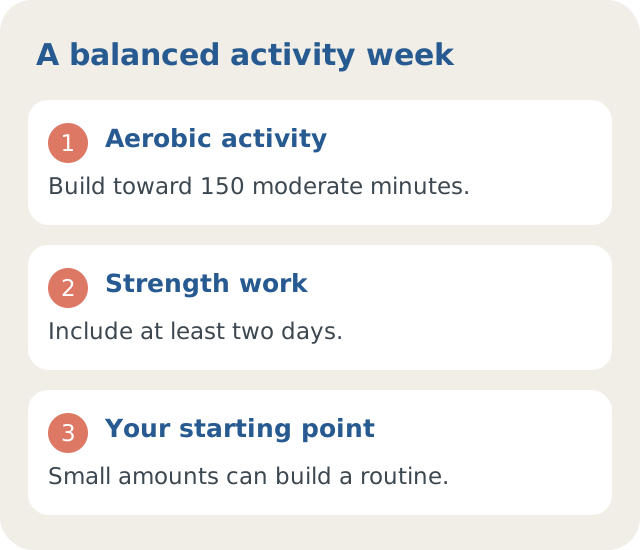
The CDC adult activity recommendations call for at least 150 minutes of moderate-intensity aerobic activity per week, or 75 minutes of vigorous activity, or an equivalent combination. They also include muscle-strengthening activity on at least two days a week, covering the major muscle groups.
The word “also” matters. The recommendations are not asking you to choose one side. If you currently do neither, start below the full target and increase gradually. A short walk and an introductory strength session can be useful building blocks even when the finished weekly plan is still some distance away.
Treat the weekly target like a budget with different categories. Aerobic minutes and strength days are related parts of a plan, but one is not a currency you can automatically exchange for the other. Three long walks do not tell you whether the major muscle groups have been challenged, and three strength sessions do not tell you how much moderate aerobic activity you completed.
Before adding anything, look at an ordinary week. You may already walk briskly during part of a commute or participate in a class. Record what actually happens rather than the schedule you wish you had. Then identify one gap that seems realistic to address. A small adjustment to an existing routine can be easier to maintain than an entirely new calendar.
The targets are general public-health guidance, not a personalized training prescription. A person preparing for a race, recovering from a procedure, or living with a condition may need a different progression or additional support. Use the recommendations to organize questions and priorities, while respecting any individualized advice you have received.
Understand what cardio contributes
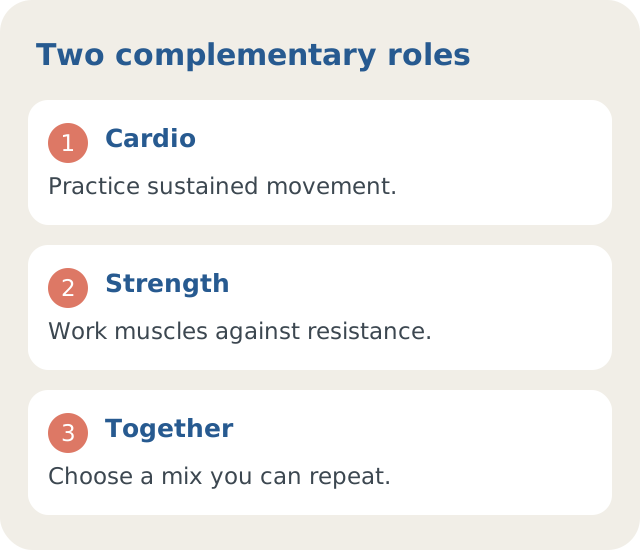
Cardio is activity that raises breathing and heart rate for a sustained period. Brisk walking, cycling, water exercise, and dancing are possible choices. The CDC talk test offers a practical intensity check: at moderate effort you can speak but singing is difficult; at vigorous effort you generally need pauses for breath after a few words.
That description is more useful than comparing your walking pace with a neighbor’s. The same route may feel easy one day and harder another. Choose a pace and setting that fit you. An indoor walk or suitable water class may work better than a hilly outdoor route, and enjoyment makes a repeat visit more likely.
Choose a form of cardio with practical staying power. Consider cost, travel, weather, access to bathrooms, joint comfort, and whether you enjoy doing it alone or with someone else. A theoretically ideal class that requires a difficult journey may be less useful than an accessible activity you can repeat near home. The best starting choice fits your actual circumstances.
For illustration, someone who enjoys walking could use a familiar flat route with a shorter option back. Someone who prefers indoor activity might choose an appropriate community class or stationary cycling after learning the setup. These examples are planning choices, not claims that the activities are interchangeable for every person or every health condition.
If a session feels unusually demanding, adjust rather than defending the original plan. A shorter duration, easier effort, or different day may be sensible. Keep the talk test as a broad guide, not a substitute for medical instructions or a way to dismiss symptoms. A routine is useful when it can adapt to ordinary variation.
Understand what strengthening contributes
Strength work challenges muscles against resistance, such as weights, bands, machines, or body weight. CDC guidance on muscle-strengthening activity emphasizes working the major muscle groups. A pair of arm exercises alone does not cover the same ground as a balanced routine.
Beginners can seek instruction in a few suitable movements before adding load. Examples to discuss include a chair sit-to-stand, a wall push-up, and a properly set-up band row. These are examples, not a complete program for every body. Choose versions that let you move with control and breathe normally. Technique takes priority over matching somebody else’s weight or repetition count.
The American Academy of Orthopaedic Surgeons recommends learning correct exercise technique, including instruction from a qualified exercise professional. Look for instruction that explains the setup, the intended movement, and a suitable starting level. With a resistance band, that includes how it is secured and how its condition is checked. With a machine, it includes adjusting the seat and movement range. Equipment does not make an exercise self-explanatory, and a demonstration aimed at experienced lifters may omit important beginner details.
When you discuss a program with an instructor, ask how it covers the body rather than collecting unrelated exercises. A balanced session may include several movement patterns, but the specific selection should reflect your needs. You do not have to master every version at once. Learning a manageable set well is more useful than rushing through a long list you cannot remember.
Keep a brief record of the exercise version and resistance used. That lets you repeat an appropriate challenge without guessing. If the movement becomes easier over time, ask whether to change resistance, repetitions, or another feature. Avoid changing all of them together. The aim is a deliberate progression with control, not simply making each session more exhausting.
If you are exploring trunk strength specifically, our deep core guide introduces controlled starting movements. Our aerobic exercise guide explains more everyday cardio options.
Build a week you can repeat
A person already comfortable with moderate walking might plan 30 minutes on five days, plus two strength days with recovery between them. That is one example, not the only arrangement. Some aerobic time can be broken into shorter periods, and a strength session may occur on the same day as a walk.
For a beginner, the first week might instead contain several short, comfortable walks and one introductory session learning appropriate resistance exercises. Increase from that starting point rather than forcing the full target immediately. The HHS guideline summary explains that activity does not need to last ten minutes at a time to count toward the overall aerobic goal.
Consider three illustrative schedules. A regular walker might keep five walking appointments and place strength work on Monday and Thursday. A person with variable shifts might schedule two flexible strength sessions first, then distribute shorter walks around work. Someone rebuilding a habit might begin with a few brief activity appointments and review the plan after a manageable week.
These schedules show organization, not prescriptions. There is no need to catch up all missed activity in an oversized weekend session. If Tuesday becomes unavailable, move the appointment, shorten it, or continue with the next planned day. A calendar that tolerates disruption is more realistic than one that depends on seven unusually convenient days.
Include preparation in the time you allow. Getting to a class, changing clothes, setting up equipment, and returning home can take longer than the exercise itself. If your available window is twenty minutes, choose something that genuinely fits it. This makes the plan more honest and reduces the feeling that ordinary time constraints are a personal failure.
Do not count every hard-feeling workout as both
A strength session can make your heart beat faster without automatically replacing your aerobic activity. A leisurely walk may be pleasant and worthwhile without providing the muscle challenge of resistance training. Some activities overlap, but their name alone does not establish that they fully cover both targets.
Keep a simple record with separate spaces for aerobic minutes and strength days. You do not need to estimate every calorie or buy a tracker. Ask whether the activity was moderately challenging for breathing, which muscles worked, and whether the plan is becoming easier to sustain. Those questions help identify gaps without turning exercise into constant bookkeeping.
A circuit class illustrates why the details matter. It may combine resistance exercises with sustained movement, or it may contain brief efforts separated by long rests. Ask what the class is designed to provide instead of assuming the word circuit means it replaces every part of a weekly routine. The same question applies to dance, yoga, gardening, and other activities with varied formats.
An activity can still be worthwhile even when you are unsure how to count it. Record it in plain language and use clearly understood sessions to plan the rest of the week. You do not need to force every enjoyable movement into a precise category. The record is a planning aid, not a scorecard that determines whether the day was successful.
Notice what your preferences leave out. If you love walking, the next useful step may be learning suitable resistance exercises. If you consistently lift but rarely do sustained aerobic activity, explore an enjoyable cardio option. The purpose of comparison is to reveal a practical opportunity, not to declare your favorite activity inadequate.
Adapt for balance, recovery, and health needs
Adults 65 and older also benefit from including balance activities, as described in CDC guidance for older adults. A balance-focused class or appropriately supported exercise may add something a walking-and-weights routine misses. If illness or travel interrupts your routine, restart at a lower level rather than making the first session a test of lost fitness.
Health conditions, pain, disability, and recovery from surgery may change which movements and amounts are appropriate. Ask for tailored advice when needed, especially before vigorous exercise after inactivity. Stop for pain, dizziness, or unusual breathlessness. No weekly calendar proves that an exercise is right for you, and no comparison headline can identify the best personal balance of activities.
Accessibility is part of planning from the outset. A person who exercises seated, uses a mobility aid, or needs assistance can ask a qualified professional about appropriate aerobic and resistance options. The adaptation should match the task and the person. A seated class is not automatically easy, and a standing exercise is not automatically more useful.
AAOS also advises allowing a full day of rest before training the same muscle group again. Build recovery into the routine as deliberately as the appointments themselves. Leave room between demanding sessions, especially when you are learning unfamiliar movements, and avoid increasing several demands at once. If an activity repeatedly leaves you unable to manage ordinary tasks comfortably, review the workload and technique with an appropriate professional rather than treating that response as proof of a better workout.
Finally, review the plan using questions you can answer: Did I attend? Was the location workable? Could I follow the exercises? What would make next week easier? Keep the parts that fit and change the obstacle that matters most. A workable combination of cardio and strength gives you more than a winning side in an exercise debate: it gives you a routine you can continue.
About this article
This original GHAC article was inspired by Health.com’s comparison of strength training and cardio.
Information here is educational and does not replace personalized medical advice.
Frequently asked questions
Is strength training better than cardio for overall health?
There is no universal winner. Adult guidelines recommend both aerobic and muscle-strengthening activity because a balanced routine includes different kinds of challenge.
Can I do both on the same day?
Yes, that can fit some schedules. Keep the total demand manageable, allow recovery, and adjust the plan to your goals, abilities, and any individual guidance.
Do short walks count?
Short periods can contribute to your aerobic total when they reach an appropriate intensity. You do not need to complete every session in one long block.
What if I cannot meet 150 minutes yet?
Start with what is manageable and build gradually. Some activity is better than none. Seek advice about adaptations if a condition limits your activity.
Plan the next manageable week
Choose one aerobic activity you enjoy and one opportunity to learn suitable strength exercises. Build from your current ability rather than trying to complete every target immediately.
More everyday wellbeing reading

Deep Core Exercises: Start With Control, Not Intensity
Understand deep core training, explore gentle bridge and hands-and-knees options, and learn when individual guidance matters.
Read article →
Carbohydrate Timing and Blood Sugar: What Matters Most
Explore what meal timing and food order may mean for blood sugar, with practical meal ideas, study limitations, and questions for your care team.
Read article →
Everyday Agility: Start With Steady Movement
Build a practical foundation for changing direction with supported balance practice, slow steps, and a careful approach to progression.
Read article →