
HEALTH JOURNAL
Deep Core Exercises: Start With Control, Not Intensity
Understand deep core training, explore gentle bridge and hands-and-knees options, and learn when individual guidance matters.

“Deep core” sounds like something that needs a special class, a complicated breathing technique, or a punishing workout. A more useful starting point is simpler: learn to use the muscles around your middle while continuing to breathe and keeping movement comfortable. The goal is a steadier foundation for activity, not a dramatic before-and-after photograph.
This guide explains what the term means and offers two established exercises to explore. It is general education, not a personalized rehabilitation plan. You can read the instructions, decide which questions apply to you, and choose a starting point without committing to a long routine or buying equipment.
Understand what your core includes
Your core is more than the muscles visible at the front of your abdomen. Mayo Clinic explains that it includes the pelvis, lower back, hips, and stomach area. These muscles work together to help you stay steady during both exercise and ordinary activities. Training that coordination can be a more useful aim than trying to isolate one small muscle perfectly.
The transversus abdominis is a deeper abdominal muscle mentioned in Mayo Clinic’s core exercise guide. The label “deep core” can help describe an area of interest, but it does not make an exercise uniquely effective or turn a general routine into treatment. Think about the movement you want to do more comfortably, rather than the marketing name attached to a workout.
Make the starting position work for you
Choose a clear space and a comfortable, nonslip mat. Before attempting a floor exercise, consider whether you can get down and back up safely. If that is difficult, ask a physical therapist for a suitable alternative. There is no requirement to practice on the floor just because an online example does.
The American Academy of Orthopaedic Surgeons recommends five to ten minutes of easy, low-impact activity before its spine conditioning exercises. Its program is intended to be selected with professional guidance, especially after injury or surgery. Use that principle here: adapt the choice to the person, rather than forcing the person into a routine.
Try a bridge with room to breathe
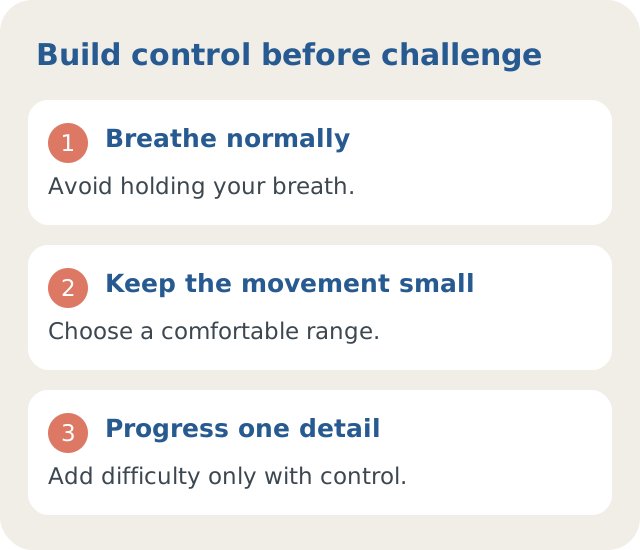
For the bridge demonstrated by Mayo Clinic, lie on your back with knees bent. Keep your back comfortably neutral. Gently engage your abdominal muscles and lift your hips until your knees, hips, and shoulders align. Hold for three deep breaths, then lower back down. Keep breathing throughout; the hold is not a breath-holding challenge.
Read the linked demonstration before trying it. Treat an initial attempt as practice, with time to reset between movements. A higher lift or longer hold is not automatically better. If you cannot find a comfortable position, leave this exercise out and ask for advice instead of repeatedly trying to force the shape.
Explore hands-and-knees control
Mayo Clinic also describes the quadruped, often called a bird dog. Begin on hands and knees, with hands beneath shoulders and head aligned with your back. Engage your abdomen. Reach one arm ahead, hold for three deep breaths, then lower and switch arms. Its progression includes lifting one leg at a time before combining opposite arm and leg.
The one-limb version is a legitimate starting option, not a failed attempt at the full pose. If your wrists or knees do not tolerate the position, skip it. You can bring a very specific question to a professional: “What movement would train a similar skill without putting pressure here?”
Keep this inside a balanced activity plan
A short core practice does not cover every part of fitness. The CDC’s adult activity guidance recommends at least 150 minutes of moderate aerobic activity weekly, or an equivalent vigorous combination, plus strengthening all major muscle groups on at least two days. Core work can contribute, but it does not replace activity for the rest of the body.
Build a routine around movements you can repeat consistently. A simple note about the exercise, comfort, and questions may be more useful than counting how exhausted you feel afterward. Our beginner back exercise guide offers related reading, although it shares some movements with this article and need not become an additional workout.
For the wider weekly picture, read our guide to combining strength training and cardio. If changes of direction are your concern, our everyday agility guide explains why steady movement comes before speed.
Choose the position before choosing the challenge
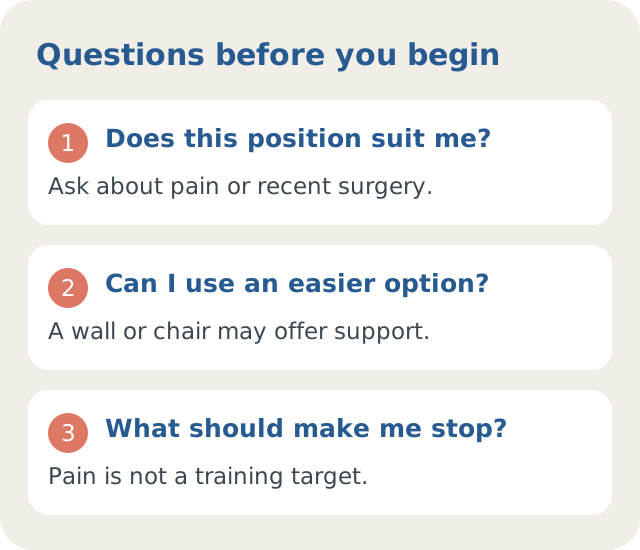
The bridge and the hands-and-knees exercise ask you to organize your body in different positions. That makes comfort in the setup a useful first decision. Can you lie on your back with bent knees without discomfort? Can you rest on hands and knees without painful pressure? Answer those questions before deciding how many repetitions to attempt. A movement that looks easy on a screen may be unsuitable for you, and that is information rather than a failure.
If both positions are comfortable, choose the one whose instructions you understand best. There is no need to alternate rapidly between them or assemble a circuit on your first attempt. You might read the bridge demonstration, practice the setup, then decide whether you need someone to check your position. Another person may prefer learning how to stay steady on hands and knees. Neither choice needs to become a permanent rule.
If neither position works, use that as the starting point for a different plan. The NHS strength exercise guide includes seated and standing choices, such as sit-to-stand movements and wall press-ups. These are broader strengthening options, not interchangeable treatments for a particular abdominal problem. A qualified professional can help select exercises for your needs without insisting that every session involve a mat.
For example, someone who can walk comfortably but cannot kneel does not need to postpone all activity until kneeling becomes possible. They can discuss a suitable standing or seated strengthening plan while continuing other activity that already fits their circumstances. The decision is about access to movement, not completing every exercise category in this article.
Use a brief technique check instead of chasing a perfect pose
Before you begin, put the instructions where you can read them without twisting to look at a phone. Read the whole sequence, including how to return to the starting position. A photograph shows a moment; it does not necessarily show how someone got there. If you cannot understand the transition, ask for a demonstration before attempting a harder version.
During practice, keep your check simple: Am I still breathing? Do I understand which part is supposed to move? Can I return without rushing? Is the position comfortable? These are practical prompts, not a diagnostic test or a score. Their purpose is to help you notice when a session has become confusing or unnecessarily difficult.
Common traps include treating the recommended hold as a contest, squeezing as hard as possible, and continuing after losing track of the instructions. Another is copying the most advanced option because it is the largest image on the page. Choose the written starting version rather than the most impressive picture. You can pause, reread, and start again without trying to rescue a repetition halfway through.
It is also reasonable to ask a trainer or physical therapist to check a movement before adding difficulty. A useful request is specific: “Please show me where my hands belong and what should stay still.” That is easier to act on than a vague concern that you are somehow doing your entire workout incorrectly.
Plan a repeatable practice, then decide how to progress
For a first practice, the task may simply be learning the setup and deciding whether an exercise belongs in your routine. That is different from a complete strength workout. Avoid turning a learning session into a self-prescribed rehabilitation program with a fixed number of weeks, daily holds, or a promise that symptoms will disappear by a deadline.
The NHS advises gradual progression over weeks when building strength. Use that general principle rather than copying someone else’s starting level. When a movement feels familiar, decide what you want to change and why. Perhaps you need clearer technique before anything else. Perhaps you are ready to ask about a more demanding variation. Adding time, repetitions, and difficulty simultaneously makes it harder to understand which change was manageable.
Write a modest plan in ordinary language: “I will review the demonstration before practice, choose a comfortable version, and note any question I cannot answer.” If you already have a professionally designed program, follow that instead of stacking these exercises on top. More instructions from more articles do not automatically produce a better routine.
Keep the record short. Note the date, exercise version, what felt straightforward, and what needs clarification. If you change something, record that too. You do not need a detailed spreadsheet or a daily photograph. The point is to make the next decision easier and to give a professional useful context if you need help.
Separate strength goals from appearance promises
A useful goal describes something you want to practice or understand: learning a controlled bridge, finding an alternative to kneeling, or including abdominal work in an existing strength plan. A vague promise to “fix your core” does not explain the problem, the outcome, or how progress will be judged. Ask what an exercise is intended to help you do before accepting its promotional language.
Appearance is a separate issue. This guide does not offer a waist-size target, a method to remove fat from one area, or a timeline for visible abdominal muscles. Comparing your body with a demonstration photograph cannot establish whether an exercise is useful for you. Clothing, lighting, the person’s starting point, and the purpose of the image all differ from your situation.
Instead, choose questions you can answer honestly. Do you understand the setup better? Can you identify a comfortable option? Have you made room for broader activity rather than replacing it with a single fashionable routine? Those observations do not diagnose your health or measure every aspect of fitness, but they can help you organize a sensible next conversation and avoid buying a program on the strength of a dramatic promise.
Know the limits of a general exercise guide
AAOS advises that its exercises should not hurt. Stop an exercise that causes pain and seek advice about the cause and appropriate alternatives. Mayo Clinic recommends checking with a healthcare professional before its core exercises if you have back problems, osteoporosis, or other health concerns. A list of exercises cannot assess those individual needs.
Established exercise guidance supports core strengthening as part of a broader program. It does not establish that one branded “deep core” sequence is best for everyone. This article promises neither a cure for pain nor a particular change in body shape. The useful outcome is a clearer starting point and better questions about what suits your body.
About this article
This original GHAC article was inspired by Health.com’s article on deep core exercises.
Information here is educational and does not replace personalized medical advice.
Frequently asked questions
Do deep core exercises require equipment?
These examples do not require weights or machines. A comfortable mat and enough clear space may help. Suitability and technique matter more than buying equipment.
Should I hold my breath to engage my core?
No. Mayo Clinic advises breathing freely during core exercises. If you cannot breathe comfortably in a position, stop and reset rather than extending the hold.
Will this routine cure my back pain?
It cannot promise that. Back pain needs an individual assessment when persistent or concerning. Ask a qualified professional which movements fit your situation. If you ask for an assessment, describe where the discomfort occurs, which position brings it on, how long it has been happening, and any previous advice you have received. Those details are more useful than calling the problem a weak core without knowing its cause.
Is the hardest version the most effective?
Not necessarily. Choose a version you can control comfortably. Progression should fit your ability and goals rather than an online demonstration. Staying with a familiar option can be sensible while you learn the movement. If you want to progress but do not know how, bring the current version and your goal to a qualified professional.
Choose one comfortable starting point
Review one linked demonstration, decide whether its setup is comfortable, and write down any question you want answered before progressing.
More everyday wellbeing reading

Carbohydrate Timing and Blood Sugar: What Matters Most
Explore what meal timing and food order may mean for blood sugar, with practical meal ideas, study limitations, and questions for your care team.
Read article →
Everyday Agility: Start With Steady Movement
Build a practical foundation for changing direction with supported balance practice, slow steps, and a careful approach to progression.
Read article →
Strength Training and Cardio: Make Room for Both
Understand how strength training and cardio complement each other, what adult activity guidelines recommend, and how to start with a manageable week.
Read article →