
RESEARCH & GUIDELINES
Coffee and Liver Health: What the New Study Can Tell Us
A large coffee study adds evidence about liver health. Understand the findings, caffeine considerations, and why an association is not a treatment.

A familiar drink is back in health headlines. New research connects coffee drinking with more favorable liver outcomes, adding to an already active area of investigation. For someone who enjoys coffee, that is interesting news. It is also easy to turn the finding into a stronger message than the study can support.
The useful question is not whether coffee has suddenly become medicine. It is what this research adds, which uncertainties remain, and whether the findings justify changing your own routine. This Research & Guidelines explainer separates the population-level result from an individual drinking recommendation.
What is new in the research
The study, published online July 1, 2026, in Clinical Gastroenterology and Hepatology, followed 354,957 UK Biobank participants without cirrhosis or hepatocellular carcinoma at baseline. Over a median 13 years, higher reported coffee intake was associated with fewer diagnoses of cirrhosis and that common form of liver cancer, and fewer liver-related deaths. The primary study abstract hosted by UK Biobank provides the methods and results.
For participants reporting at least five cups daily, adjusted hazard ratios versus non-drinkers were 0.68 for cirrhosis, 0.53 for liver cancer, and 0.58 for liver-related death. These are relative comparisons of event rates over follow-up. They are not percentage-point reductions in a person’s chance of disease, and the abstract does not provide a personal absolute benefit.
That distinction matters whenever a headline presents an impressive percentage. A result can be statistically persuasive while leaving a practical question unanswered: how much difference would this make for someone with my health history? A population estimate does not supply that answer by itself.
Consider a purely illustrative comparison: a relative reduction of one third would have a different absolute meaning if the starting event rate were three in a hundred than if it were three in ten thousand. Those are not this study’s event rates. The example simply shows why a relative figure cannot stand alone as a personal estimate. Your starting risk and the timeframe matter to interpreting any possible benefit.
Several kinds of evidence, one important boundary
The same project included liver MRI information for 28,961 participants and blood-protein measurements for 44,633. Favorable imaging and protein patterns accompanied coffee intake. Associations were also reported for both caffeinated and decaffeinated coffee. These details are described in the original paper.
Think of those measurements as different windows onto the same research question. Health records describe clinical events; imaging examines features of the liver; protein measurements offer clues for further biological investigation. Agreement across those windows makes a finding more interesting, but does not transform a nonrandomized study into a randomized trial.
The coffee groups were formed by people’s existing habits. Investigators did not decide who would drink coffee and then keep all other influences identical. A large sample makes an estimate more precise; it cannot automatically remove differences between the people being compared. The strongest reading is that the findings deserve further attention, not that every uncertainty has disappeared.
Why an association cannot write your prescription
In observational research, people who choose one habit may differ from others in many ways. Statistical adjustment is intended to account for measured differences, but an unmeasured influence or an imperfect measurement can remain. That general research limitation is especially important when an everyday habit is being linked to long-term illness.
There can also be questions about which came first. Someone who feels unwell may change beverage habits, while another person may maintain the same routine for years. Without the relevant data and an appropriate design, it is difficult to separate all the possible explanations. This is a reason to read cautiously, not a reason to discard every observational result.
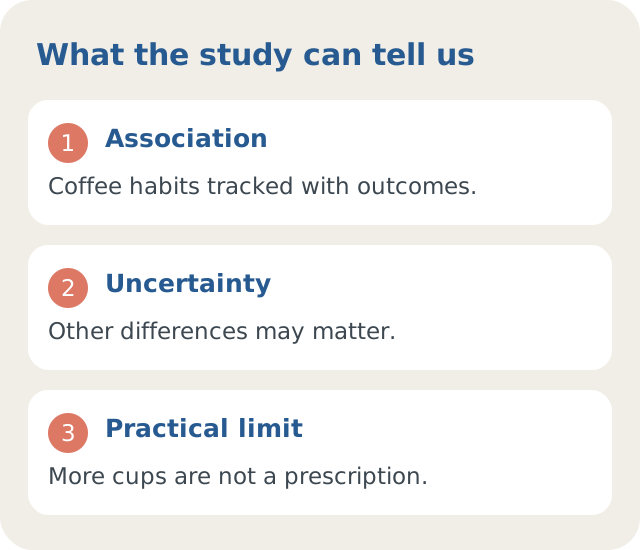
For a practical check, ask whether the research tested an action or described an existing pattern. Here, the finding describes coffee drinking and subsequent outcomes. The next question, whether asking a particular person to add coffee would improve that person’s health, is a different research problem.
Five cups is a study category, not a daily goal
A high-intake category helps researchers compare groups. It does not define a serving prescription, an optimum amount, or a level everyone can tolerate. The study’s most dramatic comparison should not become a personal challenge to add another cup.
The research team’s explanation at Cedars-Sinai says associations were seen even at one or two cups daily and explicitly states that the research cannot establish coffee as the cause of the better outcomes. Its practical message is more restrained than a five-cup headline may suggest.
If you already drink coffee comfortably, there is no requirement to change the routine to match a study group. If you dislike coffee, the news does not create a new obligation. A drink can remain a preference rather than becoming another health task to complete.
Count caffeine separately from cups
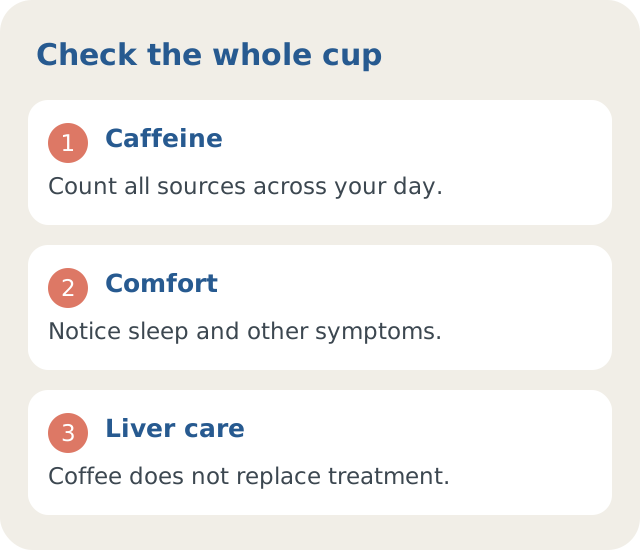
The FDA’s caffeine guidance cites 400 milligrams daily as an amount not generally associated with negative effects for most adults. It is not a target or a guarantee for every person. The FDA notes substantial variation in sensitivity, medications, health conditions, and product caffeine content.
A coffee cup is not a standardized dose. The FDA lists a typical 12-fluid-ounce brewed coffee range of 113 to 247 milligrams. Several large coffees can therefore mean something quite different from several small servings. Consider caffeine from all sources, including other drinks, supplements, and some medicines.
Check the serving size on the product or ask the café for information. A useful personal inventory is the drink, its size, its caffeine content when known, and the time you have it. This is a way to make your current routine visible, rather than an instruction to increase or optimize a dose.
Imagine two people who each describe themselves as having two coffees. One uses small cups at home; the other buys large drinks with different preparations. Their cup counts match, but the exposures may not. Before applying a research number to a routine, make sure the everyday word cup has not hidden the most relevant difference. Asking about size and preparation is more useful than assuming the label tells the whole story.
Comfort and sleep still matter
The FDA identifies sleep disruption, jitters, anxiety, upset stomach, and palpitations among possible signs of too much caffeine. It recommends discussing intake with a healthcare professional when symptoms occur. People who are pregnant, trying to conceive, or breastfeeding should ask about their own limit rather than applying a general adult figure.
A favorable liver headline does not make an unpleasant reaction irrelevant. If a drink interferes with your daily life, bring that experience into the decision. A benefit discussed for a population cannot tell you to ignore what is happening in your own routine.
For example, an afternoon coffee that feels difficult to give up can be discussed as part of a sleep conversation, rather than defended because of a liver study. The aim is a workable overall pattern. If you want to reduce regular caffeine, the FDA suggests doing so gradually because withdrawal can be uncomfortable.
Decaf is an option, not a proven substitute treatment
The association with decaffeinated coffee is a reason researchers are interested in compounds beyond caffeine. In their study discussion, the Cedars-Sinai team describes several possible biological explanations while acknowledging that the responsible compounds remain uncertain.
This does not prove that a specific decaf product prevents disease or that a coffee extract will reproduce the association. A food habit, a concentrated supplement, and an isolated chemical are different exposures. Evidence about one cannot simply be transferred to the others.
Decaf may be a beverage preference for someone who wants less caffeine. The FDA notes that it still contains some caffeine, so it may not suit someone who reacts strongly even to small amounts. Discuss the actual product and your symptoms if uncertainty remains.
What you add belongs in the bigger picture
The study should not be used to declare a sweetened specialty drink a liver-health product. An ingredient label, serving size, and your usual food pattern remain relevant even when the central ingredient has attracted research interest.
For people with fatty liver disease, NIDDK’s nutrition guidance discusses food choices, avoiding drinks with large amounts of simple sugars, and minimizing alcohol because it can further damage the liver. Those broader considerations should not be displaced by interest in coffee.
One useful question is whether the drink is something you enjoy alongside meals or a frequent large dessert-like purchase. That question does not require judging every addition as good or bad. It helps keep an ordinary decision proportionate to the whole day instead of letting one research headline dominate it.
Keep liver care anchored to your own history
Coffee is not a way to cancel the effects of alcohol, diagnose liver trouble, or replace treatment. If you have an abnormal liver test or a diagnosed condition, ask what follow-up and care are needed for that particular problem. The research here does not establish a treatment plan for any individual liver disease.
NIDDK’s fatty liver disease guidance describes the role of physical activity and, when appropriate, gradual weight management. It also cautions that some herbal products can damage the liver. This article does not offer a weight-loss program, supplement recommendation, or medicine advice.
Bring a brief list of the medicines, supplements, and beverages you actually use. A concrete description is more useful than asking whether coffee is healthy in the abstract. Your clinician can consider that routine alongside test results, symptoms, and the reason for the appointment.
If you are helping a family member prepare for a visit, ask permission to write down the questions together. Keep the coffee question separate from the main reason for care, such as a test result that needs explanation. That makes it easier to ask about a familiar habit without allowing it to crowd out a more important discussion. Leave with a clear understanding of the next agreed step.
A sensible response to an interesting headline
You do not need to act on every new association. One reasonable response is to understand the result and keep your present routine while more evidence develops. Another is to raise a specific question at a visit you already have planned.
Write the headline in plain language before sharing it: a large observational study found a link between coffee and better liver outcomes. Keep the word link in the sentence. Avoid saying the study proved prevention, that five cups are required, or that coffee can treat existing disease.
For your next conversation, ask: Does my current coffee intake fit my health needs? Is caffeine a concern with my medicines or symptoms? Is there a more important liver-health issue for me to address? The most useful takeaway is a clearer decision, not a larger mug.
A simple way to share the news responsibly is to send the research link with one sentence about its limit. Someone receiving a screenshot may never see the caution several paragraphs below the headline. Including it in your own message preserves the context. The purpose is not to dampen interest, but to keep a possible benefit from becoming an instruction that the study never tested.
Keep the original source with any notes you save. If advice changes later, that record helps you distinguish the earlier finding from a new interpretation and decide which question is worth revisiting.
About this article
This original GHAC article was inspired by Health.com’s article on coffee and liver health.
Information here is educational and does not replace personalized medical advice.
Frequently asked questions
Should I start drinking coffee to protect my liver?
This study is not a reason to start solely for liver protection. It reports an association, not proof that adding coffee prevents disease. Your preferences, caffeine sensitivity, medicines, and health history matter more than matching a research category.
Does the study mean five cups a day are recommended?
No. At least five cups was one category used to compare participants. It was not a randomized dose recommendation, and cup sizes and caffeine amounts vary. A high-intake research group should not become your daily target.
Could decaf have similar associations?
The study reported favorable associations for both caffeinated and decaffeinated coffee. That supports further research into non-caffeine compounds, but does not establish a treatment effect or prove that every preparation has the same result.
Can coffee replace care for fatty liver disease?
No. Continue the care plan recommended for your condition and discuss questions with your clinician. Coffee does not replace follow-up, prescribed treatment, nutrition advice, or conversations about alcohol and other liver risks.
Put your current routine in context
If coffee is part of your day, note the serving size and other caffeine sources. Bring one specific question about your own routine to your care team.
More everyday wellbeing reading

Shingles Vaccines and Heart Health
New studies link shingles vaccination with better cardiovascular outcomes. Understand the evidence, its limits, and current vaccination guidance.
Read article →
Light at Night and Heart Health
A large study linked brighter nights with cardiovascular disease. Understand the limits and consider practical sleep changes without sacrificing safety.
Read article →
Hormone Therapy and Dementia
Understand conflicting hormone-therapy and dementia findings, current FDA labeling changes, and why symptom treatment differs from dementia prevention.
Read article →