
RESEARCH & GUIDELINES
Mediterranean Eating and IBS: What a Small Trial Can Tell Us
A small 2025 trial explored Mediterranean eating for IBS. Understand the findings, the limits, and how to discuss a flexible food plan with your care team.

If you live with irritable bowel syndrome, another diet headline can bring both hope and homework. Could a familiar eating pattern help without adding a longer list of foods to avoid? A small Mediterranean-diet trial offers an interesting starting point for that conversation.
The study was published in 2025. This is a look at existing research, not an announcement of a new 2026 treatment. Its findings invite more investigation while leaving plenty of room for individual needs and professional guidance.
What researchers actually tested
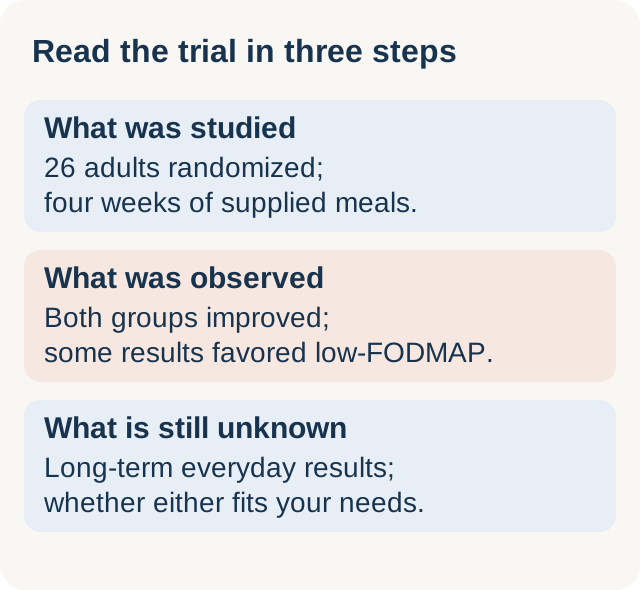
The original randomized pilot trial enrolled 26 adults with diarrhea-predominant or mixed-pattern IBS. Twenty finished the four-week study. Researchers supplied meals for both the Mediterranean and low-FODMAP groups, an important difference from choosing and preparing food independently.
Both groups improved on the main abdominal-pain measure. However, the low-FODMAP group had a greater reduction in the overall IBS symptom-severity score. The authors called for larger studies in everyday settings before routinely recommending Mediterranean eating as an IBS therapy.
Why improvement does not establish equivalence
A small study can help researchers decide whether a larger trial is worthwhile. It is much less reliable for deciding whether two approaches work equally well. A comparison that does not show a statistically significant difference is not automatically proof of equivalence.
Four weeks also cannot answer whether benefits persist, whether the plan remains affordable, or how well people manage when meals are no longer delivered. The trial focused on nonconstipated IBS, so its findings should not be extended to constipation-predominant IBS.
A nutritious pattern still needs personal tailoring
Mediterranean-style eating often includes vegetables, fruit, grains, legumes, nuts, olive oil, and fish. But a food can contribute useful nutrients and still be uncomfortable for a particular person. The NIDDK nutrition guide emphasizes that different dietary changes help different people with IBS.
You do not have to prove that a food is unhealthy before asking for a preparation or portion you tolerate better. A dietitian can help preserve variety while working around symptoms. General eating-pattern labels are less useful than the meals you can comfortably repeat.
Low-FODMAP is a process, not a permanent ban
FODMAPs are certain carbohydrates that can trigger symptoms in susceptible people. Monash University’s three-step approach begins with a short restriction phase, followed by reintroduction and then personalization. Its purpose is to identify tolerances and expand the long-term diet.
Do not turn a trial of one approach into several overlapping elimination diets. Combining strict rules can make shopping, social meals, and adequate nourishment harder. Ask what each restriction is meant to test and when you will review it.
Make your next appointment more useful
Bring a short account of what is difficult: pain after lunch, unpredictable bowel habits, fear of eating away from home, or the cost of preparing separate meals. Include any treatments you already use. That gives the conversation a clearer purpose than asking for the best diet in general.
Ask which symptom you will track, how long to try a change, and what result would justify continuing. Agree on a review point before you begin. A simple record of meals and symptoms can support the discussion without requiring constant scoring or judging every bite.
Keep the goal connected to ordinary life
A workable plan should make room for food preferences, cultural meals, your budget, and the person who does the cooking. For example, bring a familiar recipe to an appointment and ask which ingredient or portion might be adjusted while keeping the meal recognizable.
If your usual breakfast works well, it may not need to change just because a headline recommends a new pattern. Start with the part of the day that is actually difficult. This is a planning example, not a meal intervention tested in the trial.
About this article
This original GHAC article was inspired by Health.com’s report on Mediterranean eating and IBS.
Information here is educational and does not replace personalized medical advice.
Frequently asked questions
Does Mediterranean eating treat every type of IBS?
No. This small trial involved diarrhea-predominant and mixed-pattern IBS. It does not establish benefits for every subtype or prove that a diet will work for a particular person.
Should I stop a low-FODMAP plan that helps?
Do not replace an effective, individualized plan on the strength of this pilot. Discuss your goals and any difficulties with your clinician or dietitian, including how to broaden foods safely.
Does low-FODMAP mean avoiding trigger foods forever?
No. The structured approach includes reintroduction and personalization so the long-term diet can include foods and amounts you tolerate.
Bring one practical question
Choose one meal or symptom that makes daily life difficult, and ask your care team what a manageable, time-limited trial would look like.
More everyday wellbeing reading
Lowering Cancer Risk: Practical Steps Without the Promise of Certainty
Understand evidence-based cancer prevention, from tobacco and alcohol to vaccines, sun protection, movement, and a personal screening plan.
Read article →
Light at Night and Heart Health
A large study linked brighter nights with cardiovascular disease. Understand the limits and consider practical sleep changes without sacrificing safety.
Read article →
Hormone Therapy and Dementia
Understand conflicting hormone-therapy and dementia findings, current FDA labeling changes, and why symptom treatment differs from dementia prevention.
Read article →