
RESEARCH & GUIDELINES
Light at Night and Heart Health
A large study linked brighter nights with cardiovascular disease. Understand the limits and consider practical sleep changes without sacrificing safety.

A bright bedroom is an easy detail to overlook. A large study linking nighttime light exposure with later heart problems has made that ordinary detail newsworthy. But a research association is not a diagnosis, and a darker room is not a proven substitute for heart care.
Here is a measured way to read the findings: separate what researchers observed from what they tested, consider familiar sleep guidance, and protect the lighting you need for safety.
What is the news?
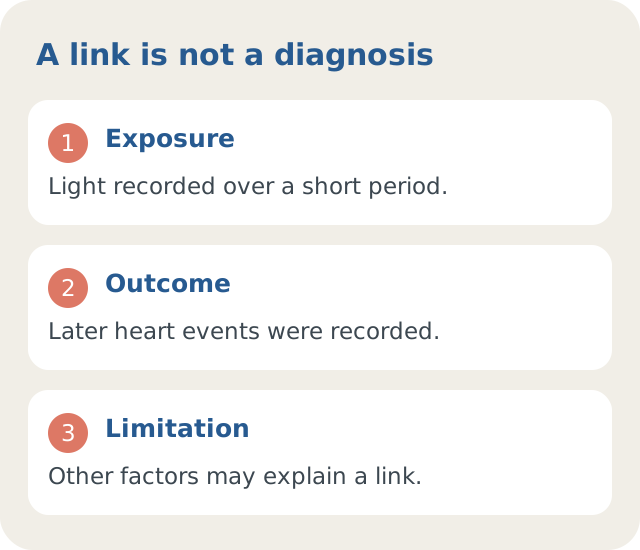
A large 2025 JAMA Network Open study found that brighter personal light exposure at night was associated with subsequent cardiovascular disease. It included 88,905 UK Biobank adults older than 40. Participants wore wrist light sensors for one week, and researchers examined later health records. The average participant was about 62. This was an observational cohort, not an experiment assigning people to brighter or darker bedrooms.
That distinction determines what the news means. The study raises a worthwhile question about a common environmental exposure. It does not establish that a bedside lamp caused someone’s heart disease, or that a new curtain will prevent a heart attack. The useful response is proportionate: understand the evidence, consider ordinary sleep habits, and keep established cardiovascular care in place.
The research was published in October 2025. We are reviewing it here with current guidance checked in October 2026. A recent newsletter link does not necessarily mean a newly conducted study. Keeping those dates visible helps you distinguish a new explanation of existing evidence from an entirely new discovery.
Read the numbers without turning them into a personal forecast
In the study’s main reported comparisons, the brightest-night group had higher hazards of several outcomes than the darker-night reference group. The abstract reports adjusted hazard ratios of 1.47 for heart attack and 1.28 for stroke. These compare groups over time. They are not percentage-point increases in a person’s likelihood of having an event.
For a purely hypothetical example, suppose two comparable groups had event probabilities of 2% and 3% over the same period. That would be a one-percentage-point absolute difference and a 50% relative increase. Those are invented teaching numbers, not the results of this study. They show why a large relative percentage can sound more dramatic than the underlying absolute difference.
A hazard ratio also is not exactly the same measure as the ratio of those two probabilities. Avoid converting it into a prediction for yourself. Personal risk depends on your starting circumstances and the time frame. A headline cannot replace an assessment of blood pressure, cholesterol, smoking, medical history, and other relevant factors.
What the study can and cannot separate
The investigators adjusted their analyses for several established cardiovascular and lifestyle factors. Adjustment helps address measured differences between groups, but it cannot make an observational study equivalent to a randomized trial. A factor can be measured imperfectly, change after it is recorded, or remain unmeasured entirely. “Adjusted” is a useful methods word, not a guarantee that every alternative explanation has disappeared.
The authors identify important limitations: light tracking covered a single week, light sources were not identified, and the cohort was predominantly White. The findings therefore do not specify which household light source to remove, establish a universal safe brightness threshold, or necessarily describe every population equally well.
One person’s nighttime light may accompany work, another’s caregiving, another’s disrupted sleep. Those situations are not interchangeable. It would be a mistake to use a group association to judge someone’s habits without understanding why the light is on. Better research can refine the question without making readers responsible for solving every uncertainty themselves.
Why ordinary sleep advice is still relevant
The National Heart, Lung, and Blood Institute’s sleep guidance recommends a quiet, cool, dark bedroom and avoiding bright artificial light in the hour before bed. It explicitly allows a dim night light when needed. These are sleep-supporting suggestions, not a prescription derived from this cardiovascular study.
Use that guidance as the practical starting point rather than trying to reproduce research sensor readings at home. You do not need to identify a perfect lux number, buy a specialist meter, or turn your bedroom into a laboratory. A comfortable space that makes sleep easier is a reasonable goal in its own right.
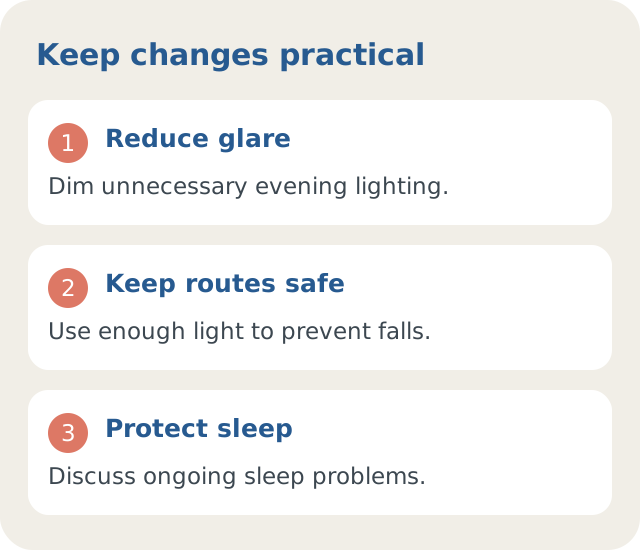
Keep the aim concrete. Perhaps the television remains on after you fall asleep, a decorative lamp serves no overnight purpose, or streetlight shines directly toward the bed. Notice what is actually present before making purchases. An unused light can be switched off; a necessary light needs a different conversation. Those are household decisions, not proof that your future cardiovascular risk has changed.
Make a simple light inventory
Look around the room at the time you usually go to bed. List the sources you can identify: overhead lighting, a bedside lamp, a television, device screens, indicator lights, hallway spill, and outdoor lighting. Then separate them by purpose. Which help someone move safely? Which support care? Which remain on simply because nobody has changed the routine?
Choose one unnecessary source to address first. You could set a television to turn off, move a bright display out of your direct view, or close existing curtains. Check the result from the bed and from the route you use when getting up. A change is not useful if it solves glare but creates a practical problem elsewhere.
Treat this as an example of organizing your surroundings, not a validated heart-prevention protocol. Keep it inexpensive and reversible. If the room is already comfortable and you sleep well, the study does not require you to keep searching for smaller and smaller sources of light. There is no evidence here for an endless pursuit of perfect darkness.
Preserve visibility where it is needed
The CDC’s NIOSH sleep-environment advice pairs a dark sleeping area with keeping a clear path to the bathroom. That combination matters. Think about the person using the room, rather than treating darkness as the only design objective.
If someone needs to get up overnight, assess the path together. Shoes, cords, loose objects, and furniture may matter as much as the light switch. Consider how a partner, visiting family member, caregiver, or person using a mobility aid will navigate. Do not remove necessary lighting because a research headline sounds urgent.
There is no need to argue that every light is either harmless or dangerous. A better question is whether the existing arrangement provides the visibility you need without unnecessary glare into the sleeping space. If vision, mobility, or falls are concerns, ask a qualified professional about a suitable home setup. This article cannot assess those individual needs from a description of the room.
Shift work and caregiving need a different approach
NHLBI gives separate suggestions for shift workers, including reducing light and sound distractions during daytime sleep and discussing persistent difficulties with a healthcare professional. Its guidance also recognizes that alertness at work matters. The right lighting while performing a task is not necessarily the right lighting while resting.
If your schedule includes nights, do not interpret this study as an instruction to work in darkness or compromise safe driving, caregiving, or clinical tasks. Write down the part of the schedule you can influence. That may be the sleeping room after a shift, a discussion about shift patterns, or arranging help so you can protect a rest period.
For caregivers, a useful plan may involve sharing responsibilities and making necessary nighttime tasks easier to complete. A newborn, an ill family member, or someone needing assistance changes what is realistic. The question is how to support rest within those circumstances, not whether you have failed to match a routine designed for someone else’s life.
Evaluate sleep changes by the problem they address
If poor sleep is affecting daily activities, NHLBI recommends talking with a clinician. A one-to-two-week sleep diary can help describe sleep timing, naps, daytime sleepiness, caffeine, alcohol, and activity. That is more useful for a consultation than a general statement that your room is probably too bright.
For example, record that you woke several times and found it difficult to return to sleep, rather than declaring that a streetlight caused insomnia. Include what you changed and whether you noticed any difference. The record helps organize an assessment; it does not diagnose the cause or measure long-term heart risk.
If a simple adjustment does not help, avoid escalating automatically to expensive sleep products. Bring the persistent problem to a qualified professional. A lighting discussion is one part of a broader sleep history. The appropriate next step depends on the symptoms, how long they have been present, and how they affect functioning, not on whether a product advertisement cites a large study.
Turn a household disagreement into a workable plan
Consider a shared bedroom where one person falls asleep with the television on and another finds the light distracting. The first discussion does not need a claim about heart attacks. Ask what each person needs from the arrangement. Is the television providing background sound, company, or an evening routine? Can that purpose be met before bedtime or with a timer? Start with the actual problem rather than using the research as an argument-ending rule.
Then agree on a small trial of the new arrangement and a time to discuss whether it works. Check both comfort and practicality. If somebody needs a light to manage medication or assist a family member, keep that need in the plan. The successful result is a setup people can use consistently, not the darkest photograph of the room. That distinction makes a modest environmental change more likely to last and less likely to become another source of bedtime tension.
Keep heart-health priorities in view
The American Heart Association’s Life’s Essential 8 includes sleep alongside eating well, physical activity, avoiding tobacco, and managing weight, cholesterol, blood sugar, and blood pressure. Nighttime lighting should fit within that larger picture. A sleep-friendly room does not replace prescribed treatment or routine follow-up.
If you have limited time or resources, use a visit to identify which issue deserves attention first. You might ask whether your blood pressure is adequately managed or whether a sleep problem warrants assessment. Avoid letting a novel, visible household change crowd out a familiar medical priority simply because the new topic is easier to photograph or buy.
Our practical approach is to make the low-effort change that suits your circumstances, then return to the care plan you already need. You do not have to choose between taking sleep seriously and maintaining perspective. A promising research direction can be worth following without becoming the central explanation for your health.
Know when this is no longer a bedroom question
CDC stroke guidance emphasizes acting quickly for sudden face or limb weakness, trouble speaking, sudden vision problems, difficulty walking, or a severe unexplained headache. Call 911 for possible stroke symptoms. Do not spend time adjusting lighting, searching for a sleep explanation, or waiting for symptoms to settle.
For everyday planning, choose a modest next step: identify one unnecessary nighttime light, preserve a safe route through the room, and note any sleep difficulty worth discussing. That is an appropriate use of the evidence. Claiming that the change prevents a specific future event would go beyond what this study establishes.
This article is general health education, not personal medical advice. It does not diagnose cardiovascular disease or a sleep disorder, recommend changing medication, or determine the lighting needed for an individual’s safety. The durable takeaway is to take sleep conditions seriously while remaining precise about what research has and has not shown.
About this article
This original GHAC article was inspired by Health.com’s coverage of nighttime light and cardiovascular risk.
Information here is educational and does not replace personalized medical advice.
Frequently asked questions
Does sleeping with a light on cause heart disease?
This study cannot establish that. It found an association between brighter nights and later cardiovascular outcomes. It did not assign people to lighting conditions or test whether changing bedroom lights prevented events.
Should I remove my night light?
Not if you need it for safe movement or care. NHLBI says a dim night light is acceptable when needed. Reduce unnecessary glare while preserving a suitable route through the room.
Do I need blackout curtains or special glasses?
The study does not establish a particular product as necessary or prove that buying one prevents heart disease. Start with the lights and curtains you already have. Choose changes that fit your sleep and safety needs.
What if I work nights?
Use guidance suited to shift work, and never compromise safe working or driving. Discuss persistent sleep difficulties with a healthcare professional rather than trying to apply a conventional bedtime routine to an incompatible schedule.
Make one sensible sleep-space change
Identify an unnecessary light, preserve safe visibility, and bring persistent sleep concerns to your healthcare professional.
More everyday wellbeing reading

Shingles Vaccines and Heart Health
New studies link shingles vaccination with better cardiovascular outcomes. Understand the evidence, its limits, and current vaccination guidance.
Read article →
Hormone Therapy and Dementia
Understand conflicting hormone-therapy and dementia findings, current FDA labeling changes, and why symptom treatment differs from dementia prevention.
Read article →
Coffee and Liver Health: What the New Study Can Tell Us
A large coffee study adds evidence about liver health. Understand the findings, caffeine considerations, and why an association is not a treatment.
Read article →