
HEALTH JOURNAL
Cognitive Health: Everyday Habits and When to Ask for Help
Support thinking and memory with practical everyday habits, sensible health checks, and clear guidance on changes that deserve medical attention.

Cognitive health is part of ordinary life: following a conversation, learning a new route, making a decision, or remembering what you meant to pick up at the store. Supporting it does not require turning every meal, walk, or hobby into a test of how well you are aging.
A useful approach combines everyday wellbeing with attention to changes. Practical habits can support thinking and memory, while a particular routine, supplement, or brain game cannot promise to prevent dementia.
Think beyond memory
Cognition includes attention, learning, reasoning, language, and decision-making as well as remembering. You can be having a hard time concentrating without having dementia. Equally, a persistent change in managing familiar tasks deserves attention even when remembering names is not the main concern.
The National Institute on Aging’s cognitive-health guidance encourages looking after general health, reviewing medicines, and treating hearing and vision problems. That wider view is useful because thinking does not happen in isolation from the rest of your health.
Instead of repeatedly testing yourself on small lapses, notice whether something is new, worsening, or disrupting daily life. Make room for curiosity rather than self-criticism. A calendar, written shopping list, or reminder on your phone is a practical aid, not evidence that you have failed.
Make movement manageable
The CDC’s dementia risk-reduction guidance includes physical activity, managing blood pressure and diabetes, avoiding smoking, and addressing hearing loss. These steps have value for overall health while also forming part of a broader approach to brain health. Risk reduction is not a guarantee that an individual will avoid disease.
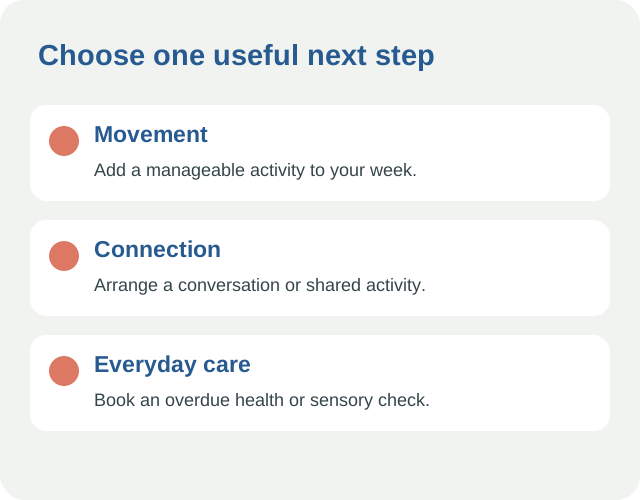
For movement, start with something that fits your ability and surroundings: a short walk, dancing at home, adapted exercise, or a community class. An ambitious plan you dread is less useful than an activity you can repeat. If pain, breathlessness, balance problems, or another condition limits you, ask for help finding a suitable option.
Pair activity with an existing cue, such as finishing lunch or switching off the work computer. Keep the first step small enough to repeat on a busy day. You can gradually build from there without judging the whole week by one missed session.
Our everyday walking guide offers flexible ways to make a manageable activity part of your week.
Include everyday medical care
Blood pressure deserves attention even when you feel well. The NIH’s SPRINT research overview reports that more intensive blood-pressure treatment reduced mild cognitive impairment in the studied population. This finding does not mean everyone should adopt the trial’s target or change medicines independently.
Ask your clinician what blood-pressure goal fits your circumstances and how to check readings accurately at home if recommended. Bring a record rather than reacting to one isolated number. If treatment causes dizziness or other problems, report them so the plan can be reviewed.
Bring sleep and mood concerns into the same conversation. A difficult night can make an ordinary day feel mentally harder. Repeated poor sleep, heavy daytime sleepiness, or low mood deserves care in its own right. Do not assume that being older means you must simply put up with these problems.
Treat hearing and vision as everyday essentials
If conversation has become harder to follow, or reading and driving are more difficult, arrange an appropriate hearing or eye assessment. Better access to conversation and surroundings can make daily life easier. You do not need a promise about dementia prevention to justify getting help.
The ACHIEVE randomized trial studied adults ages 70 to 84 with untreated hearing loss. Hearing intervention did not significantly reduce three-year cognitive decline across the full study group. A higher-risk subgroup benefited, which is encouraging but does not support saying hearing aids prevent dementia for everyone.
Practical adjustments can help while you arrange care: face the person speaking, reduce background noise, use good lighting, and wear the glasses or hearing devices prescribed for you. If access or cost is a barrier, tell the care team rather than quietly withdrawing from activities you enjoy.
Choose engaging activities, not performance pressure
Choose something you actually want to return to: learning a song, discussing a book, gardening with a neighbor, trying a recipe, or joining a familiar community group. An activity can combine learning, enjoyment, and connection without needing a score or subscription.
The National Institute on Aging’s prevention review distinguishes promising research on cognitive training from broad claims about commercial brain games. Improving at a particular task does not automatically establish protection against dementia. Enjoy a puzzle if you like it, but do not treat missing a day as a health failure.
If social plans feel exhausting, start with one manageable contact rather than a full calendar. Suggest a brief call, a shared errand, or a regular walk. The point is to make participation easier, including for someone whose mobility, hearing, energy, or budget has changed.
Be cautious with brain-health products
The National Center for Complementary and Integrative Health says direct evidence that supplements prevent Alzheimer’s disease or other dementias is lacking. A product described as natural can still cause side effects or interact with medicines. Claims about sharpening memory should not replace an assessment of a new problem.
If a clinician identifies a deficiency or another condition, treatment may be appropriate. That is a different decision from buying a supplement because its label promises brain support. Bring the actual product label, dose, and frequency to a pharmacist or clinician before adding it to your routine.
Know when a change needs assessment
Occasionally losing track of a word or misplacing an item can happen with aging. The NIA’s guide to memory changes explains that more serious problems can also have causes beyond dementia. Persistent or worsening difficulty with familiar activities, getting lost, or trouble managing medicines and bills should prompt a healthcare appointment.
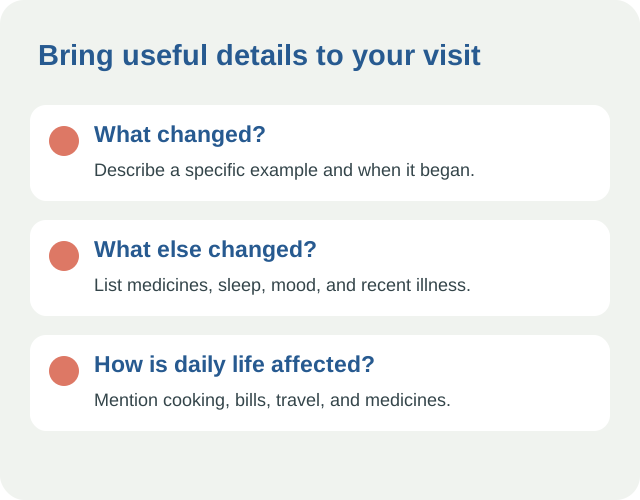
Write down specific examples, when they began, and whether someone close to you has noticed them. Bring a complete medicine and supplement list, including nonprescription sleep and allergy products. Ask whether illness, mood, sleep, or medicine effects could be contributing. Do not stop a prescribed medicine on your own.
Sudden confusion needs urgent medical attention. NINDS lists sudden confusion and trouble speaking among stroke warning signs. Call 911 for suspected stroke, including sudden face drooping, arm weakness, or speech difficulty, even if symptoms improve. Do not wait for a routine memory appointment or drive yourself.
About this article
This original GHAC article was inspired by Health’s article on cognitive health.
Information here is educational and does not replace personalized medical advice.
Frequently asked questions
Does forgetting a name mean I have dementia?
No. An occasional lapse does not establish dementia. New, persistent, worsening, or disruptive changes should be discussed with a healthcare professional.
Can healthy habits guarantee that I will avoid dementia?
No. Habits can support health and may reduce risk, but age, genetics, disease, and other factors also matter. Developing dementia is not proof that someone failed to look after themselves.
Are brain games necessary?
No. Enjoyable learning and social activities can fit everyday life. Commercial game claims should not be treated as proof of dementia prevention.
Should I buy a memory supplement?
Discuss it with a clinician or pharmacist first. Supplements have not been established as a way to prevent dementia, and they can cause side effects or medicine interactions.
What should I bring to a memory appointment?
Bring examples of changes, their timing, a medicine and supplement list, and notes about sleep, mood, or recent illness. With your permission, someone who knows you well may add useful observations.
Keep the next step simple
Small, repeatable choices are often the ones that last. Explore the Health Blog for more everyday wellbeing reading, or visit the Fitness collection for apparel that celebrates movement in real life.
More everyday wellbeing reading

Magnesium vs. Zinc for Sleep: Evidence and Safety
Compare what magnesium and zinc research really shows about sleep, understand supplement safety limits, and know when to seek sleep care.
Read article →
Wall Squats and Blood Pressure: What Once-a-Week Research Really Means
A closer look at the wall-squat study, why its starting phase matters, and how to build a realistic movement routine for heart health.
Read article →
Ultra-Processed Foods and Bowel Cancer: Beyond the Headline
What a large new study really found about ultra-processed foods, bowel cancer, and small food swaps that fit everyday life.
Read article →