
HEALTH JOURNAL
Wall Squats and Blood Pressure: What Once-a-Week Research Really Means
A closer look at the wall-squat study, why its starting phase matters, and how to build a realistic movement routine for heart health.

A once-a-week workout sounds appealing when your calendar is already full. But the details behind a blood-pressure headline change what you can reasonably take from it. A study about maintaining a benefit after several weeks of training is different from evidence that one weekly squat session is enough to begin with.
Here is the useful distinction: the new research studied a held wall squat, followed a specific training sequence, and measured short-term resting blood pressure. It offers a reason to discuss isometric exercise with your care team, without turning a promising result into a shortcut around regular movement or medical treatment.
Start with the study’s sequence
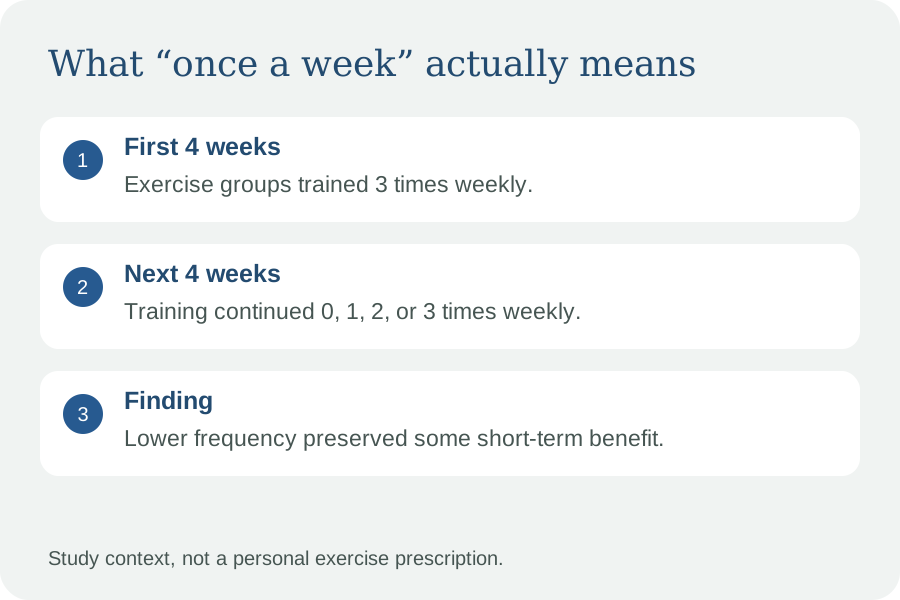
The 2026 randomized wall-squat trial included 100 adults with starting systolic pressure of 120 to 140 mm Hg. Exercise participants first trained three times weekly for four weeks, then continued for another four weeks at zero, one, two, or three sessions weekly. A separate control group kept its usual routine.
At eight weeks, the once- and twice-weekly groups retained some systolic blood-pressure benefit, while the three-times-weekly group had the greatest reduction. Stopping training lost the clear advantage over control. The lower-frequency phase lasted only four weeks.
Participants were not taking blood-pressure medicines, and the study excluded people with injuries or illnesses. This limits how confidently the result can be applied to someone with treated hypertension or other health conditions. The trial measured physiological outcomes, not fewer heart attacks or strokes.
A held wall squat is different from repeated squats
In a dynamic squat, you bend and straighten your hips and knees through repeated movements. In an isometric wall squat, your back rests against a wall while you hold a bent-knee position. Both can feel demanding, but they are different exercises. Evidence about one should not automatically become a promise about the other.
In this trial, researchers individually set the knee angle after testing participants. That is another reason not to treat a headline as a do-it-yourself prescription. A deeper hold, a longer hold, or a harder effort is not automatically a better choice for you.
The practical question is not how long you can endure burning legs. It is whether this form of exercise belongs in a plan that fits your blood pressure, joint comfort, medications, and current ability. A clinician or qualified exercise professional can help answer that.
Keep the bigger activity picture
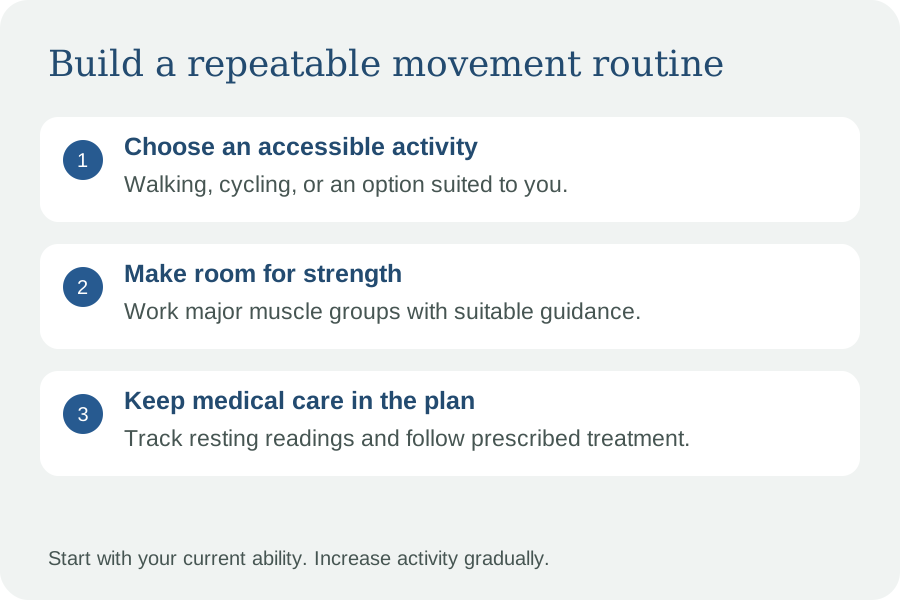
The American Heart Association activity recommendations advise adults to aim for at least 150 minutes of moderate aerobic activity weekly, or 75 minutes of vigorous activity, or a combination. Include muscle-strengthening activity at least two days weekly. These are general targets to work toward, with personal adjustments when needed.
Think about what your week can support. Walking with a friend, cycling indoors, dancing at home, or an accessible water-based activity may be easier to repeat than a workout you dislike. Strength work can complement that pattern instead of competing with it.
If you want a simpler starting point, our guide to everyday walking explores how to make movement part of a normal day. A weekly wall-squat session does not replace the wider benefits of staying active.
Make the first step easy to repeat
Choose a familiar place and a realistic moment. That might mean a short walk after lunch, a few minutes of gentle movement before dinner, or an activity session with someone whose company you enjoy. Put the plan where you will see it, such as beside your shoes or on your calendar.
Start from what you can do comfortably now. Avoid making a demanding wall-squat challenge the price of getting started. If standing movement is difficult, ask about seated options or a tailored program. Access, pain, fatigue, and confidence all matter when choosing activity.
Have a smaller version ready for difficult days. An indoor route or a shorter session can preserve the habit when weather or appointments disrupt your plans. This is a planning idea, not a claim that any particular small session reproduces the trial’s blood-pressure results.
Breathing and symptoms deserve attention
The American Heart Association’s exercise guidance recommends gradual warmups and cooldowns and regular breathing during exercise. Breath-holding and straining can raise blood pressure. An exercise that looks still can still be strenuous, so a wall hold should not be assumed safe simply because it involves no jumping or equipment.
Ask for individual advice before trying demanding holds if your blood pressure is uncontrolled, you have cardiovascular disease, or you have been told to limit certain activities. Mention knee or back pain and any dizziness with standing. Share the actual exercise you are considering, rather than asking only whether exercise is good.
Stop if you develop concerning symptoms. Chest discomfort, fainting, severe or unusual breathlessness, or stroke warning signs need urgent medical attention. Do not push through symptoms to finish a timer. For a broader introduction, see our exercise and high blood pressure guide.
Measure resting pressure, rather than judging by how you feel
You cannot reliably feel whether your blood pressure is improving. Follow a monitoring schedule agreed with your clinician. The American Heart Association home-monitoring instructions recommends an automatic upper-arm cuff with a suitable fit. Avoid exercise, caffeine, and smoking for 30 minutes beforehand, then rest quietly for at least five minutes.
Sit with your back supported, feet flat, and arm supported at heart level. Take two readings one minute apart and record them. Consistent conditions make the record more useful than chasing the lowest number immediately after a workout.
Bring the record to your care team and ask what trend they want you to watch. Continue prescribed medication unless your clinician changes it. A promising exercise study, or an encouraging home reading, is not a reason to reduce a dose yourself.
Use the headline to start a better conversation
A useful appointment question is: “Would a supervised introduction to wall-squat training suit me, and how would it fit with my other activity?” You can also ask what effort is appropriate, what symptoms should stop a session, and how your medications affect exercise advice.
If the answer is that another activity fits better, you have still gained something useful. The aim is a routine you can maintain with confidence. Research can expand the menu of options, but your plan should reflect your health and everyday life rather than a headline’s smallest number.
About this article
This original GHAC article was inspired by Verywell Health’s article on squatting and blood pressure.
Information here is educational and does not replace personalized medical advice.
Frequently asked questions
Can squatting once a week lower blood pressure?
This trial does not establish that starting with one weekly session is enough. Participants first completed four weeks of more frequent isometric wall-squat training. Once-weekly training then preserved some systolic benefit during a four-week maintenance phase.
Are wall squats the same as normal squats?
No. A wall squat holds a position against a wall. A dynamic squat repeatedly bends and straightens the legs. The new maintenance study tested isometric wall squats, so its findings should not be applied automatically to ordinary squat repetitions.
Should I replace walking with wall sits?
No. Aerobic activity and strength work each have a place in general activity guidance. Ask your care team whether isometric exercise could complement your routine rather than replacing other activity you enjoy.
How long should I hold a wall squat?
The study used individually tested training positions. It does not establish one universal hold suitable for every reader. Ask a clinician or qualified exercise professional about an appropriate starting position, effort, and duration.
Can I stop blood-pressure medication if exercise helps?
Do not stop or change prescribed medication on your own. Share your readings and activity changes with your clinician, who can decide whether treatment needs adjusting. Exercise supports care rather than replacing it.
Keep the next step simple
Small, repeatable choices are often the ones that last. Explore the Health Blog for more everyday wellbeing reading, or visit the Fitness collection for apparel that celebrates movement in real life.
More everyday wellbeing reading

Magnesium vs. Zinc for Sleep: Evidence and Safety
Compare what magnesium and zinc research really shows about sleep, understand supplement safety limits, and know when to seek sleep care.
Read article →
Cognitive Health: Everyday Habits and When to Ask for Help
Support thinking and memory with practical everyday habits, sensible health checks, and clear guidance on changes that deserve medical attention.
Read article →
Ultra-Processed Foods and Bowel Cancer: Beyond the Headline
What a large new study really found about ultra-processed foods, bowel cancer, and small food swaps that fit everyday life.
Read article →