
HEALTH JOURNAL
Magnesium vs. Zinc for Sleep: Evidence and Safety
Compare what magnesium and zinc research really shows about sleep, understand supplement safety limits, and know when to seek sleep care.

When sleep feels unreliable, choosing between magnesium and zinc can look like an easy next step. Both are essential minerals, and both appear in products promoted for rest. But the useful question is whether either supplement addresses a need you actually have.
Neither mineral is an established insomnia treatment, and current evidence does not justify declaring one the better sleep supplement for everyone. Understanding the research and safety considerations can help you decide what to discuss with your care team.
What a mineral can and cannot promise
Magnesium supports muscle and nerve function; zinc supports immune function, wound healing, and other essential processes. Being essential does not mean that taking extra will make a well-nourished person sleepy. A nutrient can participate in normal biology without acting like a reliable bedtime medicine.
Correcting a genuine nutritional shortfall is a different goal from treating insomnia. Trouble sleeping alone cannot tell you which nutrient you need. Your eating pattern, digestive conditions, medications, and other symptoms matter when a clinician assesses whether a deficiency is plausible.
Magnesium: a possible benefit with uncertain evidence
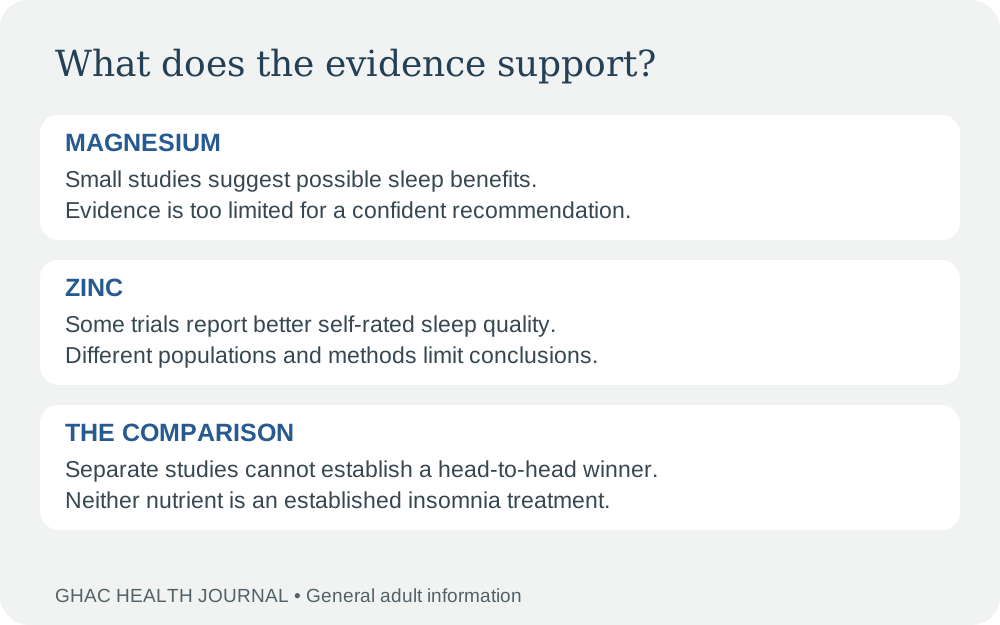
A 2021 review of three randomized trials included 151 older adults. In a pooled analysis of two trials, people taking magnesium fell asleep about 17 minutes sooner than those receiving placebo. Total sleep time did not improve significantly. The evidence was rated low or very low quality, so that average is an uncertain research finding, not a promised result.
The participants, formulations, and trial sizes limit how confidently those findings apply to a younger person, someone with sleep apnea, or a different product. A small study showing improvement does not establish that every magnesium formulation works, or that more magnesium produces better sleep.
NCCIH’s magnesium and sleep overview concludes that there is not enough rigorous evidence to determine whether magnesium supplements help sleep disorders. Popularity, personal testimonials, and an appealing evening ritual do not resolve that uncertainty.
Zinc: encouraging signals do not establish a winner
A 2024 systematic review of eight randomized trials found some improvement in sleep quality, but results were inconsistent. Studies involved different groups, durations, and products. Some measured questionnaire scores rather than objective sleep recordings. The authors called for further trials that consider people’s usual zinc intake.
A better self-reported sleep score is useful information, but it does not automatically mean a treatment reliably resolves insomnia, increases sleep duration, or works for everyone. A product containing several ingredients also cannot tell us what zinc contributed on its own.
These separate research summaries do not provide a dependable head-to-head comparison. Counting positive studies for each mineral would ignore differences between participants and measurements. There is no established overall sleep winner here, and neither supplement should replace assessment of persistent symptoms.
Read the label before choosing a bedtime product
Check the Supplement Facts panel for the amount of the mineral per serving and the number of tablets or gummies that make a serving. The weight of a compound, such as magnesium citrate, is different from the amount of elemental magnesium it supplies. Use the listed nutrient amount when reviewing your intake.
Bring every relevant label into the conversation: a multivitamin, a combination sleep powder, an electrolyte product, cold remedies, and medicines. Buying two products under different names can still mean doubling the same ingredient. Adding melatonin or herbs also changes the safety discussion.
Words such as “gentle,” “natural,” or “nighttime” do not establish effectiveness. If a clinician identifies a reason to supplement, ask which nutrient, amount, and duration address that reason. There is no need to assemble a large collection of sleep supplements first.
Understand the different safety ceilings
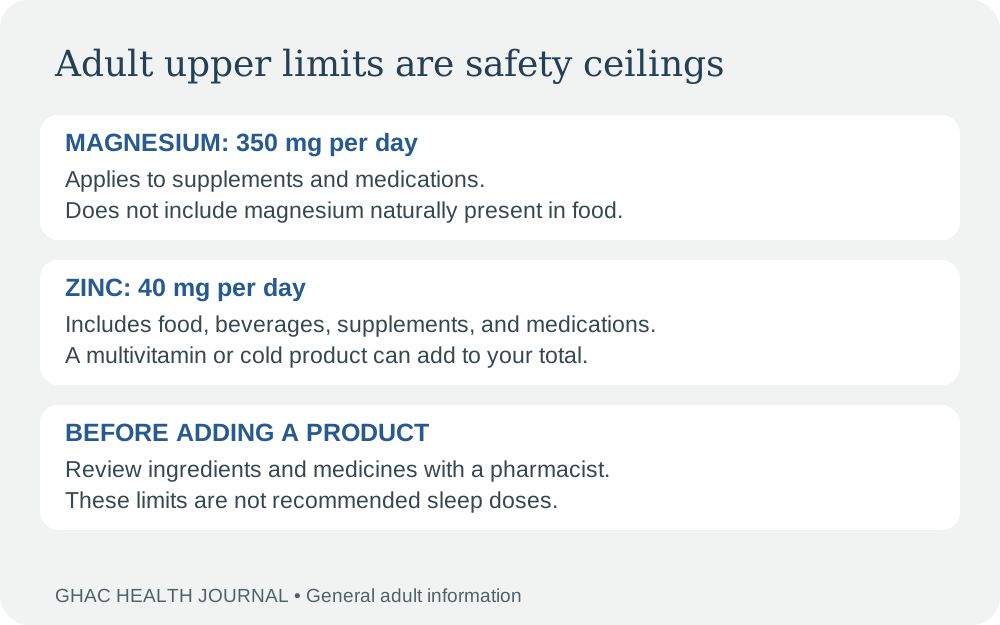
For adults, the NIH magnesium fact sheet lists an upper limit of 350 mg a day from supplements and medications. That ceiling does not include magnesium naturally present in food. Diarrhea, nausea, and cramping can occur with high supplemental intakes. These are safety boundaries, not instructions for a sleep dose.
The NIH zinc fact sheet lists an adult upper limit of 40 mg a day from all sources, including food. Too much zinc can cause nausea and other stomach symptoms; sustained excess can lower copper levels. A high-dose tablet can use up or exceed that ceiling before meals are counted.
Upper limits do not describe every person’s medical needs, and supervised treatment may differ. Ask for individual advice before supplementing if you have kidney disease, are pregnant or breastfeeding, or are choosing a product for a child. Adult limits should never be used as children’s instructions.
Check medicines and timing with a pharmacist
Both minerals can interfere with some antibiotics. Magnesium can also affect absorption of osteoporosis medicines, and zinc can interfere with penicillamine. The magnesium and zinc interaction guidance explain why spacing or another plan may be needed. Ask a pharmacist about your exact medicine rather than choosing a separation interval yourself.
Do not stop a prescribed medicine because a supplement label raises a question. Take photographs of the labels and ask whether the combination is appropriate, whether the amount is necessary, and what to do if side effects occur. A quick review can prevent an avoidable problem.
Let food meet an ordinary nutritional need
Magnesium sources include beans, nuts, seeds, whole grains, and leafy greens. Zinc comes from foods including meat, seafood, dairy, beans, and fortified cereals. You do not need to eat every item or follow a special evening menu. Choose combinations that fit your preferences, allergies, budget, and nutritional needs.
For a practical companion, our food and sleep guide explores meal timing and comfort. Foods can support an adequate diet without being marketed as sedatives. A satisfying dinner does not need a claim about deep sleep to be worthwhile.
When the better next step is sleep care
If sleep trouble continues or interferes with daily life, bring it to a healthcare professional. NHLBI identifies cognitive behavioral therapy for insomnia, or CBT-I, as a usual first treatment for long-term insomnia. It addresses patterns that keep insomnia going rather than relying on a nutrient trial.
Mention loud snoring, waking while gasping, marked daytime sleepiness, and any recent medication changes. These details can point toward a problem that supplements will not address. If you feel too sleepy to drive safely, avoid driving and arrange help.
You can arrive with a simple record of sleep times, daytime symptoms, caffeine, and products you use. The practical goal is to understand what is disrupting rest and choose care that fits the cause. You do not have to prove that you have tried every supplement before asking for support.
About this article
This original GHAC article was inspired by Health.com’s article on magnesium and zinc for sleep.
Information here is educational and does not replace personalized medical advice.
Frequently asked questions
Is magnesium better than zinc for sleep?
Current evidence does not establish a reliable overall winner. Some studies suggest benefits from either mineral, but differences in study populations and methods prevent a confident comparison.
Can I take magnesium and zinc together at bedtime?
A combined product is not automatically necessary or more effective. Review the ingredients, total amounts, medicines, and your reason for taking each with a pharmacist or clinician first.
How much should I take for sleep?
There is no universally established sleep dose for either mineral. The adult upper limits, 350 mg from supplements and medications for magnesium and 40 mg from all sources for zinc, are safety ceilings, not sleep recommendations.
Does poor sleep mean I have a mineral deficiency?
No. Sleep trouble has many possible causes and cannot diagnose a magnesium or zinc deficiency. A clinician can assess diet, medical history, medicines, and whether testing is appropriate.
When should I ask for help instead of trying a supplement?
Seek advice when sleep problems persist, affect daily function, or come with loud snoring, gasping, or substantial daytime sleepiness. CBT-I is a usual first treatment for long-term insomnia.
Keep the next step simple
Small, repeatable choices are often the ones that last. Explore the Health Blog for more everyday wellbeing reading, or visit the Fitness collection for apparel that celebrates movement in real life.
More everyday wellbeing reading

Cognitive Health: Everyday Habits and When to Ask for Help
Support thinking and memory with practical everyday habits, sensible health checks, and clear guidance on changes that deserve medical attention.
Read article →
Wall Squats and Blood Pressure: What Once-a-Week Research Really Means
A closer look at the wall-squat study, why its starting phase matters, and how to build a realistic movement routine for heart health.
Read article →
Ultra-Processed Foods and Bowel Cancer: Beyond the Headline
What a large new study really found about ultra-processed foods, bowel cancer, and small food swaps that fit everyday life.
Read article →