
HEALTH JOURNAL
Finding Mental Health Care When Insurance Lists Lead Nowhere
A practical guide to checking mental health providers, asking your insurer for help, and keeping track when directory listings lead to dead ends.

You have decided to ask for mental health support. You open your insurance directory, find a name, and call. The number is disconnected, the office is not taking new patients, or nobody can tell you whether your particular plan is accepted. After several attempts, finding care can start to feel like another job.
A listing is a starting point, rather than a confirmed appointment. This guide explains the gap between a provider directory and available care, then offers a manageable way to check options and ask for help. Difficulty getting through is not a reflection of how deserving you are of support.
What a “ghost network” means
A ghost network describes a gap between the clinicians an insurance network appears to offer and the care someone can actually access. A listing may contain an old number, describe the wrong service, or point to a practice with no appointments available. Those are different problems, even though each can leave a person without a useful next step.
One unanswered call does not prove that a clinician has left a network or stopped practicing. Small offices may return messages later. The important distinction is between information that is confirmed wrong and availability that remains unknown. Keep that distinction in your notes so you can explain the problem accurately.
What the new study can tell us
A 2026 JAMA Health Forum study used simulated-patient calls to psychiatrists and psychologists in commercial insurance directories in five states. Researchers made 5,822 calls. Only 2,252 were evaluable for the study’s analysis; the rest did not provide enough information, often because calls reached voicemail or an automated system.
Among evaluable calls, 23.6% resulted in an appointment with the listed clinician, and 55.6% revealed directory inaccuracies. These percentages do not describe all calls, all insurance plans, or your personal chance of finding care.
The study used one call attempt per listing and did not leave messages or assess callbacks. It cannot establish that every unanswered number was a false listing. It does show why the presence of a name in a directory should not be confused with verified access.
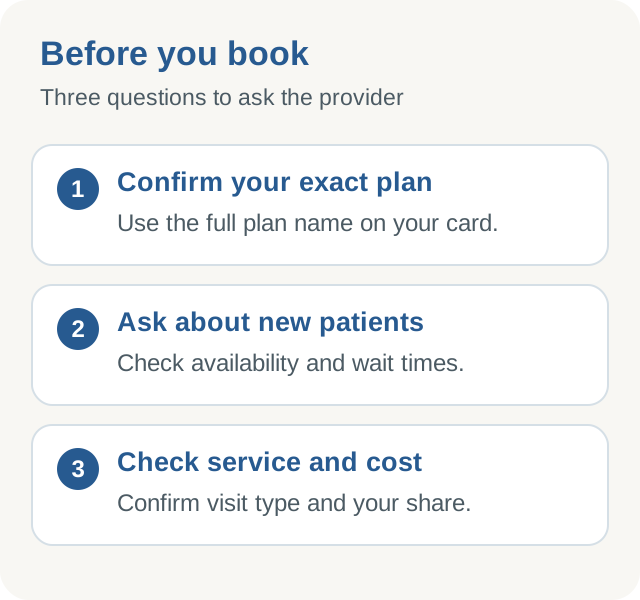
Check your exact plan before booking
CMS advises checking network status and notes that directories can be inaccurate. Have your insurance card ready. Ask the office and your insurer about your exact plan, the individual clinician, the appointment location, and the service you intend to receive.
“We take that insurance company” is less specific than confirming your particular plan. Ask whether the clinician is in-network, whether new patients are accepted, and whether the appointment is for the service you need. A practice offering therapy may not offer medication management, or vice versa.
If the answers conflict, ask the insurer to clarify before booking. Save the information you receive. Verification can reduce confusion, but it is not a promise that every charge will be covered.
Ask about the cost as well as the opening
SAMHSA’s insurance guidance recommends asking what treatment your plan covers and what you will pay. Ask about copays, coinsurance, the deductible, and any referral or authorization requirements. Check telehealth separately if that is how you hope to attend.
You can keep the opening question short: “I am looking for a new-patient mental health appointment with this plan. What would I need to confirm before booking, and who can explain my expected costs?” If the office cannot answer the benefits question, ask your insurer.
Ask whether a case manager can help with the search. If someone you trust will make calls with you, ask the insurer how to authorize that person. You can accept practical help without handing over every detail of your health history.
Keep a small call record
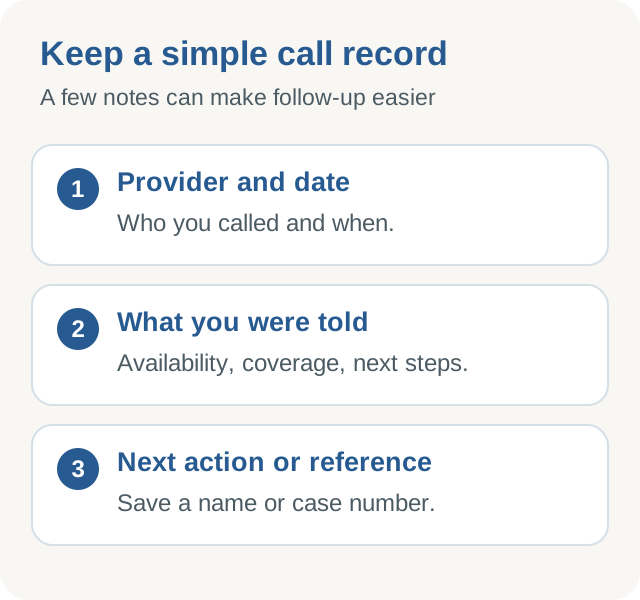
A few consistent notes are easier to use than a collection of half-remembered conversations. Record the practice or clinician, contact details, date, answer, and next step. Useful answers include “not accepting new patients,” “number disconnected,” “left message,” and “plan status needs checking.” Avoid recording an unanswered call as a confirmed rejection.
Add a reference number when an insurance representative provides one. If a directory entry is wrong, save the listing and tell the insurer what you found. Keep your record somewhere private and easy to find. It does not need to be a detailed account of your symptoms.
For example: “Tuesday: called listed office; staff said this clinician no longer works there. Next step: report the entry and request another option.” One clear sentence is enough to help the next conversation move forward.
Ask for help when the list is not working
NAMI’s guidance for finding an in-network provider recommends returning to the insurer when multiple contacts have not produced care. Share your record and ask for help locating a clinician who is accepting patients, rather than simply requesting the same directory again.
Explain practical needs such as language, accessibility, appointment times, and in-person or online care. Ask whether a representative can help arrange an appointment. If the problem remains unresolved, ask how to submit a formal complaint or grievance and how you will receive a response.
Use the practice’s preferred contact method and follow up where appropriate. Keep the request specific: “These listed options have not led to an appointment. Please help me find an available in-network clinician.” Coverage and complaint procedures vary, so ask your plan for its own instructions.
Explore another route without assuming the cost
SAMHSA’s lower-cost treatment guidance describes options such as income-based fees and community services. Ask a local clinic about fees, eligibility, waiting times, and the care it provides. A reduced fee can be useful, but it still needs to fit your budget.
FindTreatment.gov can help identify mental health and substance use treatment facilities. Contact a facility to confirm services and availability before visiting. Another locator is a new lead to check, rather than proof of an opening or insurance coverage.
Before paying privately, ask what you would owe and whether your plan offers any relevant benefit. Do not assume an out-of-network appointment will be reimbursed. Choose with clear information about the likely cost.
Bring the difficulty to your regular care team
The National Institute of Mental Health recommends discussing mental health concerns with a primary care provider. Explain both how you are feeling and the obstacles you have encountered. Ask what assessment, referral, or support may be appropriate while you continue looking.
Prepare a short account of when symptoms started and how they affect your day. Bring a medicine and supplement list. A trusted person can help take notes if you want them involved. You do not need a perfectly organized story before asking for care.
Everyday wellbeing habits can complement professional support. Our gentle introduction to meditation offers an optional activity, but it is not a substitute for assessment or treatment. Trouble finding an appointment should not become a reason to dismiss what you are experiencing.
Know when not to wait for a routine appointment
If you are in emotional distress or a mental health crisis in the United States, call or text 988, or use the 988 Lifeline’s online chat. Support is available around the clock. This is a crisis-support route, separate from scheduling ongoing treatment.
For a life-threatening situation, immediate danger, or a medical emergency, call 911 or go to the nearest emergency department. The NIMH guide to finding help explains these immediate-care options. Do not wait for a directory call to be returned when urgent help is needed.
About this article
This original GHAC article was inspired by Jacqueline LaPointe’s Healthcare Dive article, “Ghost networks haunt mental health access, study finds” (October 21, 2026).
Information here is educational and does not replace personalized medical advice.
Frequently asked questions
Does an unanswered call mean a provider listing is wrong?
No. A practice may return messages later. Record whether you left a message, reached a disconnected number, or received a definite answer about appointments. These are different outcomes.
Does accepting my insurance company mean the clinician is in-network?
Not necessarily. Confirm your exact plan, clinician, location, and service with the office and insurer. Ask about expected costs and any requirements before booking.
What should I tell my insurer if nobody has an opening?
Share the providers you contacted and their responses. Ask for help finding an available in-network clinician, appointment assistance, or instructions for making a formal complaint if the problem continues.
Can someone help me make the calls?
Yes. Someone you trust can help organize questions and notes. If they will discuss your benefits or care on your behalf, ask the insurer or practice what authorization is needed.
Is 988 only for people who are suicidal?
No. The 988 Lifeline also supports people in emotional distress or mental health crisis. Call or text 988 in the United States, or use its online chat. Call 911 for immediate danger or a medical emergency.
Make the next call easier
Choose one action you can manage today: confirm a plan detail, write down the calls you have already made, or ask someone you trust to help. If your symptoms are worsening, tell your care team rather than waiting quietly for an opening.
More everyday wellbeing reading

Cognitive Health: Everyday Habits and When to Ask for Help
Support thinking and memory with practical everyday habits, sensible health checks, and clear guidance on changes that deserve medical attention.
Read article →
Magnesium vs. Zinc for Sleep: Evidence and Safety
Compare what magnesium and zinc research really shows about sleep, understand supplement safety limits, and know when to seek sleep care.
Read article →
Meditation for Beginners: Find a Practice That Fits Your Life
Explore gentle ways to practice meditation, from guided sessions to walking, with realistic expectations, accessible adaptations, and a simple plan for getting started.
Read article →