
HEALTH JOURNAL
Fitness Measures and Longevity: What Strength, Balance, and Stamina Can Tell Us
Explore how strength, balance, and stamina relate to longevity, what fitness tests cannot predict, and how to use the findings constructively.

A story about a simple fitness test can make healthy aging sound like a single score: how long you can balance, how quickly you get up, or how many times you stand from a chair. These abilities can provide useful clues about physical function. They cannot tell you how many years you have left.
The constructive question is what a measurement might help you do next. A result may start a conversation about strength, balance, stamina, pain, or support. Research can explain why clinicians care about those abilities, while a personal assessment helps decide what is relevant to your own daily life.
A study that looked beyond exercise habits
A 2026 JAMA Network Open cohort study followed 13,423 adults aged 65 and older in Taiwan for a median of seven years. Researchers examined measured fitness, rather than relying only on reports of how often participants exercised.
The assessments covered balance and agility, strength, flexibility, and cardiorespiratory fitness. Better performance was associated with lower all-cause mortality, with particularly strong patterns for balance and agility, lower-body strength, and aerobic fitness.
This was observational research. It did not assign people to an exercise program and demonstrate that improving a particular score prolonged their lives. Health conditions, access to activity, and other differences can influence both test performance and later outcomes.
What the measurements represent
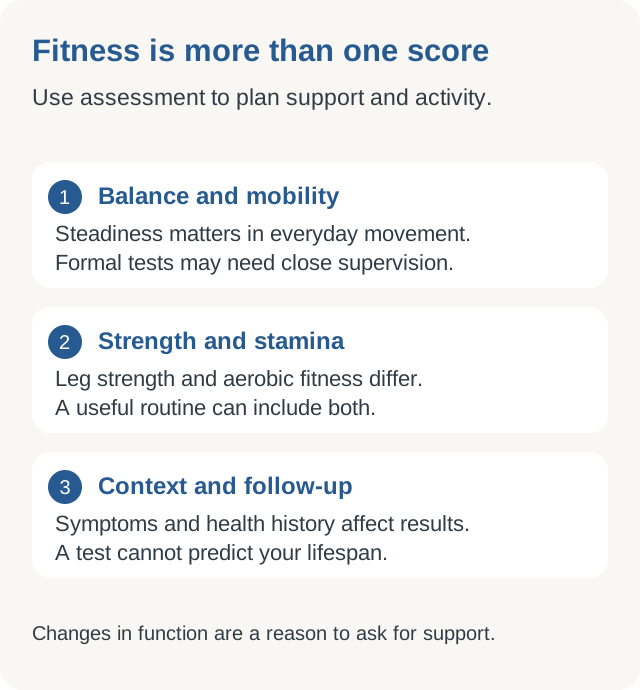
Balance involves remaining steady. Mobility includes moving between positions and through space. Leg strength contributes to standing up and other everyday tasks. Aerobic fitness concerns the capacity to sustain activity. These abilities overlap, but one does not stand in for all the others.
Imagine two ordinary goals: getting up from the sofa comfortably and enjoying a longer outing with a friend. The first may bring strength or joint comfort into focus. The second may also involve stamina, walking confidence, accessible routes, and places to rest. The useful plan depends on the task and the person.
Someone who walks regularly may still benefit from appropriately chosen strength and balance work. Someone who lifts weights may want a comfortable way to build aerobic activity. A varied routine offers more options than trying to excel at a single online challenge.
Why a score is not a personal forecast
The Taiwan study included adults able to participate in its assessments and excluded some serious conditions. Its results cannot automatically describe every person living with disability, major illness, or advanced age. A group-level association also cannot identify an individual’s future.
A painful knee may slow a chair stand. A medication change or dizziness may affect steadiness. A test taken during recovery from illness may say something different from the same test taken months later. Those are reasons to understand the circumstances, rather than attach a frightening meaning to a number.
Nor does a strong result remove the need for ordinary health care. Symptoms, chronic conditions, preventive care, and other parts of wellbeing still deserve attention. Fitness provides useful information alongside that picture. It does not replace it.
Formal assessment is different from a home challenge
The CDC’s 30-second chair-stand assessment is designed to assess leg strength and endurance in a clinical falls-prevention context. It specifies the chair setup and instructions, and tells the assessor to stand beside the patient for safety. Those details affect both safety and interpretation.
That is a different situation from racing yourself in a kitchen chair, using furniture with wheels, or trying to balance without support nearby. Do not attempt a timed or unsupported test if you feel unsteady, have fallen, or have symptoms that make it unsafe. Ask a clinician or physical therapist to help assess you.
There is no need to copy the study’s test battery at home to benefit from its broader message. A professional can help decide which measurements are useful and how to adapt the process when a standard test is unsuitable.
Build a mix that supports daily life
CDC guidance for adults 65 and older recommends aerobic activity, muscle-strengthening activity on at least two days each week, and balance activities. The aerobic target is at least 150 minutes of moderate-intensity activity weekly, or 75 minutes of vigorous activity, or an equivalent mix. People who cannot meet the targets should be as active as their abilities and conditions allow.
Think of these as several doors into movement. A familiar walk may be one starting point. A suitable strength class may be another. A supervised balance program can provide a different kind of support. The choice should fit your health, preferences, access, and confidence.
You can spread activity through the week and start with shorter periods. If a full schedule feels out of reach, choose one manageable opportunity instead of waiting for a perfect routine. General targets provide direction; they do not make a smaller beginning meaningless.
Our guide to strength training and cardio explains how those activities complement each other. Our bodyweight exercise guide offers another way to explore a manageable starting point.
Notice changes that matter to you
Rather than testing yourself repeatedly, consider one everyday task you would like to make easier. It might be rising from a comfortable chair, reaching a nearby destination, or feeling more confident while moving around your home. Use that task to explain your goal to a clinician, therapist, or qualified instructor.
Describe changes concretely: when the difficulty began, whether pain or dizziness is involved, whether one side feels different, and whether you have fallen. That information can be more useful than announcing that you failed a test found online.
Avoid changing the task into a competition. Using a handrail, walking aid, chair support, or rest break can be part of moving safely. Support does not erase the value of the activity or make your effort less worthwhile.
When to seek guidance
Arrange medical advice for new or worsening weakness, repeated falls, persistent dizziness, or unexplained changes in walking or stamina. A new difficulty should not simply be dismissed as an inevitable part of getting older. A review can help identify what support is appropriate.
Sudden one-sided weakness, facial drooping, speech difficulty, severe chest pain, fainting, or severe shortness of breath needs emergency attention. Do not use a fitness test to investigate an urgent symptom.
This article is general health education, not a diagnosis or an individual exercise prescription. The useful aim is to keep activities meaningful, manageable, and as safe as possible, with professional support when needed.
About this article
This original GHAC article was inspired by Health.com’s fitness measures and longevity topic, used as topic inspiration.
Information here is educational and does not replace personalized medical advice.
Frequently asked questions
Can a balance or chair-stand test predict my lifespan?
No. Research can connect group-level test results with later outcomes, but a score cannot tell an individual how long they will live.
Did the study prove that better fitness causes longer life?
No. It was an observational cohort study. Associations can reflect other health and life circumstances as well as fitness.
Should I time a chair-stand test at home?
You do not need to. Formal assessments have specific instructions and safety arrangements. If you are unsteady, symptomatic, or have fallen, ask for a supervised assessment instead.
Is walking enough for older adults?
Walking can provide aerobic activity. CDC guidance also recommends muscle-strengthening and balance activity, adapted to individual ability and health.
What if I cannot do a standard test?
That does not determine your worth or your future. A clinician or therapist can consider your symptoms, daily tasks, and suitable alternatives.
Choose a daily-life goal
Name one activity you would like to do more comfortably. Use it to guide a manageable movement plan or a conversation with a clinician or physical therapist.
More everyday wellbeing reading
Lower-Body Kettlebell Exercises: Build the Foundations First
Learn how squats and hip hinges fit into lower-body kettlebell training, with practical starting cues, easier options, and clear reasons to slow down.
Read article →
Fiber and Sleep: A Promising Connection, Not a Bedtime Cure
What research says about fiber and sleep, plus comfortable ways to add plant foods without treating dinner as an insomnia remedy.
Read article →