
HEALTH JOURNAL
Lower-Body Kettlebell Exercises: Build the Foundations First
Learn how squats and hip hinges fit into lower-body kettlebell training, with practical starting cues, easier options, and clear reasons to slow down.

A kettlebell can make familiar lower-body movements feel different. The handle gives you a way to hold resistance while you bend your hips and knees, stand up, or practice a controlled lift. But owning the weight is the easy part. Learning where your body moves, and where the weight should stay, deserves more attention than choosing an impressive number of repetitions.
This guide focuses on foundations rather than a fast circuit. A comfortable squat, a hip hinge, and the ability to set the weight down under control are useful places to begin. You can practice the patterns without a kettlebell, and you can choose another kind of resistance if its shape or grip suits you better.
What the kettlebell adds
The weight is a tool, not a requirement for stronger legs. If you already enjoy a bodyweight routine or resistance bands, there is no need to replace them simply because a different piece of equipment is popular. A kettlebell may be appealing when you want a compact option and are comfortable controlling its handle.
CDC adult activity guidance includes muscle-strengthening work on at least two days each week, alongside aerobic activity. That strength work should involve all the major muscle groups. A lower-body session is one part of that larger picture, rather than a complete weekly activity plan.
Before buying a bell, consider trying one with a qualified instructor. Handle shape, available space, and the ease of picking up and putting down the weight matter. A weight that feels manageable during one demonstration may feel very different when you are tired.
First practice: a hip hinge and deadlift
The American Council on Exercise’s kettlebell introduction starts with basic technique. Its deadlift setup uses a two-handed grip, a bend at the hips with some knee bend, and a controlled return to standing. This is a different movement from dropping into a deep squat.
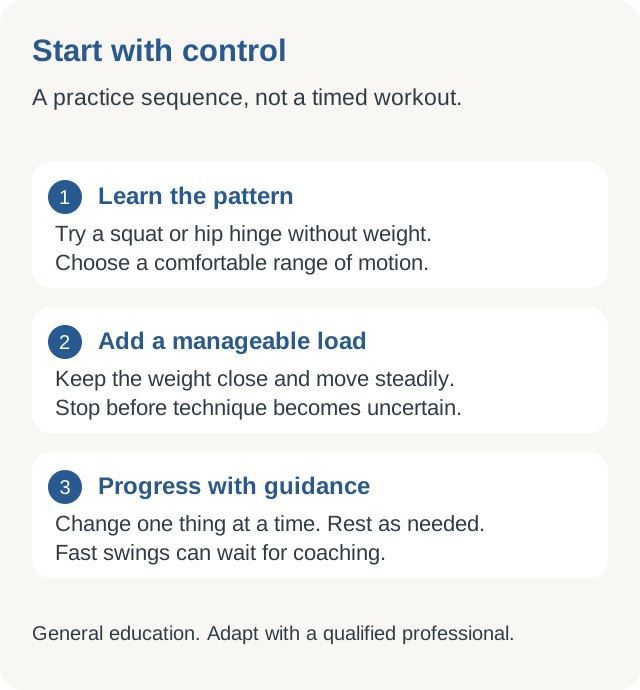
Begin by rehearsing the hip hinge without a weight: let your hips travel backward while your knees soften and your trunk stays controlled. Think about making space behind you rather than reaching your shoulders toward the floor. If you cannot find the pattern comfortably, ask for a demonstration before adding resistance.
For a kettlebell deadlift, keep the bell close rather than reaching it far away from your body. Move slowly enough that you can stop and set it down deliberately. Do not pull yourself upright with a sudden jerk or finish by leaning backward. If the floor is too far away to reach with control, get help adapting the setup rather than forcing the range.
The first useful goal is a repeatable movement, not a heavier weight. Your hips, knees, back, balance, and grip all influence how the exercise feels. A trainer or physical therapist can help distinguish a technique problem from a movement that needs a different approach.
Second practice: a goblet squat
In a goblet squat, you hold the weight in front of your chest while bending your hips and knees. NASM’s goblet squat guide emphasizes keeping the weight close, the torso controlled, and the movement steady. A weight that pulls you forward or makes the descent jerky is a reason to adjust.
Try a bodyweight squat first. Choose a stance that feels stable and a depth you can manage without pain or losing control. You do not need to match somebody else’s depth. A stable chair can provide a familiar sit-to-stand starting point when that variation is appropriate for you.
If you add a kettlebell, make sure you can hold it securely before beginning. Let the knees follow the direction of the feet instead of collapsing inward. Stand smoothly, keep breathing, and lower with the same attention you gave the upward movement. The final repetition should still look like a movement you chose, rather than one the weight forced.
Wrist discomfort, difficulty holding the bell, or trouble getting it into position may make another exercise more useful. An instructor can suggest a different grip or tool. There is no benefit in insisting on a kettlebell when it distracts from a comfortable, controlled movement.
Lunges are an option, not a required next step
ACE also describes a kettlebell lunge, which adds a stepping movement to loaded leg work. The transition brings extra balance demands. That makes it a choice to learn thoughtfully, rather than an automatic addition to every beginner session.
If stepping and returning to standing already feel uncertain, leave the kettlebell aside. Ask a qualified professional about a supported or stationary alternative that suits you. Holding a heavy object while trying to catch your balance is not a useful way to practice.
You can build a worthwhile session around movements you understand. A longer exercise list does not automatically provide a better starting point, especially when several of the movements are new.
Why swings can wait
A kettlebell swing is a faster, momentum-based skill. It should not be improvised by simply lifting the weight with your arms or copying the speed of an online video. Confidence with a slow lift does not automatically mean you are ready to control a moving bell.
Learn swings with qualified coaching when they fit your goals and ability. Until then, there is plenty to practice in a controlled squat or deadlift. Snatches, cleans, overhead movements, and single-leg lifts can also wait. Choosing a simpler exercise gives you more room to notice technique and comfort.
Make the first session a practice session
Choose one movement you can perform comfortably without weight. Rehearse it, rest, and decide whether adding resistance makes sense today. If it does, keep the amount of work small enough that you can pay attention throughout. This is an approach to learning, not a universal set or repetition prescription.
Keep a clear area around you, away from pets, children, loose rugs, and breakable objects. Plan where the bell will rest between attempts. You should be able to put it down without having to twist around or reach through an obstacle.
Afterward, note what felt manageable: the grip, setup, depth, pace, and how you felt later. Progress might mean repeating a comfortable session before changing anything. It does not have to mean using more weight each time.
Know when to stop or ask for help
MedlinePlus’s exercise-injury guidance recommends warming up, learning proper form, allowing recovery, and avoiding sudden increases in difficulty. Ask a health professional about suitable exercise if you have been inactive or have a condition that could affect safety.
Stop for sharp pain, dizziness, chest discomfort, faintness, or unusual breathlessness. Severe or persistent chest symptoms, severe breathing difficulty, or fainting need urgent medical attention. Do not try another repetition to see whether you can push through them.
If you are returning after injury, surgery, pregnancy, or a long break, individual guidance may change the exercises and loads that are appropriate. This article provides general education and does not replace medical advice or an individual training assessment.
For a simpler starting point, explore our bodyweight exercise guide. For the bigger weekly picture, read about making room for strength training and cardio.
About this article
This original GHAC article was inspired by Health.com’s lower-body kettlebell topic, used as topic inspiration.
Information here is educational and does not replace personalized medical advice.
Frequently asked questions
What kettlebell weight should a beginner use?
There is no universal starting weight. Choose a load you can grip, move, and set down under control, with guidance if you are unsure. Practice the pattern without weight first.
Do I need to do kettlebell swings?
No. Swings are an optional skill. Controlled squats or deadlifts may be more useful while you learn the basic patterns.
How low should I squat?
Use a range you can control comfortably. Mobility, symptoms, and the exercise variation affect suitable depth. Do not force a particular depth because someone else uses it.
Can I start without a kettlebell?
Yes. Unweighted movement can help you learn the pattern. A stable chair, bands, or another suitable tool may fit your needs better.
Choose one pattern to learn
Start with an unweighted squat or hip hinge. If it feels uncertain, get a demonstration and a suitable adjustment before adding a load.
More everyday wellbeing reading

Fiber and Sleep: A Promising Connection, Not a Bedtime Cure
What research says about fiber and sleep, plus comfortable ways to add plant foods without treating dinner as an insomnia remedy.
Read article →Fitness Measures and Longevity: What Strength, Balance, and Stamina Can Tell Us
Explore how strength, balance, and stamina relate to longevity, what fitness tests cannot predict, and how to use the findings constructively.
Read article →