
RESEARCH & GUIDELINES
Healthy Diets and Biological Aging
A new study links diet quality with biological aging markers. Explore what the findings mean, their limits, and practical ways to build nourishing meals.

A headline about slowing biological aging can sound like an invitation to find the perfect diet. A recent study points toward a less demanding interpretation: several ways of eating were associated with more favorable aging-related measurements. The news is interesting because it allows room for different food traditions, tastes, and budgets.
It also needs careful translation. A laboratory marker is not the same as a longer life, and an observational association is not proof that changing your meals will turn back time. Here is how to understand this research while keeping everyday nourishment, rather than an anti-aging promise, at the center of the conversation.
What makes this a news story
A 2026 study in Nature Communications examined dietary quality and DNA-based aging measurements in 6,470 Rhineland Study participants and checked key findings in 1,034 EPIC-Potsdam participants. The original paper reports associations across multiple diet-quality scores rather than testing a single branded eating plan.
The research institution’s September 15 explanation describes ten dietary scoring approaches, including Mediterranean, Nordic, plant-based, and DASH-style patterns. Better quality across the scoring approaches was linked with more favorable biological aging measures. The researchers did not find a simple winner that every reader should adopt.
The useful development is the connection between a broad feature of daily life and newer ways of studying aging. It adds a question for researchers to investigate. For readers, it offers context for healthy eating without creating a new deadline to overhaul the kitchen.
What researchers mean by biological aging
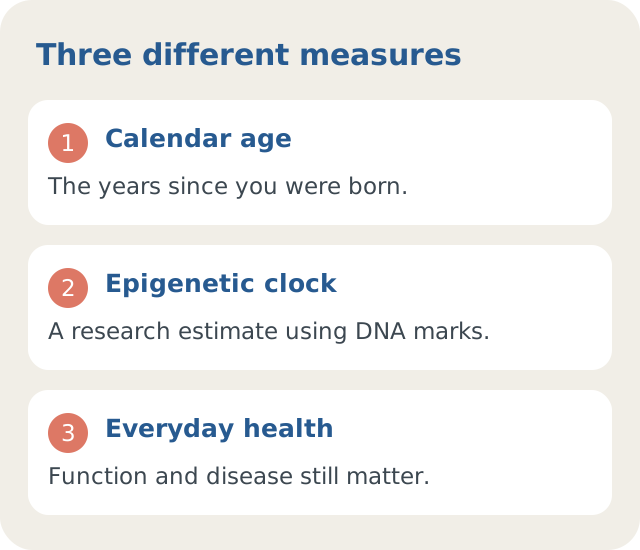
Your chronological age counts the years since birth. A biological aging measure tries to describe some aspect of how the body is changing. In this study, investigators used three epigenetic metrics: GrimAge acceleration, PhenoAge acceleration, and DunedinPACE. The paper’s methods and results explain how they were calculated from blood DNA methylation data.
DNA methylation refers to chemical markings associated with the regulation of gene activity. Different clocks use different patterns and mathematical approaches. GrimAge and PhenoAge are used here to assess age acceleration relative to chronological age, while DunedinPACE estimates a pace of aging. They are research measurements, not three independent calendars showing your actual future.
A helpful reading habit is to ask which clock was measured and what its units mean. The phrase younger by a certain number of years may refer to a statistical estimate, not an observed extension of life. The number becomes easier to interpret once the outcome is named precisely.
A marker is not a guarantee about the future
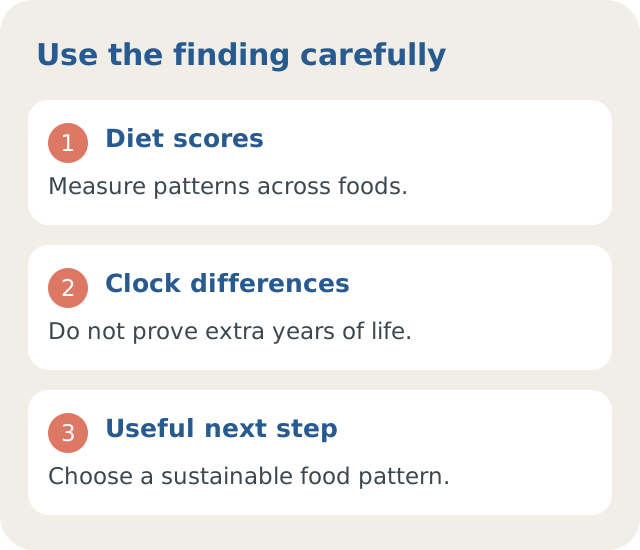
This study does not establish how many extra birthdays someone would have by changing meals. It also does not demonstrate that a particular food prevents dementia, preserves independence, or reverses every feature of aging. Those are different outcomes requiring their own evidence.
Think of the gap between a marker and a lived result. A research measurement can be informative without answering whether a person will feel better, avoid a diagnosis, or need less help later. It is reasonable to be interested in the marker while waiting for stronger evidence about those practical outcomes.
When a headline uses the word reverse, look for what was actually observed. Was a blood measurement different between groups, or did an intervention change the measurement over time? Did researchers track disease or daily functioning? Keeping those questions separate prevents an appealing phrase from doing more work than the evidence.
Suppose a report describes two groups with different average clock readings. That comparison cannot tell you what would happen to one reader who changes breakfast tomorrow. The group difference, the personal change, and the long-term result are three separate claims. Looking for which claim the evidence actually supports is a practical skill you can use with many health stories, even without understanding every detail of the laboratory method.
What the study design can and cannot show
The analysis compares existing eating habits and biological measurements. Participants were not randomly assigned to spend years following competing diets. The findings therefore cannot isolate diet from every other influence on health, even when the statistical models account for measured characteristics.
The paper describes adjusted analyses and replication in a second cohort. Replication strengthens confidence that the pattern is not confined to one dataset. It still does not remove every possible source of confounding or make the evidence equivalent to a long-term randomized trial.
For a reader, this means two statements can be true at the same time: the result is worth discussing, and its practical implications remain limited. Taking uncertainty seriously does not require treating the study as worthless. It means matching the strength of the conclusion to the way the evidence was collected.
Several patterns can share useful features
The institution’s research summary emphasizes that different people may score well under different dietary systems. The finding leaves room to consider personal and cultural preferences instead of presenting one universally correct menu.
That is a useful distinction between a pattern and a label. A pattern describes what you repeatedly eat. A label may suggest a set of foods, but it does not tell the whole story of meals, portions, preparation, or access. Two people using the same label can have very different routines.
For example, someone may prefer beans and rice with vegetables, while another regularly chooses fish with grains and greens. Neither meal has to be renamed or made fashionable before it can be discussed with a dietitian. Start with the foods you already know, and ask what would make the pattern more nourishing and manageable.
Use established guidance for actual food choices
For practical meal planning, the NHLBI DASH eating plan is an established example. It includes vegetables, fruit, whole grains, beans, nuts, fish, poultry, and low-fat dairy, while limiting foods high in saturated fat and sugar-sweetened drinks. It does not require special products.
The American Heart Association’s Mediterranean-style eating overview also describes a flexible pattern with plant foods and an emphasis on overall eating habits. These resources help translate broad dietary ideas into meals. They should not be presented as proof that either pattern reverses aging.
Use the guidance as a starting point for a question rather than a test of perfection. Which foods are easy for you to obtain? Which do you enjoy? What can you prepare on a busy day? An eating approach that works only during an unusually quiet week may need adjusting before it can become a useful routine.
Make one realistic change visible
Choose an ordinary meal you repeat and describe it without judging it. Note what you eat, how you prepare it, and what tends to make the meal difficult. This can reveal a practical opportunity more clearly than a long list of foods you hope to avoid.
An example might be adding a convenient vegetable to a familiar lunch, including beans in a soup you already cook, or keeping an affordable fruit available for a snack. These are planning examples, not a formula tested by the aging study. Adapt them for allergies, preferences, and any individual dietary restrictions.
Decide what would make the change easier to repeat. Perhaps the useful step is buying a frozen ingredient, making an extra portion, or choosing a food that needs little preparation. The goal is to reduce the work required to eat well. You do not need to calculate an aging score to notice whether a plan fits your day.
For a household, agree on an option that works for the person doing the shopping and the person preparing the food. An ingredient that regularly goes unused is not making the plan easier. A simpler alternative that gets eaten may be a better starting point. Review whether the change was affordable, enjoyable, and realistic before deciding to add another. This is practical planning, not a claim that the example alters an epigenetic clock.
Nourishment matters as much as the anti-aging message
An aging headline should not become an instruction to eat as little as possible. This study did not establish a calorie-restriction prescription. The relevant question is the quality of an overall pattern, not whether someone can make every meal smaller.
The National Institute on Aging’s meal-planning guidance encourages variety and enough protein throughout the day, with options such as seafood, dairy or fortified soy products, beans, peas, and lentils. Its advice is especially useful when considering the practical nutrition needs of older adults.
If eating has become difficult because of appetite, chewing, swallowing, cost, or shopping challenges, that deserves attention in its own right. MedlinePlus’s older-adult nutrition overview describes several reasons nutrition needs and eating difficulties may change. Ask for help with the actual barrier instead of adding a restrictive plan to an already difficult situation.
A good plan has room for health conditions and preferences
General healthy-eating examples do not replace an individualized plan for kidney disease, diabetes, digestive conditions, food allergy, or another health concern. Ask a clinician or registered dietitian how a proposed change fits the care you already receive.
For example, a person who has been told to limit particular nutrients should not assume that every food included in a popular diet is appropriate in unlimited amounts. The right question is why the restriction exists and how to maintain an enjoyable, adequate diet within it. This article cannot supply that personal assessment.
Bring a short account of a usual day, including foods you enjoy and anything you find difficult. Ask which single change would be most useful to work on first. A specific, achievable recommendation can be more valuable than a general promise to follow a longevity diet exactly.
Keep commercial promises separate from the research
The study does not establish that readers need a biological-age test, supplement subscription, or branded meal program. A research clock used to study a population is not automatically a decision tool for choosing an individual’s meals. The cost of a product does not strengthen the evidence behind it.
Before buying an anti-aging offer, ask what outcome was tested, whether the product itself was studied, and what result a customer could reasonably expect. If the sales page moves from a population association to a guaranteed personal benefit, pause at that jump. This study cannot bridge it.
It is also reasonable to respond to the news without buying anything. Save a trustworthy explanation, prepare a question for your next appointment, or make a manageable food-planning change. The value of the research is better understanding, not an obligation to become a customer.
Read the next longevity headline with a few questions
Ask who took part, what kind of study it was, what was measured, and what the finding cannot tell you. Look for a link to the original paper. A report that explains its limitations gives you more to work with than one that offers only an exciting number.
Keep the study’s message proportional: better diet quality was associated with more favorable epigenetic aging measurements in these cohorts. That supports interest in the relationship between nutrition and aging. It does not prove a personal time reversal, establish a universal best diet, or guarantee that a marker will predict your future.
The practical response is familiar and flexible. Build meals that nourish you, use guidance appropriate to your health, and choose habits you can maintain. You can take food quality seriously without turning every meal into an anti-aging experiment.
Keep the original source with any notes you save. If advice changes later, that record helps you distinguish the earlier finding from a new interpretation and decide which question is worth revisiting.
About this article
This original GHAC article was inspired by Health.com’s article on diets and biological aging.
Information here is educational and does not replace personalized medical advice.
Frequently asked questions
Did this research prove that a diet reverses aging?
No. It found associations between dietary quality and epigenetic aging measures. It did not prove that a dietary change extends life, reverses all aspects of aging, or prevents a particular illness. A marker and a long-term health outcome are different things.
Which diet was the winner?
The research does not establish a single best diet for everyone. Several scoring approaches showed favorable associations. Choose a nourishing pattern that suits your food preferences, access, and health needs rather than trying to win every diet score.
Should I buy a biological-age test to choose my meals?
This study does not establish that you need such a test or that a commercial result can determine your best diet. Discuss practical health and nutrition goals with a qualified professional before spending money on an aging claim.
Should older adults eat less to slow aging?
This study is not a calorie-restriction prescription. Adequate nourishment and protein remain important. Seek individualized advice if appetite is poor, weight is changing unintentionally, or eating has become difficult, instead of using an aging headline to justify restriction.
Start with a meal you already enjoy
Describe one regular meal and one practical barrier. Choose a manageable improvement, or ask a dietitian how to adapt that meal to your health needs.
More everyday wellbeing reading

Shingles Vaccines and Heart Health
New studies link shingles vaccination with better cardiovascular outcomes. Understand the evidence, its limits, and current vaccination guidance.
Read article →
Light at Night and Heart Health
A large study linked brighter nights with cardiovascular disease. Understand the limits and consider practical sleep changes without sacrificing safety.
Read article →
Hormone Therapy and Dementia
Understand conflicting hormone-therapy and dementia findings, current FDA labeling changes, and why symptom treatment differs from dementia prevention.
Read article →