
RESEARCH & GUIDELINES
Hormone Therapy and Dementia
Understand conflicting hormone-therapy and dementia findings, current FDA labeling changes, and why symptom treatment differs from dementia prevention.

Headlines about menopause hormone therapy and dementia can point in opposite directions. One suggests protection; another raises concern. The difference often begins with who was studied, when treatment started, and whether the research actually tested a treatment or observed people using it.
The clearest distinction is between treating menopause symptoms and prescribing hormones to prevent dementia. Here is how current research and guidance help frame that conversation, including U.S. labeling changes that older coverage may not reflect.
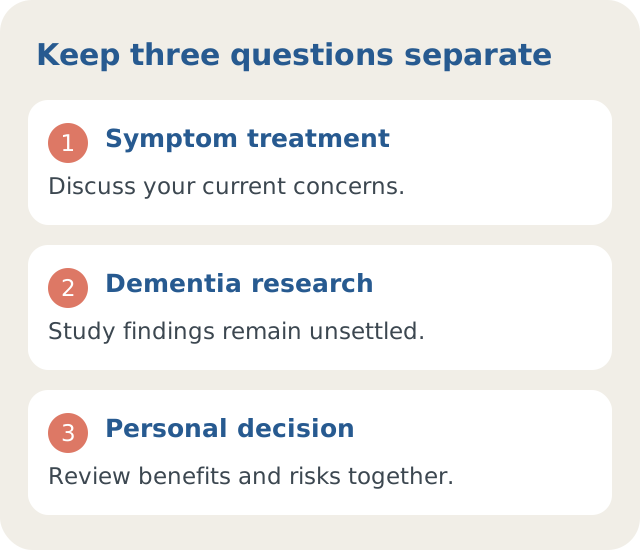
The important distinction: symptom treatment versus prevention
Menopausal hormone therapy is used to treat symptoms such as hot flashes and night sweats. Asking whether it helps a current symptom is different from asking whether it prevents dementia years later. A treatment can be worthwhile for one purpose without being established for another. The NIH menopause overview explains the symptom-treatment role and the need to weigh individual benefits and risks.
Keep those two purposes separate when reading a headline. “I would like help with disruptive symptoms” opens a clinical conversation about treatment options. “I want a prescription to prevent Alzheimer’s disease” makes a prevention claim that needs its own evidence. The second claim does not become established simply because the first use is familiar.
This article addresses the research question, not every option for menopause care. It does not decide whether hormone therapy is right for you, compare all formulations, or provide a regimen. Its purpose is to make the next conversation clearer and prevent a promising study from becoming a personal treatment instruction.
What a recent observational study found
A 2026 UK Biobank analysis followed 183,450 postmenopausal women for an average of 13.3 years and identified 3,948 dementia cases. Reported hormone therapy use for at least one year was associated with a lower hazard of all-cause dementia: hazard ratio 0.90, with a 95% confidence interval of 0.84 to 0.96. The researchers also examined differences by menopause type, genetic risk, and treatment-starting age.
That makes the study useful as a source of research questions, particularly about whether timing and individual circumstances matter. It does not mean that every participant taking hormones was protected, or that people who did not take them made an unhealthy choice. The comparison describes groups, not the result any individual can expect.
The study was published in August 2026. We include it as current context for the broader hormone-and-dementia question, rather than assuming that every article on the topic refers to this same paper. Check the date and original study link when comparing headlines that appear to reach different conclusions.
Why a lower hazard does not prove protection
In an observational study, people using a treatment may differ from people not using it. Reasons for seeking care, symptoms, access to services, prior health, and other circumstances can influence both treatment choices and later outcomes. Statistical adjustment is valuable, but it does not erase every possible difference or substitute for random assignment.
A hazard ratio of 0.90 should not be described as ten fewer dementia cases per hundred people. It is a relative measure of events over time, not an absolute percentage-point reduction. You would need appropriate absolute-risk information and a defined time period to describe a difference in expected case numbers. Even then, observational estimates would not automatically become a personal forecast.
If a headline offers a dramatic percentage, ask three questions before acting: What exactly was measured? Which groups were compared? Was the treatment assigned or chosen in ordinary care? You do not need to master the statistical model to recognize the difference between “associated with lower risk” and “shown to prevent disease.”
An older randomized trial answers a narrower question
The Women’s Health Initiative Memory Study, published in 2003, randomized 4,532 women aged 65 or older to a specific oral estrogen-plus-progestin regimen or placebo. Over about four years, probable dementia occurred more often in the hormone group: 45 versus 22 cases per 10,000 person-years. This result concerns that regimen and older starting population.
A randomized trial is stronger evidence about the effect of the treatment it actually tested because assignment reduces some differences between groups. Its boundaries still matter. It does not tell us that every hormone product at every age produces the same outcome, or that starting near menopause is identical to starting years later.
Put the two kinds of evidence beside each other rather than selecting whichever result matches your preference. The older trial raises a specific caution. The newer cohort raises questions about broader patterns and subgroups. Neither can be transformed into a universal verdict without considering the treatment, age, timing, study design, and outcome.
What the broader evidence says
A 2025 systematic review and meta-analysis by Melville and colleagues did not find evidence that menopausal hormone therapy overall increased or decreased dementia risk in postmenopausal women. Its authors did not establish hormone therapy as dementia prevention. A review summarizes available studies; it does not eliminate limitations in the underlying evidence.
An overall estimate also need not settle every subgroup question. Different studies may involve different starting ages, follow-up periods, products, or definitions of outcomes. A result can be uncertain even when many participants have been studied. “No clear effect established” is not the same statement as “an effect is impossible.”
The sensible reading is therefore neither panic nor a promise. Researchers are still working to understand which differences matter. An individual should not have to resolve that literature alone before receiving help for symptoms. Bring the question to a clinician who can distinguish evidence relevant to your treatment goal from evidence about another population.
Current guidance does not recommend prescribing solely to prevent dementia
The NICE menopause guideline says not to offer combined or estrogen-only hormone therapy for dementia prevention. NICE is UK guidance, not a U.S. prescribing instruction, but it provides an explicit evidence-based distinction between treating menopause and preventing dementia. It also addresses how age and treatment circumstances affect discussions of risk.
For a U.S. reader, the practical question is what your own clinician recommends under current local guidance and the current labeling for the exact product. Do not use a guideline from another country as a shortcut to an individual decision. Its value here is showing that a research association and an established prevention indication are different things.
If someone advertises hormone therapy primarily as a way to protect your future memory, ask which evidence supports that claim and whether the product is being prescribed for that purpose or for symptoms. A clear answer should identify the goal and acknowledge uncertainty. You deserve both symptom care and an honest explanation of what is not yet established.
Important U.S. update: FDA labeling has changed
Older articles may describe prominent warnings that have since changed. On February 12, 2026, the FDA approved labeling changes for six menopausal hormone therapy products. Statements about cardiovascular disease, breast cancer, and probable dementia were removed from those products’ boxed warnings. The agency had initiated the labeling process in November 2025.
The Office on Women’s Health explains that information about certain risks remains elsewhere in labeling, and the boxed endometrial-cancer warning remains for whole-body estrogen-only products. A changed warning does not mean a medicine has no risks. It also does not establish a new indication for dementia prevention.
Ask your pharmacist or prescriber for the current information for your specific product. An old screenshot, a general article, and an updated package insert may describe different points in the labeling process. Use the product name and the date to resolve the discrepancy. Avoid assuming either that all old wording remains current or that every risk discussion has disappeared.
Why timing and formulation should stay in the conversation
The words “hormone therapy” cover more than one treatment situation. A discussion about a whole-body regimen for hot flashes is not automatically the same as a discussion about a local treatment for vaginal symptoms. Likewise, research on one oral combination should not be relabeled as a trial of every patch, tablet, or cream.
The Office on Women’s Health notes that benefits are more likely to outweigh risks when treatment begins before age 60 or within ten years of menopause. That is a framework for evaluating symptom treatment, not proof of dementia prevention or a rule that everyone within that window should use hormones.
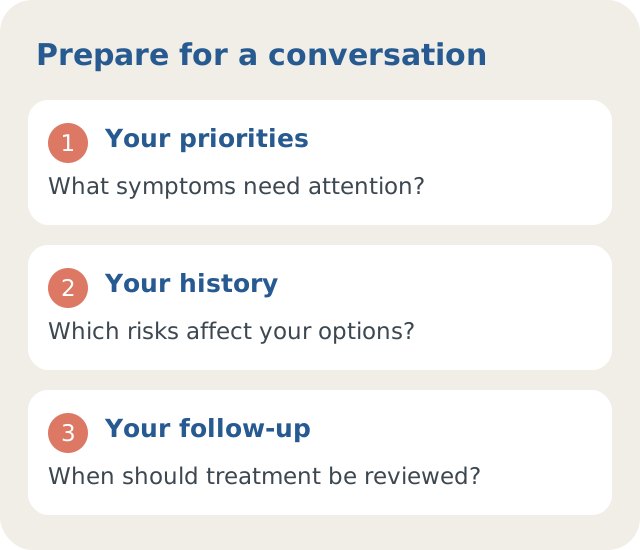
Bring the actual product, starting age, symptom goal, and relevant history to your visit. If you do not know the exact name or dose, take the packaging or medication list. That gives the clinician something concrete to review. A social-media discussion about “estrogen” often leaves out details that determine whether the research applies at all.
Prepare for a useful appointment
Write down the main reason you want advice. Is it disruptive hot flashes, poor sleep, vaginal symptoms, a worry about future dementia, or several concerns? Separate them on the page. Then note what you have already tried, current medicines and supplements, and any previous treatment advice. You do not need an elaborate dossier; a short, accurate list is enough.
Useful questions include: What symptom are we treating? What benefit should I realistically notice? Which risks matter in my history? Are there nonhormonal options for this problem? When should we reassess? How does the research about dementia change, or not change, the recommendation you are making for me?
If the answer remains unclear, ask for it in ordinary language. You can say, “I understand this might help my symptoms, but are you saying it is proven to prevent dementia?” That question removes ambiguity without challenging the value of treatment. It also helps distinguish a reasonable clinical choice from a much broader claim made in a headline.
Keep memory concerns separate from a research headline
A fear of dementia can make any prevention claim feel urgent. If you have noticed a change in memory or everyday functioning, describe the change itself rather than assuming hormones explain it. Give examples, say when it began, and note whether someone else has noticed it. Let an appropriate professional assess the concern.
The National Institute on Aging’s cognitive-health guidance places brain health within broader care, including addressing health conditions, reviewing medicines, remaining active, and managing blood pressure. Those priorities do not require treating hormone therapy as a universal prevention tool.
Do not buy a genetic test merely to match a subgroup headline or assume a family history settles a prescription decision. A subgroup association is a research finding, not a self-contained clinical instruction. If genetic risk is already part of your care, discuss its meaning with a qualified professional rather than translating an online percentage into a treatment plan.
A practical way to use the news
Imagine two readers seeing the same headline. One is experiencing severe symptoms and wants to understand available treatment. Another has few symptoms but is worried about a parent’s dementia. They may need different conversations. The research does not require the second reader to seek hormones, or the first to dismiss legitimate symptom relief because dementia research is unsettled.
For someone already taking prescribed therapy, the appropriate response is a review of the existing plan when needed, not starting, stopping, or changing it solely because of this article. Keep the purpose of treatment visible. A clear plan should explain what is being treated, what monitoring is needed, and when the balance of benefits and risks will be reconsidered.
This is general education, not individualized medical advice or a prescribing guide. The evidence supports a careful discussion, not a promise of protection. Current research and labeling deserve attention, but a useful next step remains straightforward: bring your symptoms, treatment goals, and questions to a clinician who can evaluate your circumstances.
About this article
This original GHAC article was inspired by Health.com’s coverage of menopause hormone therapy and dementia.
Information here is educational and does not replace personalized medical advice.
Frequently asked questions
Is hormone therapy proven to prevent dementia?
No. Observational findings are mixed and do not establish prevention. Current NICE guidance says not to offer hormone therapy solely for dementia prevention. Symptom treatment is a separate decision.
Should I stop my prescribed hormones after reading a dementia headline?
Do not change prescribed treatment solely because of a headline or this article. Ask your prescriber to review your goal, exact product, timing, and individual risks.
Did the FDA remove dementia warnings?
In February 2026 the FDA approved labeling changes for six products, removing probable-dementia risk statements from their boxed warnings along with other specified changes. This does not establish hormone therapy as dementia prevention. Ask for current information for your exact medicine.
Why do studies disagree?
They can study different ages, products, starting times, and outcomes. Observational treatment choices also differ from random assignment. A result from one population should not automatically be applied to every person using hormones.
Separate your treatment goal from the headline
Bring a short list of symptoms, medicines, and questions. Ask what treatment is intended to help and what remains uncertain about dementia prevention.
More everyday wellbeing reading

Shingles Vaccines and Heart Health
New studies link shingles vaccination with better cardiovascular outcomes. Understand the evidence, its limits, and current vaccination guidance.
Read article →
Light at Night and Heart Health
A large study linked brighter nights with cardiovascular disease. Understand the limits and consider practical sleep changes without sacrificing safety.
Read article →
Coffee and Liver Health: What the New Study Can Tell Us
A large coffee study adds evidence about liver health. Understand the findings, caffeine considerations, and why an association is not a treatment.
Read article →