
HEALTH JOURNAL
Preparing for a Mammogram: Six Things to Know
A calm guide to booking, preparing for, and understanding a mammogram, plus breast awareness and screening advice for every season.

October brings pink ribbons and reminders to pay attention to breast health. The useful part lasts longer than a month: knowing when to ask about screening, what an appointment involves, and how to follow up afterward. You do not need to feel completely confident before making the first call.
An Adore Me email highlighting its American Cancer Society partnership prompted this guide. Its six practical topics offer a helpful starting point. Here, we put them in context with independent health guidance, so you can prepare for a mammogram without treating an awareness campaign as a personal medical plan.
Breast awareness belongs in every month
The campaign’s opening message is simple: breast cancer awareness deserves attention throughout the year. That can mean helping a friend arrange care, asking about your own screening schedule, or making time to discuss a change you have noticed. Wearing pink can start a conversation, but the practical follow-through is what makes the reminder useful.
The accompanying webpage includes a four-step self-exam routine. Breast awareness and screening have different roles. A self-exam routine should not be mistaken for a screening test. The American Cancer Society explains that self-exams are not sufficient screening and are unlikely to find cancer early in people at average risk. Being familiar with your breasts still matters: tell a healthcare professional about a change.
You do not have to decide on your own whether something is serious before calling. A new lump, nipple change, unusual discharge, skin dimpling, or another persistent difference deserves medical attention. Mention symptoms when booking, even if you recently had a normal mammogram. Do not wait for your next routine screening appointment or for October to come around again.
1. Understand what a mammogram can tell you
A mammogram uses low-dose x-rays to look inside breast tissue. Screening looks for changes before symptoms appear; diagnostic imaging investigates a symptom or an area needing a closer look. The National Cancer Institute’s mammogram guide explains these different uses. Telling the office why you are calling helps staff arrange the appropriate appointment.
Think of the image as one part of a care process. A finding may need comparison with older images, further pictures, or a different test before its meaning is clear. A mammogram does not itself prevent breast cancer, and no screening test can rule out every possible problem. The purpose is to find concerning changes and guide the next step.
If you hear unfamiliar terms, ask for a plain-language explanation. Useful questions include: “Is this a screening or diagnostic appointment?” and “What question is this test trying to answer?” You do not need to arrive knowing the vocabulary. Understanding the reason for the test can make both the appointment and the eventual report less confusing.
2. Choose a facility and organize your records
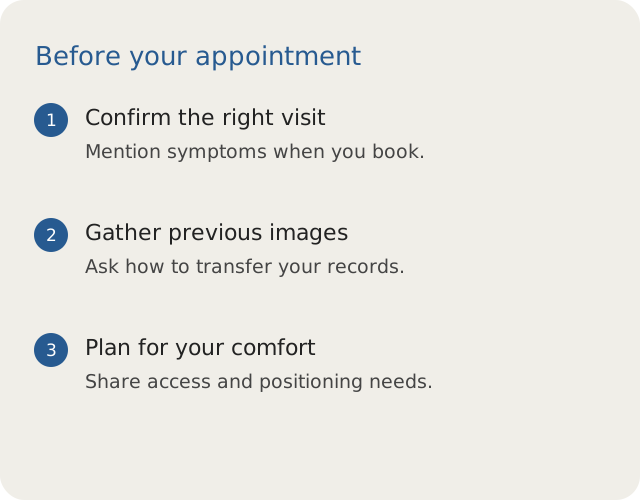
Mammograms are available through breast clinics, hospital imaging departments, and other imaging facilities. Your usual healthcare office can help you find an appropriate service. Ask whether you need an order or referral, whether the center accepts your insurance, and whether the appointment is for screening or evaluation of a symptom.
Using the same center can make comparison with previous images easier. If you are changing facilities, ask how to transfer the actual images and reports before your visit. Write down the name of the previous center and the approximate date of your last mammogram. Moving or changing insurance does not mean you must abandon the useful history those records provide.
Also ask about practical needs while you are booking. Let the center know if you need an interpreter, help with standing or positioning, or a discussion about access. Check the address and arrival instructions rather than assuming the imaging department is in the main clinic building. A little preparation can prevent a rushed or unnecessarily difficult visit.
3. Separate your screening schedule from appointment timing
There are two different timing questions: when screening should begin and which day is comfortable for the appointment. For average-risk women, the U.S. Preventive Services Task Force recommends mammograms every two years from ages 40 through 74. Other organizations recommend different intervals, and your clinician may recommend a different plan based on your history.
A known high-risk genetic change, previous breast cancer, or certain past chest radiation treatments can call for a separate screening approach. Beyond age 74, decisions also need an individual discussion. Bring relevant family and personal history rather than trying to choose a schedule from a general article. If you have symptoms, the question is evaluation now, not whether you have reached the routine screening age.
For comfort, people who menstruate may prefer a time when their breasts are less tender. RadiologyInfo’s preparation guidance suggests the week after a period and avoiding the tender premenstrual week when possible. This is a comfort consideration, not a reason to delay assessment of a concerning change. Tell the office if timing or limited appointment availability is creating a barrier.
4. Keep clothing simple and skip certain products
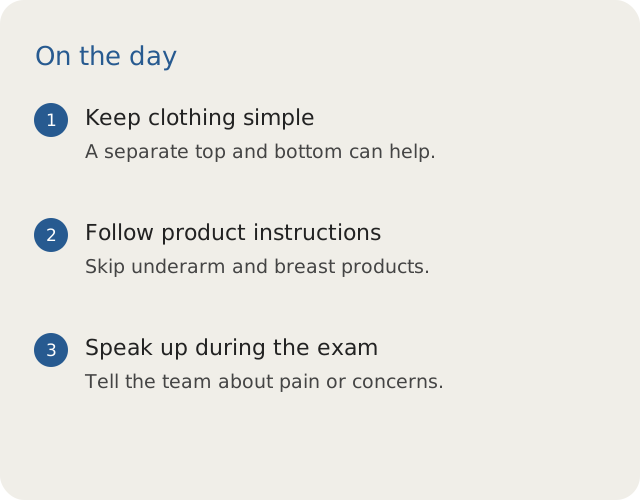
A separate top and bottom can make changing easier because the examination requires access to the breasts. Follow the facility’s instructions about deodorant, antiperspirant, powders, lotions, and similar products on the breasts or underarms that day. Some products can interfere with image interpretation. The American Cancer Society’s appointment tips cover these preparations.
If you normally apply these products automatically, leave yourself a reminder the evening before. Ask the center what to do if you forget, rather than canceling on your own. Pack whatever you would like for after the appointment and allow enough time to check in without rushing. Choose clothes for ease and comfort, not because you need a special outfit.
Before the images are taken, tell the technologist about breast implants, previous breast procedures, current symptoms, breastfeeding, or a possible pregnancy. Mention pain or movement limitations too. These are useful details for the team, not inconveniences you need to hide. If you are unsure whether a detail matters, it is reasonable to bring it up.
5. Know what happens during the examination
A technologist positions the breast on the imaging surface and applies compression with a paddle while pictures are taken. The breast is repositioned for different views. Compression can feel uncomfortable and can be painful for some people. It is brief for each image, but your experience matters: tell the technologist if it hurts or if you feel unwell.
Plan for roughly 20 to 30 minutes for a routine examination, with extra time for arrival and changing. Individual appointments can take longer, especially when more views are needed. Ask the center how much time to allow when arranging work, transportation, or caregiving. Avoid scheduling another commitment so tightly that you feel pressure to rush through questions.
You can ask the technologist to explain what will happen before positioning begins. If a previous examination was difficult, mention that at the start rather than waiting until you are uncomfortable. A simple sentence such as “I am nervous and would appreciate you talking me through it” gives the team something concrete to respond to. Asking for support is part of receiving care.
6. Leave with a plan for results and follow-up
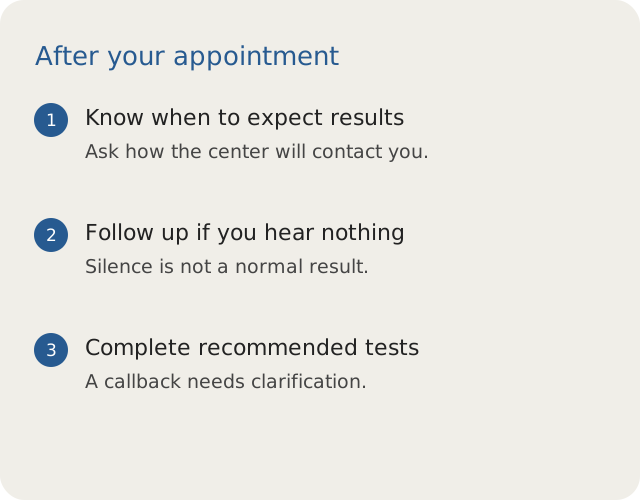
Before leaving, ask when results should arrive, how you will receive them, and whom to call with questions. Do not treat silence as an all-clear. The American Cancer Society advises contacting the provider or imaging center if you have not heard within 10 days. If the center gave you a shorter expected timeframe, follow up when that timeframe passes.
A callback means the team needs more information, not that a cancer diagnosis has been made. The American Cancer Society’s callback guide describes reasons such as unclear pictures or an area that needs closer assessment. Additional mammogram views, ultrasound, or sometimes a biopsy may be recommended. Keep the follow-up appointment and ask what it is intended to clarify.
When a report arrives in a patient portal, read it with your care team if the wording is unclear. Ask: “What does this mean for me?” “What happens next?” and “By when should that happen?” Save the response or write it down. A reassuring phrase in a report should not lead you to overlook a specific recommendation for another visit or test.
Know the benefits and the limits
The CDC’s breast screening overview explains that screening can detect cancer earlier, while also carrying potential harms. These include false alarms that lead to extra tests, cancers that are missed, and detection of cancers that would not have caused problems during a person’s lifetime. Discussing those tradeoffs helps you make an informed choice rather than relying on a slogan.
Breast density may also appear in your report. Dense tissue can make images harder to interpret and is relevant to risk. Ask what your result means in the context of your history. Extra imaging is not automatically the same decision for everyone. The appropriate discussion is about your situation, the possible benefit of another test, and its drawbacks.
General screening advice often addresses women, but breast care needs also exist for transgender men, nonbinary people, and others. A clinician can help tailor advice to your anatomy, past surgery, hormone exposure, and risk. Anyone with a new concerning breast or chest change should seek an assessment rather than assuming an article’s audience excludes them.
Make the next step easier to take
Cost, transport, time off work, and past experiences can make an apparently simple appointment difficult. If money is a barrier, ask a local clinic about assistance. The CDC describes free or low-cost mammograms through its National Breast and Cervical Cancer Early Detection Program for people who qualify. Confirm eligibility and local availability before assuming a particular appointment will be covered.
If you are helping someone else, offer a specific form of support: a ride, help making a call, or company while they wait. Let them decide what feels useful. Avoid promises about what a test will find, or comments suggesting that worry is unreasonable. Practical help can leave more room for the person to ask questions and make decisions.
At GHAC, our Health Blog supports everyday conversations about wellbeing. This guide is a starting point for talking with a healthcare professional, not a diagnosis or an individual screening plan. Save your questions, make the call that fits your needs, and keep the follow-up on your calendar. Breast awareness remains useful long after the pink ribbons come down.
About this article
This original GHAC article was inspired by Adore Me’s breast cancer awareness campaign and its reader-supplied mammogram email.
Good Health Apparel Company proudly supports cancer care across cancer types through donations to the Jimmy Fund, which supports research and care for adults and children at Boston’s Dana-Farber Cancer Institute. An official charity of the Boston Red Sox since 1953, the Jimmy Fund brings people together to support progress against cancer.
Information here is educational and does not replace personalized medical advice.
Frequently asked questions
Can a self-exam replace a mammogram?
No. Being familiar with how your breasts usually look and feel can help you notice changes, but self-exams do not replace recommended screening or assessment of a new symptom.
Should I wait for my next mammogram if I find a lump?
No. Contact a healthcare professional promptly and tell the booking office about the symptom. You may need a diagnostic assessment rather than a routine screening appointment.
Does a callback mean I have breast cancer?
No. A callback asks for more information. Follow the recommended next steps so the care team can clarify the finding.
What if I have not received my results?
Call the imaging center or ordering provider when the promised timeframe passes. The American Cancer Society advises following up if you have not heard within 10 days. Do not assume no news means a normal result.
Keep the next step simple
Small, repeatable choices are often the ones that last. Explore the Health Blog for more everyday wellbeing reading, or visit the Fitness collection for apparel that celebrates movement in real life.
More everyday wellbeing reading

Gut Health After Antibiotics: A Practical Care Guide
Understand gut changes after antibiotics, food and probiotic choices, and the symptoms that need medical advice.
Read article →
Ultra-Processed Foods and Bowel Cancer: Beyond the Headline
What a large new study really found about ultra-processed foods, bowel cancer, and small food swaps that fit everyday life.
Read article →
Ultra-Processed Foods: A Practical Everyday Guide
Understand ultra-processed foods, what research can and cannot tell us, and simple ways to make everyday meals work better for you.
Read article →