
HEALTH JOURNAL
Morning or Evening Walks for Blood Sugar?
Choose a practical walking time for blood sugar, with guidance on morning routines, after-meal walks, and diabetes safety.

If you are choosing between a morning walk and an evening walk for blood sugar, there is no single clock time that wins for everyone. Walking regularly is useful, and a short walk after a meal is a practical option to consider. Your schedule, meals, health, and medications all help determine the best fit.
This guide focuses on one decision: where to place a manageable walk in your day. It separates research on walking after meals from claims about a universal best hour, then shows how to try a routine safely. If you live with diabetes, use your care team’s exercise plan alongside these general ideas.
Start with a routine you can actually repeat
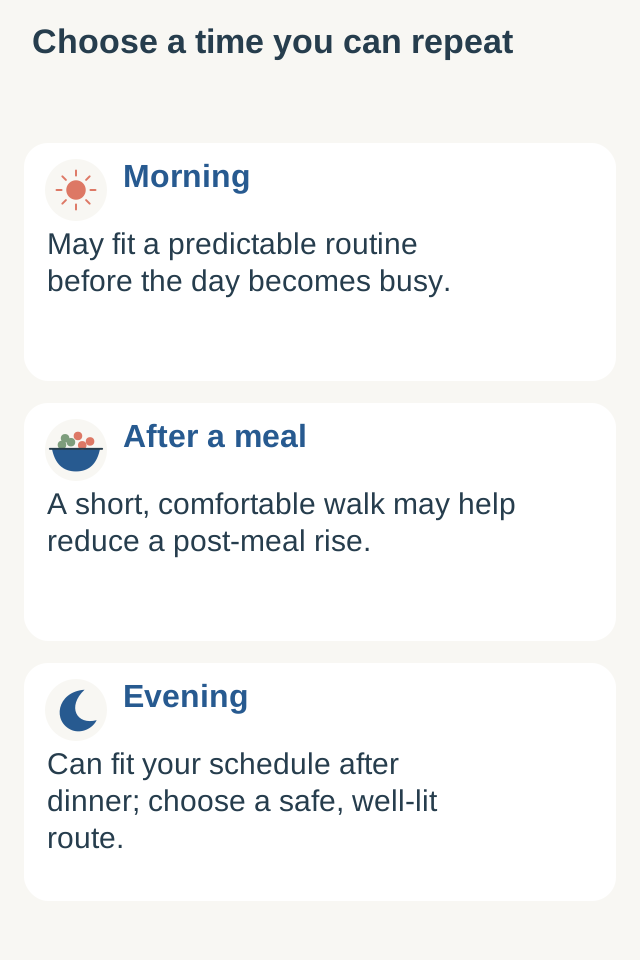
A morning walk has an obvious practical strength: it can happen before the day fills up. An evening walk has a different one: it may fit naturally after dinner. Neither advantage requires a claim that your body responds best at that hour. The first task is to identify when you can walk safely and often enough to make it a habit.
Ask yourself three questions. Which part of the day has a reliable opening? When is the route comfortable and well lit? Does the time work with your meals and any diabetes safety instructions? If only one option meets those needs, you already have a reasonable starting choice. You can revisit it later without treating the change as failure.
If you already enjoy walking, our guide to walking after eating adds context about meal-linked movement. This article takes the next step: deciding whether breakfast, dinner, or another point in the day is the easiest anchor for you.
What the walking research does and does not show
A small 2013 study of postmeal walking compared three 15-minute walks after meals with a single 45-minute morning or afternoon walk. It involved ten inactive adults aged 60 or older who were at risk of impaired glucose tolerance. Postmeal walking helped postdinner glucose in that controlled setting. That is useful evidence, but it is not a universal instruction for every adult.
Notice what was compared: several meal-linked walks versus one sustained walk. The result cannot isolate the clock as the only cause. Meal timing, how walking was divided, and the participants all matter. It does not prove that moving a familiar morning walk to the evening will improve your own results.
A separate 2022 study involving 21 healthy young volunteers found that brisk walking after meals reduced the glucose peak under the study conditions. Again, the participants and setting limit how broadly the result applies. These studies support considering movement after food. They do not establish a guaranteed glucose drop or replace longer-term diabetes care.
When a morning walk may fit best
Choose morning when it is the part of the day you can protect. You may have a familiar route near home, a friend available before work, or a few quiet minutes after breakfast. These are strong reasons because they reduce the decisions needed to get out the door. You do not need an elaborate morning routine to make the walk count.
Make the setup specific. Put your shoes where you will see them, check the forecast the evening before, and decide on a short route. If you have limited time, choose a loop that ends at home rather than a route that tempts you to go farther than your schedule allows. A manageable walk is easier to repeat than one that makes the rest of the morning rushed.
Morning does not have to mean walking before eating. If you use insulin or another medicine that can cause low blood sugar, fasting exercise may need special planning. Follow your own instructions about meals, glucose checks, and activity. Do not copy a fasted-walking trend or skip breakfast to make the habit seem more effective.
When an evening walk may fit best
An evening walk can work well when dinner is a reliable daily event. Clearing the table can become the cue to put on shoes instead of settling immediately into a chair. If a family member or neighbor wants to join you, the walk can also be shared time. Keep the route simple enough that it still works on a busy evening.
Pay attention to the setting rather than the label on the clock. A quiet route in daylight may be a good choice, while the same route after dark may have uneven surfaces that are hard to see. Consider an indoor option when visibility, weather, or neighborhood conditions make outdoor walking less suitable. An evening habit should feel manageable, not like another hurdle at the end of the day.
If you manage diabetes, ask how evening activity fits with your medication and overnight glucose plan. The possibility of delayed low glucose is especially relevant for some people using insulin. That does not mean evening walks are off limits. It means a safe plan is more important than a headline claiming that evening is the best time.
Think about meals as an anchor, not a stopwatch
There is a useful difference between “I walk at seven” and “I walk after a meal when I feel comfortable.” The first is tied to the clock. The second attaches the habit to something that happens even when the schedule shifts. A breakfast walk, lunch break, or dinner loop may each work depending on your day.
Avoid turning the idea into a strict countdown. The studies use particular timing and durations so researchers can compare conditions. Your everyday routine has other variables, including meal size, medication, symptoms, mobility, and the route available. A general article cannot prescribe one minute when everyone should begin walking.
Try a comfortable, easy walk after the meal that fits your schedule, provided it matches your health plan. If you feel overly full, nauseated, dizzy, or unwell, pause rather than forcing yourself to meet a timing rule. Do not use walking to “cancel out” a meal. Food and movement each have a role in health, and neither needs to become a punishment for the other.
Use a simple choice process
Start by choosing one dependable opening in your day. If mornings are calm and evenings unpredictable, begin in the morning. If mornings involve work, caregiving, or an uncomfortable rush, an after-dinner walk may be more realistic. If neither works, a lunch walk is still a real option. The decision is about fitting movement into your life, not passing a morning-versus-evening test.
Next, choose your easiest safe route and a modest duration you feel confident about. Someone starting from little activity might choose a brief loop and build gradually. A more active person may already have a comfortable walking routine. There is no need to reset that routine simply because a new article favors another hour.
Finally, make a backup plan. Write down where you will walk if it rains or if the usual route is unavailable. Tell a walking partner the smaller version still counts. Planning a short indoor option in advance can prevent a minor disruption from becoming a week without movement. The backup should be something you can actually use, not an ideal option that requires a long drive.
Try a week that leaves room to learn
Treat the first week as practice rather than a test of your blood sugar. Pick a few days when the same cue is likely to happen, such as finishing breakfast or putting the dinner dishes away. Choose comfortable clothing and shoes, and leave the route simple. You are finding out whether the habit fits, not trying to reach a dramatic daily total.
After each walk, note a few useful details: when you went, roughly how long it lasted, whether the pace felt comfortable, and what got in the way. If the walk made dinner cleanup stressful or left you hurrying to work, adjust the setup. A different route or a shorter outing may solve more than a stronger promise to be disciplined.
At the end of the week, decide what to keep. Perhaps morning worked on weekdays and early evening worked on weekends. That is a reasonable pattern. You do not need to select one time forever. If you want to expand, change one feature at a time so the routine stays easy to understand and repeat.
Read glucose information with the right context
The American Diabetes Association explains how exercise affects glucose: working muscles use glucose, and activity can improve insulin sensitivity. Responses vary, so one walk does not produce the same result in every person. Duration, effort, food, medication, illness, and stress can all be part of the picture.
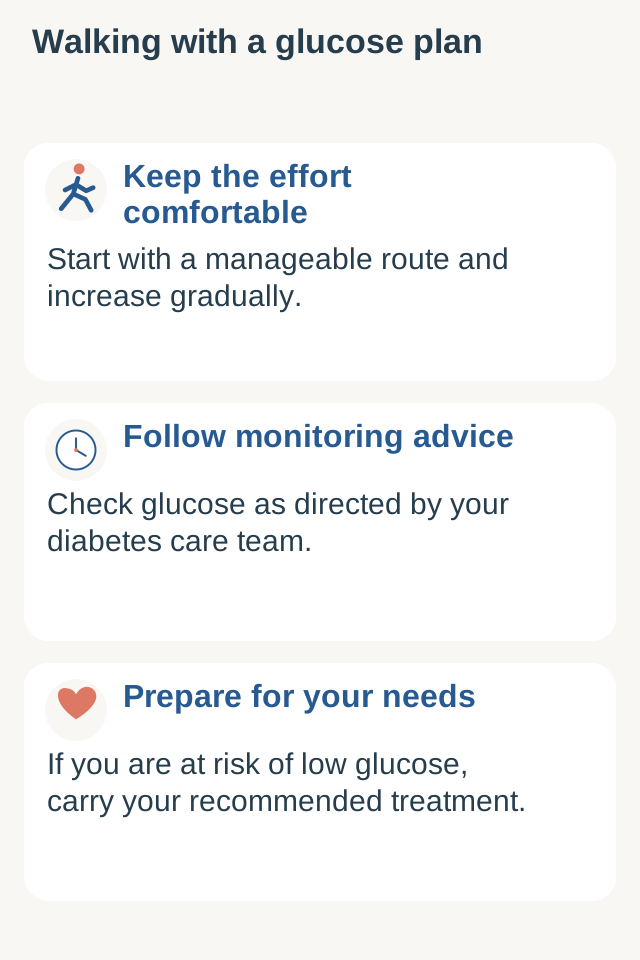
If glucose monitoring is already part of your care, follow your team’s instructions about when to check and how to respond. Note the walk alongside relevant details instead of judging the routine from one reading. A lower number is not always a better number, particularly when you are at risk of hypoglycemia. Ask your team what range and response plan apply to you.
A personal log can support a conversation, but it is not a controlled experiment. You cannot confidently credit a change to the time of walking if dinner, medication, sleep, and effort also changed. People without diabetes generally do not need to buy a glucose device just to choose a walking time. Keep the question practical unless a clinician recommends something more specific.
Put diabetes safety ahead of timing
If you take insulin or a medication that can cause low blood sugar, talk with your diabetes care team about activity before making a significant change. Ask about checking glucose, carrying fast-acting carbohydrate, handling a downward trend, and watching for delayed lows. Do not change medication doses based on this article or on someone else’s walking routine.
Have your usual low-glucose treatment with you when your plan calls for it. Make sure a walking partner knows how to help if needed. If you feel shaky, sweaty, faint, confused, or otherwise unwell, stop and follow your care plan. Severe symptoms, inability to swallow safely, or loss of consciousness require emergency help. Do not keep walking in the hope that symptoms will pass.
Very high glucose can also need a specific plan, especially with illness or possible ketones. Exercise is not a universal emergency treatment for a high reading. Follow your team’s instructions and ask for urgent medical guidance when indicated. New chest pain, severe shortness of breath, or fainting during activity also deserve urgent attention, regardless of your glucose reading.
Have an answer for the ordinary obstacles
If the weather is poor, consider a safe indoor corridor, community space, or another setting you already know. Check that it is open and suitable before making it the backup. If you have mobility limitations, ask a physical therapist about appropriate alternatives. A plan can be adapted without pretending every kind of movement has been studied in exactly the same way.
If motivation is the problem, make the cue clearer and the first step smaller. Arrange to meet someone at a specific time, or decide that you will put on your shoes when the meal ends. Avoid setting the starting task so high that you keep postponing it. A routine you complete is more useful for learning what fits than a demanding plan that remains on paper.
If time is tight, remember that movement does not have to sit in one long block. A small trial of walking breaks during prolonged sitting found lower postmeal glucose and insulin responses when participants interrupted sitting with brief walks. That short-term finding supports looking for movement opportunities, while leaving plenty of room for individual needs and longer-term research.
Keep walking inside a broader health routine
The ADA activity targets place aerobic activity alongside other parts of an exercise routine. A walk can be a useful piece, but timing it carefully does not replace strength work, balanced meals, sleep, medication, or regular care. Our aerobic exercise guide offers other ways to think about enjoyable movement.
At Good Health Apparel Company, we support everyday habits that feel possible to maintain. No special outfit is needed to try a walk. If comfortable, health-minded clothing helps you get ready, explore our apparel collection. The useful choice is the one that helps you move safely and return tomorrow, whether that is after breakfast, at lunch, or before the evening settles down.
About this article
This original GHAC article was inspired by Verywell Health’s article on morning versus evening walks for blood sugar.
Information here is educational and does not replace personalized medical advice.
Frequently asked questions
Is an evening walk better than a morning walk for blood sugar?
There is no universal winner. Studies of walking after meals suggest a useful role for meal-linked activity, but they do not prove one clock time is best for everyone. Choose a reliable, safe time that works with your schedule and any diabetes care instructions.
Should I walk before or after breakfast?
Either may fit a routine, but do not assume fasted walking is necessary. If you use glucose-lowering medication, follow your care plan about meals, monitoring, and activity. An after-breakfast walk can be a practical option when it feels comfortable and is appropriate for you.
How long should my first after-meal walk be?
Choose a manageable starting amount based on your current activity, mobility, and health advice. Research uses specific durations, but those are not a minimum that everyone must complete. A brief, comfortable route that you can repeat is a reasonable place to begin planning.
Can walking replace diabetes medicine?
No. Walking can support diabetes management but does not replace prescribed medication, monitoring, or clinical care. Never reduce or stop a medicine because you are walking more. Discuss your activity and glucose patterns with your diabetes team so changes, if needed, are made safely.
Keep the next step simple
Small, repeatable choices are often the ones that last. Explore the Health Blog for more everyday wellbeing reading, or visit the Fitness collection for apparel that celebrates movement in real life.
More everyday wellbeing reading

Exercises for Stronger Bones: A Practical Start
Build a balanced bone-health routine with weight-bearing movement, simple strength exercises, balance practice, and clear safety guidance.
Read article →
High-Fiber Foods for Heart Health: Everyday Meal Ideas
Find practical ways to enjoy high-fiber foods for heart health, with familiar ingredients, meal ideas, and guidance on gradual changes.
Read article →
After-Dinner Habits for Long-Term Heart Health
Build an evening routine with manageable movement, satisfying food choices, sleep, and consistent care to support long-term heart health.
Read article →